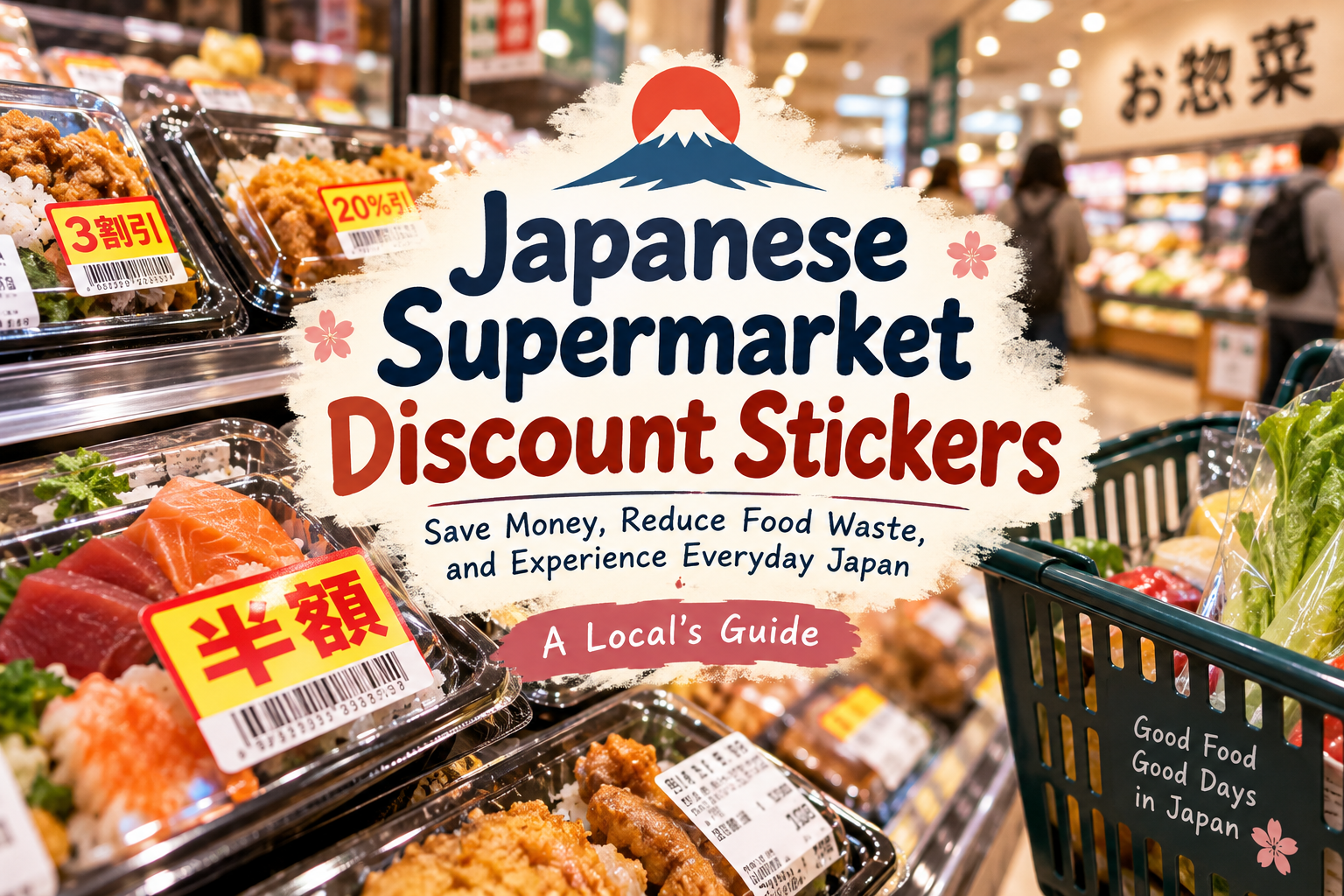
Walk into a Japanese supermarket in the evening and you may notice a subtle change around the bento and prepared-food section.
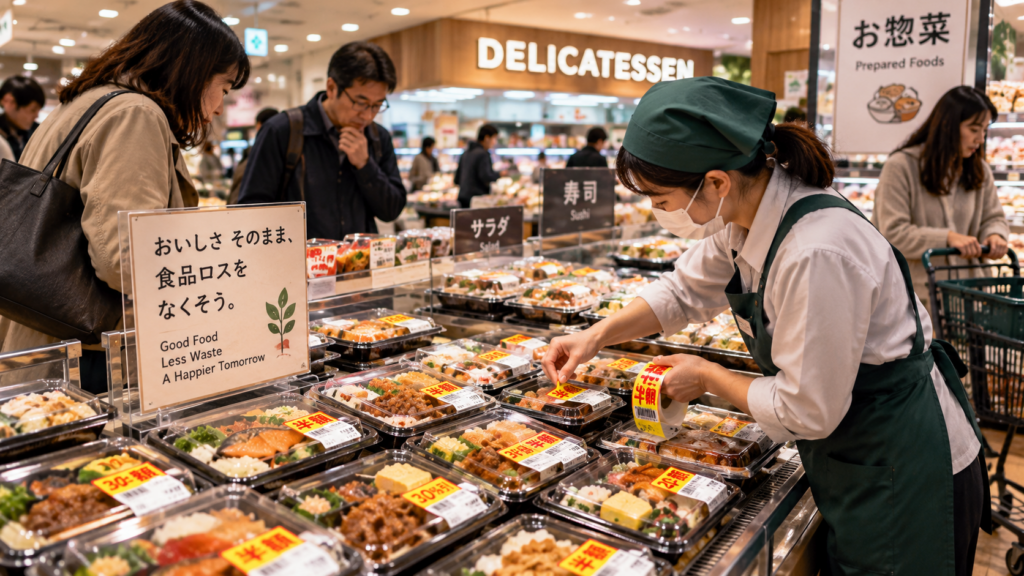
An employee appears with markdown labels. A few shoppers suddenly seem more interested in the shelves. Some stay close. Others hover farther away, looking at nearby products while keeping an eye on where the employee is going next.
Then the stickers start appearing.
20% off. 30% off. And sometimes the one worth recognizing even if you cannot read much Japanese:
hangaku — half price.
For visitors, this can look like a secret supermarket ritual. For people who live in Japan, it is much more ordinary. Discount stickers are simply part of everyday grocery shopping: a way for stores to sell perishable food while it is still saleable, and a chance for shoppers to get dinner for less.
I buy discounted food fairly often myself, especially prepared side dishes and bento. I do not normally plan a supermarket trip around markdown time. But if I happen to be shopping when discounts are appearing, I definitely check what has been marked down.
Sometimes, the discounts even decide what I eat that night.
QUICK ANSWER
Japanese supermarkets commonly mark down perishable foods such as bento, prepared side dishes, sushi, sashimi, meat, fish, bakery items, and other products that need to be sold relatively quickly.
Discounts often become more noticeable later in the day, but there is no nationwide “half-price hour.” Timing, products, and discount levels vary by store and by day.
And do not rely on sticker color. Learn a few simple Japanese discount expressions instead.
HOW TO READ JAPANESE DISCOUNT STICKERS
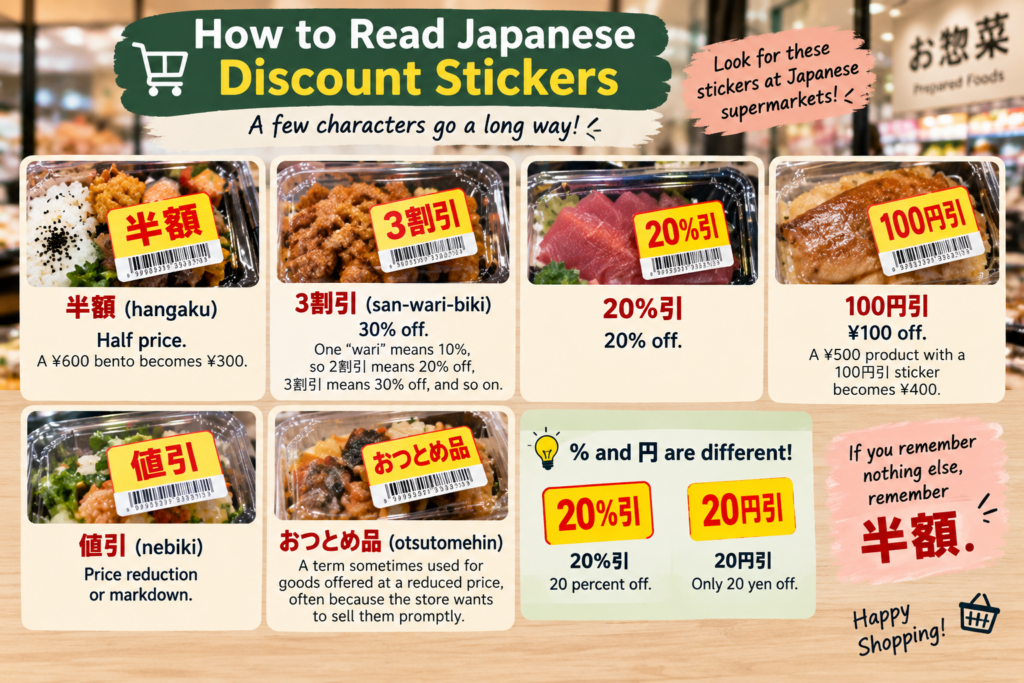
You do not need to speak Japanese to understand most supermarket markdowns. A handful of characters and numbers will get you surprisingly far.
DISCOUNT STICKER TERMS
- hangaku — Half price. A ¥600 bento becomes ¥300.
- 3-wari-biki — 30% off. One “wari” means 10%, so 2-wari-biki means 20% off, 3-wari-biki means 30% off, and so on.
- 20%biki — 20% off.
- 100Yenbiki — ¥100 off. A ¥500 product with a 100Yenbiki sticker becomes ¥400.
- nebiki — Price reduction or markdown.
- otsutomehin — A term sometimes used for goods offered at a reduced price, often because the store wants to sell them soon.
One useful distinction is between % and Yen:
20%biki means 20 percent off.
20Yenbiki means only 20 yen off.
If you remember nothing else, remember hangaku.
Once you recognize those two characters, you will start spotting them surprisingly quickly.
DON’T RELY ON STICKER COLORS
There is no nationwide color system for supermarket discount stickers.
A yellow sticker does not universally mean 20% off, and a red sticker does not automatically mean half price. Designs, colors, wording, and markdown practices vary between stores.
So rather than memorizing sticker colors, read the number and wording on the label. That knowledge works almost anywhere.
WHY DO JAPANESE SUPERMARKETS MARK FOOD DOWN?
The practical reason is simple: perishable food has a limited window in which it can be sold.
Supermarkets have to balance two risks. Mark an item down too aggressively and the store gives up revenue it might have earned at full price. Wait too long and the item may remain unsold and eventually be discarded.
Markdowns help manage that balance. The decision can depend on the type of food, remaining inventory, sales pace, time of day, store policy, and other conditions. It is not simply a timer that automatically turns every bento half price at a certain hour.
Markdowns can also help reduce food waste. According to Japanese government estimates released in 2026, Japan generated about 4.61 million tonnes of food loss in fiscal 2024, with food retailers accounting for around 480,000 tonnes.
Selling food at a discount while it can still be consumed is one way to reduce unnecessary disposal.
You may see this connected to the Japanese idea of mottainai — a sense that wasting something usable is regrettable. The connection makes cultural sense, but supermarkets do not mark food down simply because of an ancient Japanese philosophy. At its core, this is retail and inventory management, with food-waste reduction as an important benefit.
WHAT TIME DO JAPANESE SUPERMARKETS DISCOUNT FOOD?
This is probably the question travelers most want answered.
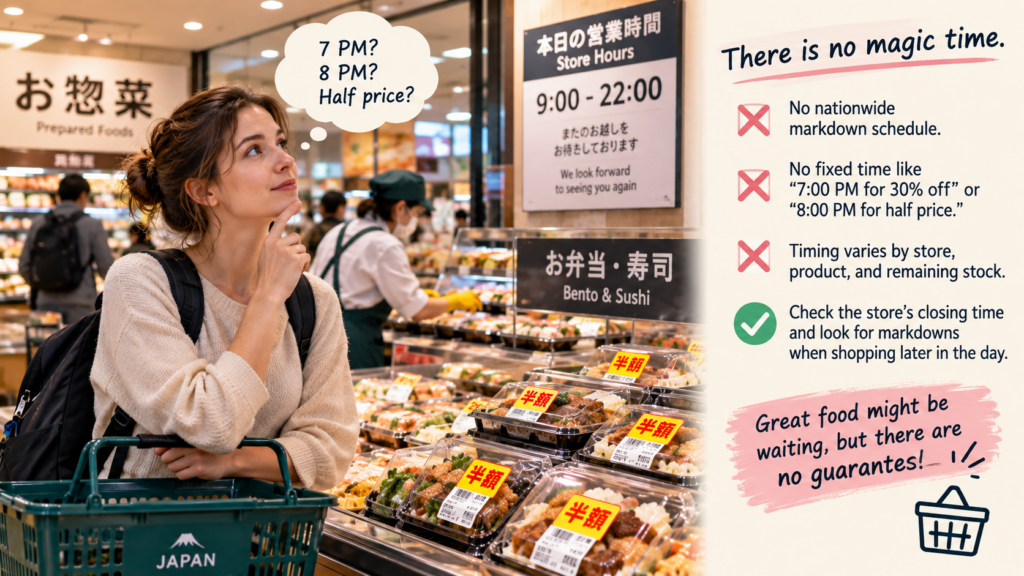
Unfortunately, there is no magic time.
Japanese supermarkets do not share a national markdown schedule, and there is no rule saying “go at 7:00 PM for 30% off and 8:00 PM for half price.”
In my experience, timing clearly varies from store to store, and closing time matters. But even knowing the closing time does not guarantee when a particular product will be discounted.
Different products may also be marked down differently depending on remaining stock and how quickly they are selling.
For travelers, the useful rule is simple: check the supermarket’s closing time, and if you are shopping later in the day, look for markdowns — but do not build your dinner plans around a guaranteed “half-price hour.”
WHAT FOODS GET DISCOUNTED?
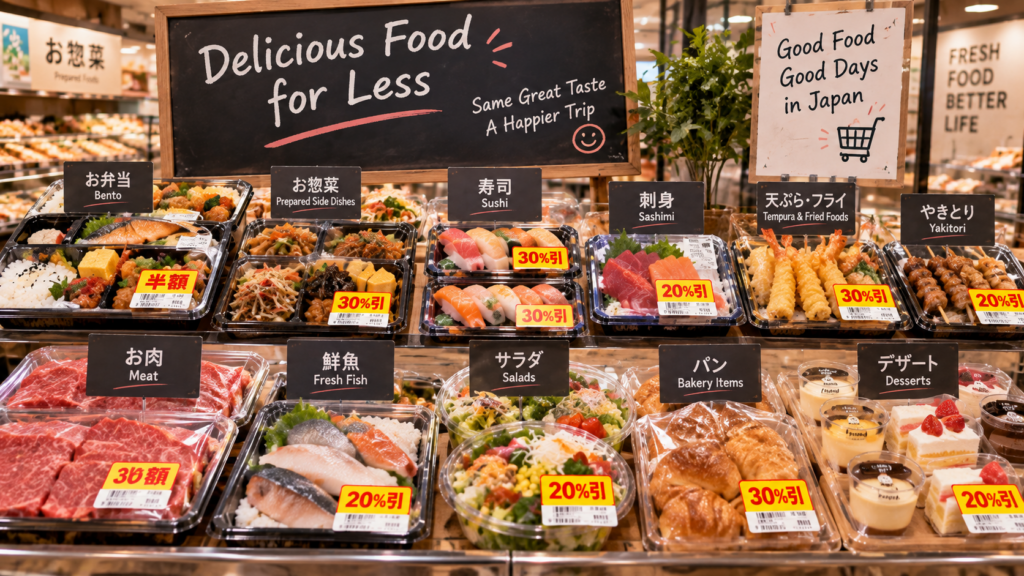
Markdowns are especially noticeable on foods that need to be sold quickly. Depending on the supermarket, you may find discounts on bento, prepared side dishes, sushi, sashimi, tempura, fried foods, yakitori, meat, fresh fish, salads, bakery items, and desserts.
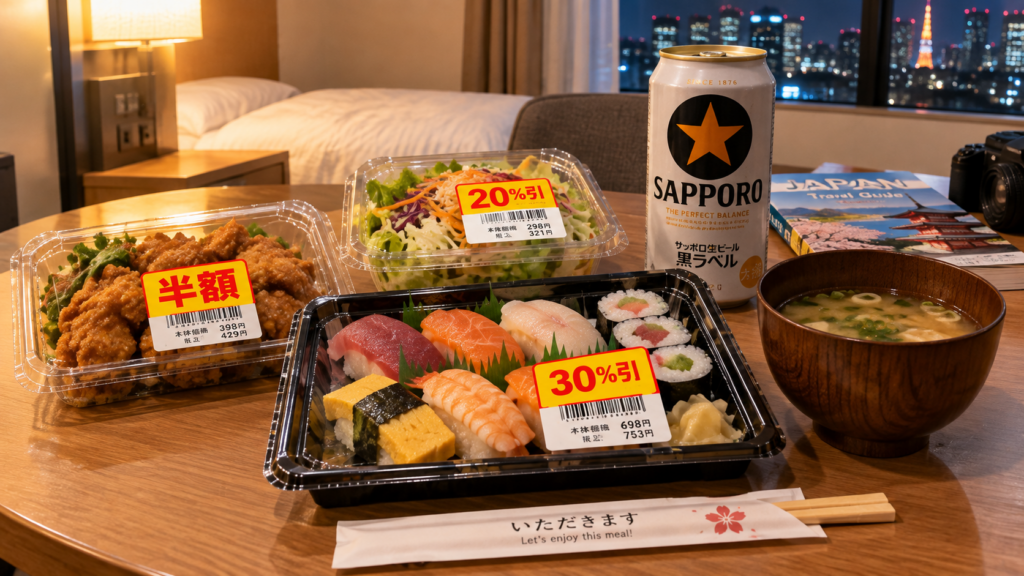
For travelers, the prepared-food section can be particularly useful. A supermarket bento, salad, side dish, or pack of sushi can already be an inexpensive alternative to a restaurant meal. Add a markdown sticker and dinner can become remarkably inexpensive.
Discounts can also make slightly more expensive foods tempting. I sometimes buy meat or fish that I might normally consider a little expensive if it has been marked down enough.
A discount sticker is not only a way to buy the cheapest dinner possible. It can also be a chance to try something a little nicer for less.
SHOULD YOU WAIT FOR HALF PRICE?
This is where supermarket shopping becomes a small gamble.
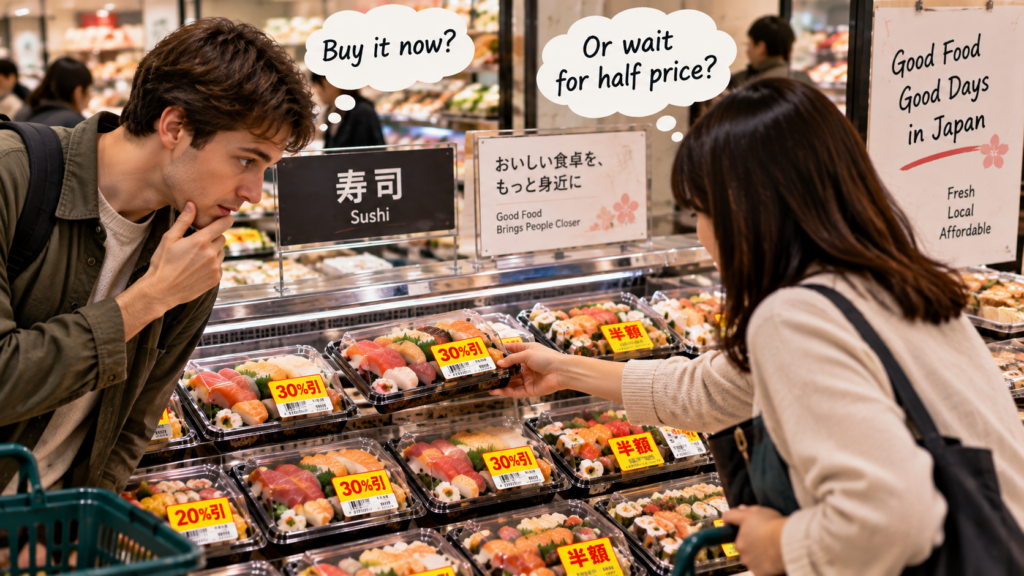
Imagine finding exactly the sushi you want at 30% off. You could buy it now, or wait and hope it drops to half price.
But someone else may buy it first.
I have been on both sides of this. I have picked up a discounted item before someone else could, and I have also watched something I wanted disappear into another shopper’s basket.
That is why waiting for half price is not always the best strategy. The deeper the markdown, the less selection may remain.
If you really want a particular item, a smaller discount may be better than no dinner at all.
The cheapest time to shop is not necessarily the best time to shop.
THE UNWRITTEN RULES OF THE STICKER HUNT
The behavior around markdowns can be almost as interesting as the discounts themselves.
I have seen shoppers stay close to the employee applying stickers, wait a little farther away, or continue looking at nearby products while obviously paying attention to where the employee is going next.
I do not personally wait for an employee to begin markdowns. But if an employee is already applying stickers and moving toward something I want, I have waited for that item to be marked down.
There is no single ritual every Japanese shopper follows. Still, there can be a funny atmosphere of not-quite-waiting — everyone shopping normally while several people are clearly aware of the stickers.
For visitors, the rule is simple: do not get in the employee’s way, and give other shoppers space.
CAN YOU ASK THE CLERK FOR A DISCOUNT STICKER?
There is no nationwide rule that neatly answers whether customers should ask for a markdown. Stores have their own procedures, and employees decide which products are being discounted.
Personally, I have never taken an item to an employee and asked for a discount sticker.
I have experienced the reverse, though. While an employee was applying markdown stickers, I was holding an item and the employee asked whether I wanted them to put the sticker on it too.
For visitors, the safest approach is not to assume you are entitled to a discount just because similar products are being marked down. Let the staff decide which items qualify.
IS BUYING DISCOUNTED FOOD EMBARRASSING IN JAPAN?
For me, no.
I buy discounted food regularly and do not feel embarrassed about putting it in my basket. Seeing other shoppers buy marked-down food is completely ordinary.
There is a small nuance, though: if literally everything in my basket had a discount sticker on it, I might feel slightly self-conscious.
That is my personal reaction, not a rule about Japanese society. Different people obviously feel differently.
Japanese food-loss initiatives have acknowledged that some consumers may feel self-conscious about visibly discounted products. Some retailers have therefore experimented with labels that emphasize food-waste reduction rather than simply presenting the item as “cheap food.”
But buying discounted groceries itself is nothing unusual. For many shoppers, it is simply sensible shopping.
IS DISCOUNTED SUPERMARKET FOOD SAFE?
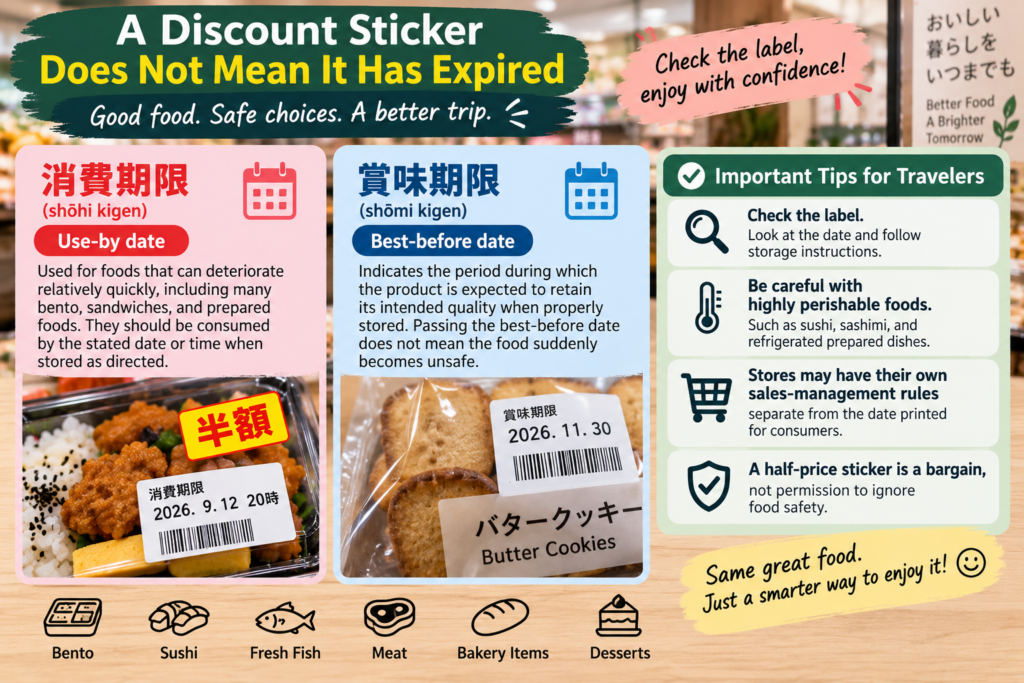
A discount sticker does not mean the food has already expired.
Japan distinguishes between two important date labels:
shōhi kigen — use-by date.
This is used for foods that can deteriorate relatively quickly, including many bento, sandwiches, and prepared foods. They should be consumed by the stated date or time when stored as directed.
shōmi kigen — best-before date.
This indicates the period during which the product is expected to retain its intended quality when properly stored. Passing the best-before date does not mean the food suddenly becomes unsafe.
Stores may also use internal sales-management rules separate from the date printed for consumers.
For travelers, the practical advice is straightforward: check the label, follow storage instructions, and be particularly careful with highly perishable foods such as sushi, sashimi, and refrigerated prepared dishes.
A half-price sticker is a bargain, not permission to ignore food safety.
WHAT ABOUT CONVENIENCE STORES?
Discounting is not limited to supermarkets.
Japanese convenience stores have also expanded markdown programs for products approaching the end of their normal sales window, often linking these efforts to food-loss reduction.
But convenience stores and supermarkets do not follow one common markdown system. Timing, eligible products, labels, and discount methods vary.
If your goal is to browse a broad selection of discounted bento, sushi, prepared foods, meat, and fish, a supermarket is generally the better place to look.
IS JAPAN’S DISCOUNT STICKER CULTURE UNIQUE?
No — and that makes the comparison more interesting.
Japan did not invent discounted groceries. The United Kingdom, for example, has a well-known “yellow sticker” culture around reduced-price groceries. British shoppers also look for reduced near-date food and learn when their local stores tend to mark items down.
So what makes the Japanese supermarket experience worth talking about?
Part of the answer may be what is being discounted.
Japanese supermarkets often devote substantial space to ready-to-eat foods: bento packed with several dishes, sushi, sashimi, tempura, croquettes, yakitori, salads, simmered vegetables, grilled fish, and many other prepared items.
When markdowns appear across those sections, the stickers can influence an entire meal rather than just one ingredient.
That is how I sometimes shop. I may enter the supermarket without deciding what to eat, see what has been discounted, and build dinner around what looks good.
What is interesting is not that Japan has discounts, but how naturally those discounts fit into ordinary grocery shopping.
HOW TO FIND DISCOUNTED FOOD: A PRACTICAL GUIDE FOR TRAVELERS
You do not need a complicated strategy.
PRACTICAL GUIDE
- Find a supermarket near your accommodation and check when it closes. Shopping later in the day may increase your chances of seeing markdowns, but no particular time guarantees them.
- Look in the prepared-food, sushi, fish, meat, and bakery sections for stickers showing “hangaku”, a percentage followed by “biki”, or an amount in “Yen” followed by “biki”.
- Read the number rather than relying on sticker color.
- If something you genuinely want is already discounted, consider buying it rather than waiting indefinitely for a deeper markdown. Half price is satisfying; an empty shelf is not.
- Do not crowd employees applying stickers, and do not assume an item will be marked down simply because a similar product has been.
- Finally, check the use-by or best-before information and store the food appropriately.
THE ORDINARY SIDE OF JAPAN
Japanese supermarket discount stickers are easy to turn into a story about a mysterious local custom.
The reality is more ordinary — and, in some ways, more interesting.
I do not think of buying discounted bento or side dishes as participating in a cultural tradition. I see something I want at a lower price, and I am glad to save the money.
Sometimes I choose dinner based on what is discounted. Sometimes a markdown convinces me to buy a nicer piece of meat or fish. Sometimes I get the item before another shopper does. Sometimes they get there first.
It is everyday shopping.
And that may be exactly why it is worth experiencing.
Travel in Japan is often built around famous temples, restaurants, museums, and attractions. But if you want to see another side of the country, walk through a neighborhood supermarket in the evening and look at what ordinary people are putting in their baskets.
You may find dinner at half price.
More importantly, you may notice a small piece of daily life that no guidebook itinerary could schedule for you.