
Walk through the rice-cooker section of a Japanese electronics store and you may wonder: Why does cooking rice need this much technology?
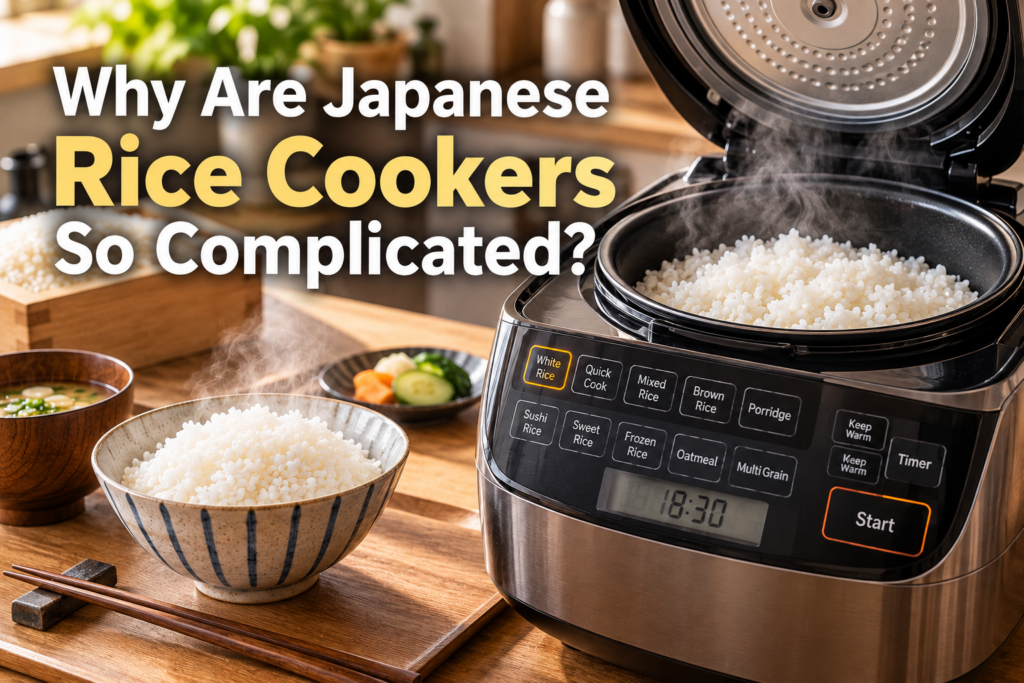
Modern Japanese rice cookers can offer settings for white rice, brown rice, mixed rice, quick cooking, porridge, different textures, small portions, rice intended for freezing, and more. Then there are terms such as Micom, IH, pressure IH, and variable pressure. Premium models go even further, with elaborate inner pots and sophisticated heating systems.
From the outside, it can look unnecessarily complicated.
But as a Japanese person who has used rice cookers for most of my life, I don’t really think of them as difficult appliances. They have certainly become more sophisticated, but using one is still usually simple: add rice and water, select your usual setting, and press start.
That apparent contradiction explains a lot about how the Japanese rice cooker evolved.
The machine became more complicated so cooking rice didn’t have to be.
Rice Cooking Used to Be More Complicated — for the Cook
Before automatic rice cookers, the complicated part wasn’t the appliance. It was the person cooking the rice.
Traditional kamado cooking required someone to manage the fire and adjust its intensity as the rice cooked. Controlling a wood fire took attention and experience.
That changed dramatically in 1955, when Toshiba’s automatic electric rice cooker arrived. Toshiba describes it as Japan’s first domestically produced automatic electric rice cooker, and says the appliance reached roughly half of Japanese households within four years, greatly reducing the work involved in preparing rice.
The technology kept taking over more of the cook’s job.
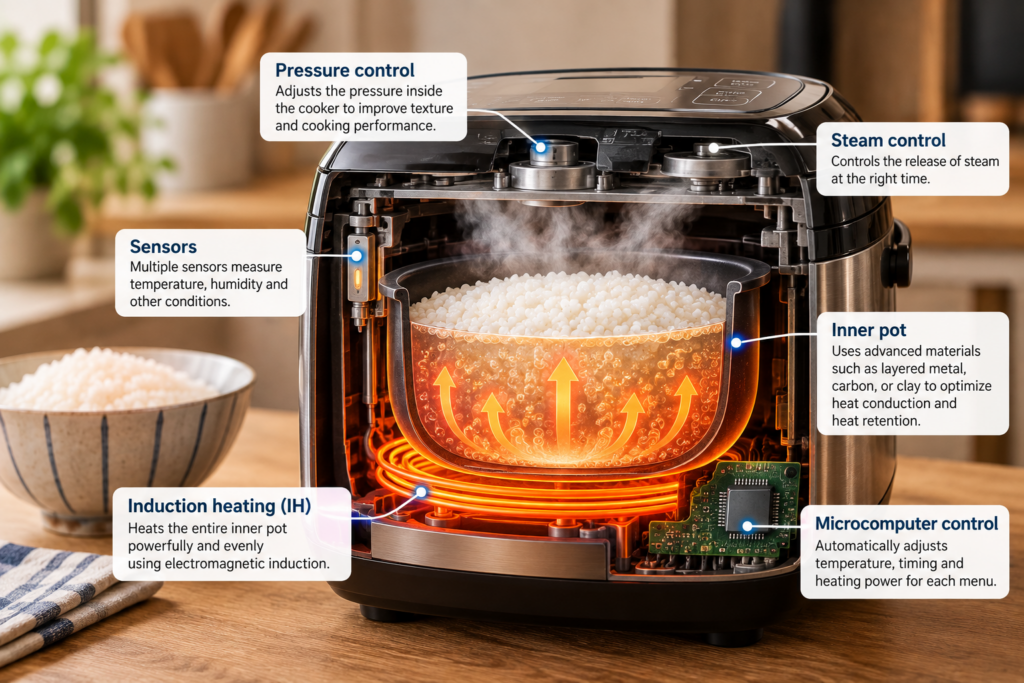
Keep-warm functionality appeared in the early 1970s. Microcomputer-controlled models followed in 1979, allowing the machine to adjust heating according to the amount of rice. IH — induction heating — arrived in 1988, followed by pressure IH in the early 1990s.
Modern microcomputer rice cookers can even handle part of the soaking process automatically, controlling temperature and timing before the rice really begins to cook.
So the history of the Japanese rice cooker isn’t simply a story of manufacturers adding more buttons.
Each generation moved another part of the cooking process from the person to the machine.

How Far Can You Engineer a Bowl of Rice?
Once manufacturers could reliably automate basic rice cooking, the question changed.
It was no longer just, “Can the machine cook rice?”
It became, “How do you want your rice?”
Japanese short-grain rice can be prepared with noticeable differences in firmness, softness, stickiness and moisture. Modern machines may therefore offer different textures as well as programs for different types of rice and different uses.
This doesn’t mean every Japanese person is a rice connoisseur.
I’m certainly not. I pay some attention to the variety of rice I buy, and I have varieties I prefer, but I wouldn’t say I’m obsessive about it. I don’t change my cooker’s settings for every variety, and I rarely adjust the firmness setting. I do change the water slightly for new-season rice, and I can notice differences caused by the way rice is cooked.
For manufacturers, however, even relatively small differences became something that could be engineered.
Eventually, even the pot became technology.
Zojirushi uses inner pots that combine materials such as iron, aluminum and stainless steel. Mitsubishi has premium models with inner pots made from 99.9% pure carbon material — not ordinary charcoal. Tiger takes a different approach again: some of its premium pressure-IH cookers use actual clay inner pots.
There is something wonderfully circular about that development. Electric rice cookers spent decades replacing traditional pot cooking — and some premium rice cookers eventually put a real clay pot back inside.
The point isn’t that one material is objectively better. It’s that even the removable bowl became part of Japan’s competition to refine the way rice is cooked.

Why Are There So Many Modes?
This is where those long menus start to make more sense.
Some modes exist because different grains require different cooking. Others reflect preferences for texture or speed. Still others developed around the way people actually live.
A surprisingly good example is the “frozen rice” setting.
I almost never use the keep-warm function on my own rice cooker. If rice is left over, I usually freeze it soon after cooking because I find that keeping it warm for a long time changes its flavor and smell.
I’m far from alone in avoiding long periods of keeping rice warm. Some modern rice cookers are designed around exactly that kind of behavior. Panasonic and Zojirushi, for example, offer models with dedicated settings for rice that will later be frozen and reheated.
Think about what happened there.
People cook rice. Some freeze what they don’t eat. Manufacturers respond by developing a program specifically for that habit.
And the menu gains one more option.
This is one reason Japanese rice cookers accumulate functions. Often, a new setting is simply an everyday preference or habit turned into an automatic program.

Do Japanese People Actually Use All Those Functions?
Not necessarily.
Looking at a product page can give the impression that Japanese households constantly switch between a dozen specialized settings. Actual usage is much more concentrated.
A 2023 MyVoice survey found that while many rice cookers included functions such as keep-warm, timers and quick cooking, the regular white-rice course dominated actual use. Quick cooking and timers were used by much smaller shares of respondents.
My own kitchen illustrates that gap between available functions and functions actually used.
I bought my current Panasonic variable-pressure IH rice cooker about ten years ago. Its original price was just under ¥50,000, although I bought the previous-generation model for around ¥32,000.
Most of the time, I use only three settings: regular white rice, quick cooking, and mixed rice.
I don’t currently use the timer or keep-warm functions, and I don’t have every menu memorized. If I need something unusual, I can simply look through the options.
When I’m in a hurry, I use quick cooking. I can notice a slight difference in the result, though, so when I have enough time I normally choose the regular setting.
To me, the cooker is sophisticated, but it isn’t difficult to operate.
Having many options doesn’t mean you have to use many options.

Is an Expensive Rice Cooker Worth It?
That’s harder to answer because taste and value are personal.
More expensive rice cookers may add more sophisticated heating and pressure control, specialized inner pots, texture options, better keep-warm systems, and additional cooking programs.
But a cooker that costs twice as much doesn’t make rice twice as delicious.
I’ve used cheaper rice cookers, and I do notice a difference. Yet one of the biggest differences with my current cooker isn’t that every bowl makes me stop and think, “This is amazing.”
It’s almost the opposite.
I rarely think, “The rice didn’t turn out very well.”
The result is consistently good without requiring much attention from me.
That consistency may be one of the less obvious benefits of a sophisticated rice cooker. Instead of asking the user to manage every stage of soaking, heating and timing, the machine handles more of those variables automatically.
Would I personally spend ¥100,000 on one? Probably not. Around the ¥30,000 range is closer to what I would be comfortable paying.
But I understand why someone would spend considerably more. If you eat rice frequently and use the same appliance for years, paying for small improvements in texture, consistency and convenience can make sense.

So, Are Japanese Rice Cookers Really Complicated?
Technically, yes.
Modern Japanese rice cookers can contain microcomputer controls, sensors, induction-heating systems, pressure control, carefully engineered inner pots, and programs designed for surprisingly specific situations.
But that doesn’t necessarily make them complicated for the person using them.
In my case, I add rice and water, select one of the few settings I regularly use, and press start. I don’t need to decide exactly how long the rice should absorb water, when the heat should change, how pressure should be controlled, or how long the rice should steam at the end.
The cooker handles those decisions.
That is almost the reverse of traditional kamado cooking, when the equipment was simple but the cook needed knowledge and attention to control the process.
So perhaps the many menus and technologies on a Japanese rice cooker make more sense if we stop asking why cooking rice became so complicated.
For the person cooking it, much of the history has actually moved in the opposite direction.
The rice cooker became more complicated so cooking rice didn’t have to be.