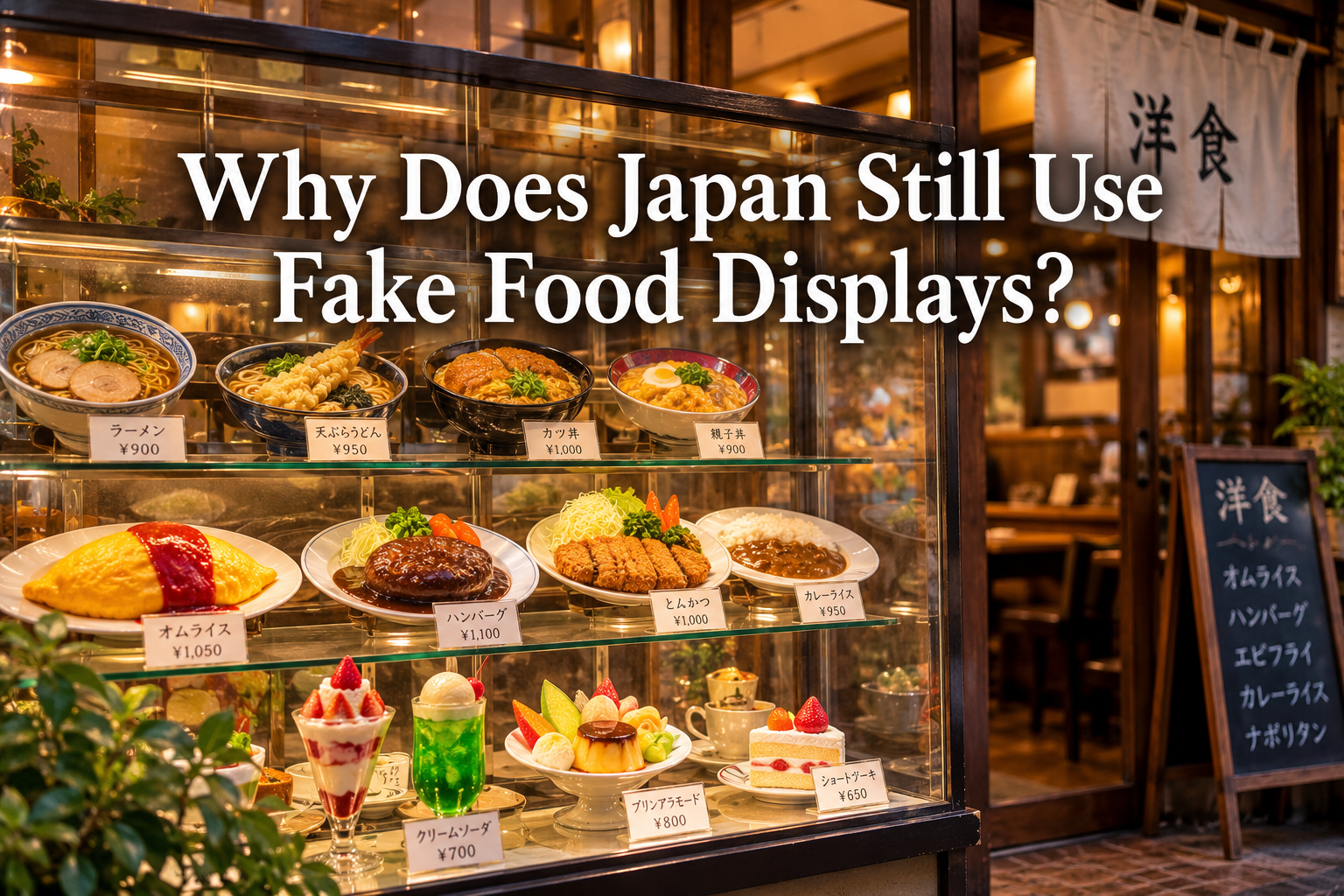
Walk past certain restaurants in Japan and you may see a bowl of ramen that never gets cold, a parfait that never melts, or a plate of curry that has been sitting in the window for years.
They look real. None of them are edible.
These are Japanese food samples, known as shokuhin sampuru (食品サンプル) — realistic food replicas displayed outside restaurants to show customers what they can order.
Visitors often stop to photograph them. Growing up in Japan, I never thought they were particularly unusual. They were simply there.
If a restaurant had food samples, I looked at them. Sometimes they influenced whether I went inside or what I ordered.
But I don’t see them as often as I remember seeing them in the past.
Today, Japanese restaurants can use photographs, Google Maps, social media, digital signs, tablets and QR-code menus. A physical food replica costs money to make, takes up space and cannot be updated with a few taps on a screen.
So why does Japan still use fake food displays?
The answer is not simply “tradition.” Food samples still do their original job surprisingly well. But in Japan today, they are also starting to feel like something else: a familiar part of the restaurant landscape that is slowly becoming nostalgic.
What Are Japanese Food Samples (Shokuhin Sampuru)?
Shokuhin sampuru literally means “food sample.”
These life-size replicas reproduce restaurant dishes in three dimensions. Modern samples are generally made from durable synthetic resins rather than the wax used historically.
A skilled maker can reproduce tiny details: the uneven surface of tempura batter, the gloss of a sauce, slices of meat or noodles suspended above a bowl.
The craftsmanship can be impressive, but these objects were not created simply to show off technical skill.
They had a job. They sold food.
Before entering a restaurant, customers could see what was available, how a dish was presented, what came with it and roughly how large it was.
In practical terms, they worked like a three-dimensional menu.
Why Did Japanese Restaurants Need a 3D Menu?
Food replicas appeared in Japan in the early twentieth century. Takizo Iwasaki, who founded a food-sample business in Osaka in 1932, became one of the key figures in commercializing and spreading them.
But the more interesting question is why restaurants wanted them.
Imagine seeing this on a menu:
Omurice — ¥1,100
If you already know the dish, that tells you something. But it does not tell you how large it is, whether the egg wraps around the rice or sits softly on top, what sauce is used, or whether it comes with a salad.
A photograph answers some of those questions.
A life-size model answers them differently. You can see the plate, proportions, side dishes and overall volume at a glance.
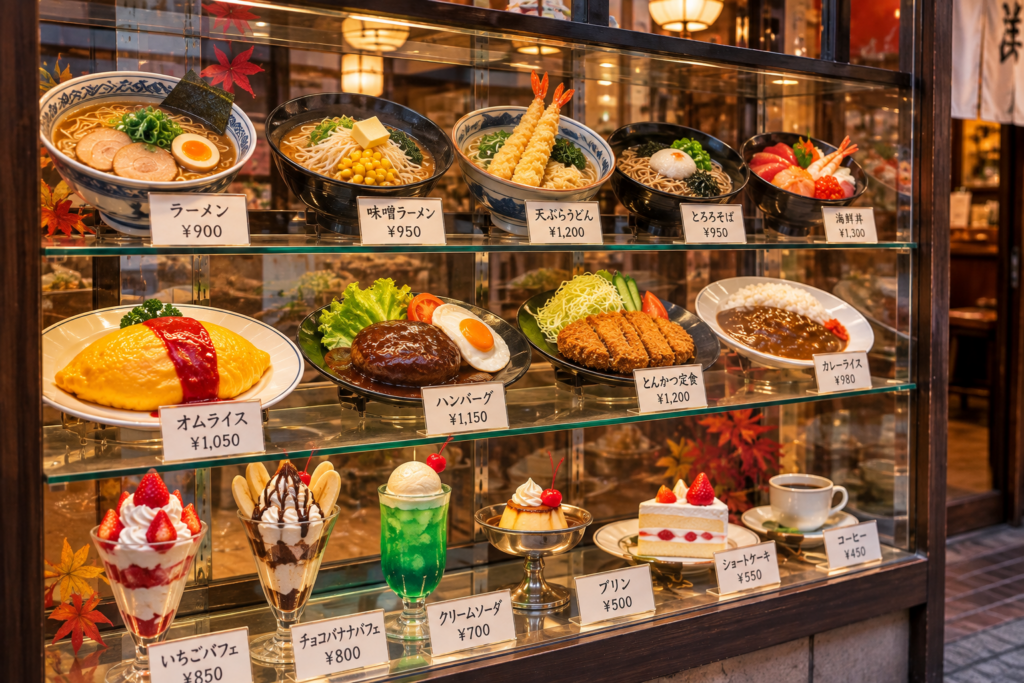
I still find food samples easier than photographs when I want to picture what a meal will actually be like.
There is nothing to open or scroll through. You just look.
Do Japanese People Actually Pay Attention to Food Samples?
Food samples can sound remarkably exotic when they are described outside Japan. They are often presented as examples of Japanese craftsmanship and obsessive attention to detail.
The craftsmanship is real. But that was never how I thought about them as a child.
Food samples were just part of going to a restaurant.
Even now, if a restaurant has them, I look. They have influenced my choice of restaurant, and I have chosen dishes after seeing their samples.
When I have done that, the actual food has generally been close to what I expected.
If someone from another country told me how unusual Japanese food samples were, my first reaction would probably be:
“Really? You don’t have these?”
That gap in perception is one of the most interesting things about them. Something that looks distinctly Japanese to a visitor may barely register as “Japanese culture” to someone who grew up with it.
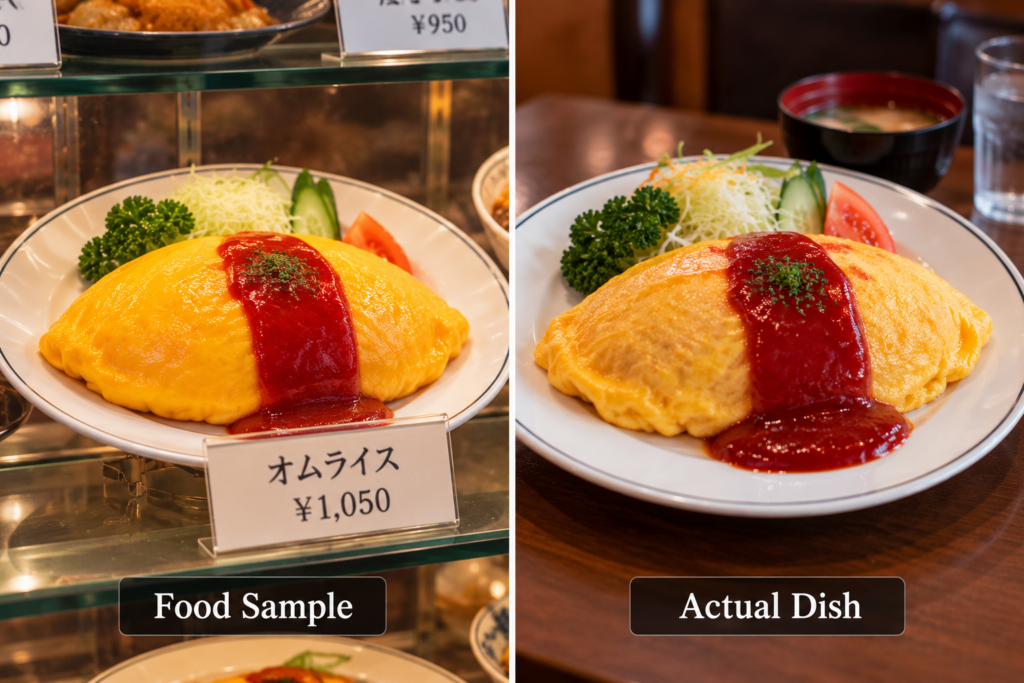
Does the Real Food Actually Look Like the Sample?
Despite the name, a food sample is not simply a scientific copy of a meal.
It is also advertising.
Food-sample makers have to think about how a dish will appear inside a display case, under artificial lighting and from the customer’s viewing angle. The goal is not only accuracy but making the food look appetizing.
That means a sample may emphasize color, gloss, texture or presentation.
It is part replica, part menu and part advertisement.
So the plate that arrives at your table will not necessarily reproduce every detail of the display. The sample creates a visual expectation; it is not a guarantee that every piece of garnish will sit in exactly the same place.
In my own experience, though, dishes I have ordered after looking at samples have been very close to what I expected.
Why Not Just Use Food Photos?
A physical replica is not the cheapest or easiest way to show a customer a dish.
As a rough indication of cost, ready-made food replicas sold in Japan in 2026 include ramen and hamburger models priced at around ¥5,000–¥6,000 each. Custom restaurant displays are a different market and may require individual quotations depending on the dish, size, tableware and other requirements.
A restaurant displaying many dishes is therefore investing in a physical sales tool.
Photographs are easier to reproduce. Digital images can be changed quickly. A tablet can hold an entire menu without taking up a display window.
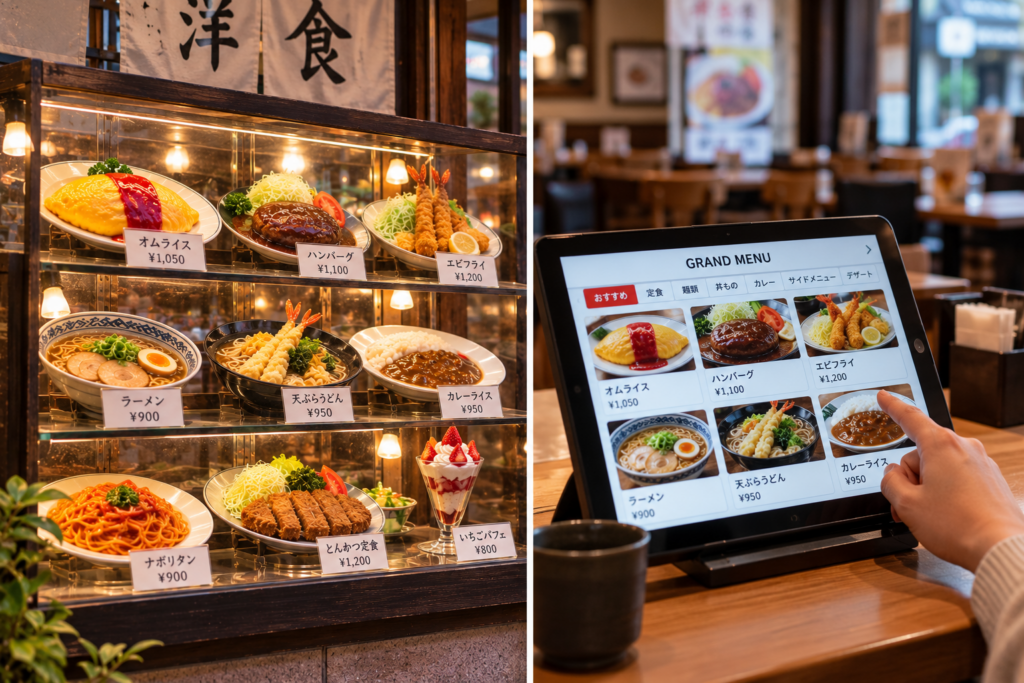
Food samples are harder to update and need physical space.
But they still have one major advantage: immediacy.
You do not have to unlock your phone, search for the restaurant, open a menu or scroll through photographs.
You walk past and see the food.
“That looks good.”
“That’s bigger than I expected.”
“I want that.”
Food samples were not created for international tourists, but they also work without much language. A visitor who cannot read the name of a dish can still understand a great deal simply by looking at it.
That simplicity helps explain why the idea has survived even when cheaper alternatives exist.
But survival does not mean nothing has changed.
Why Are Food Samples Becoming Less Common in Japan?
Japan’s food-sample industry has acknowledged declining domestic demand.
Better and cheaper printing gave restaurants alternatives to physical replicas, and digital menus and signage have expanded those options further.
I notice the change myself.
I associate traditional food displays today with places such as older Western-style restaurants, soba and udon shops, department stores and tourist areas. I rarely associate them with modern family restaurants, and many newer restaurants I visit do not use them.
That is my own observation, not a survey of Japanese restaurants. Food samples certainly have not disappeared.
They simply do not feel as universal to me as they once did.
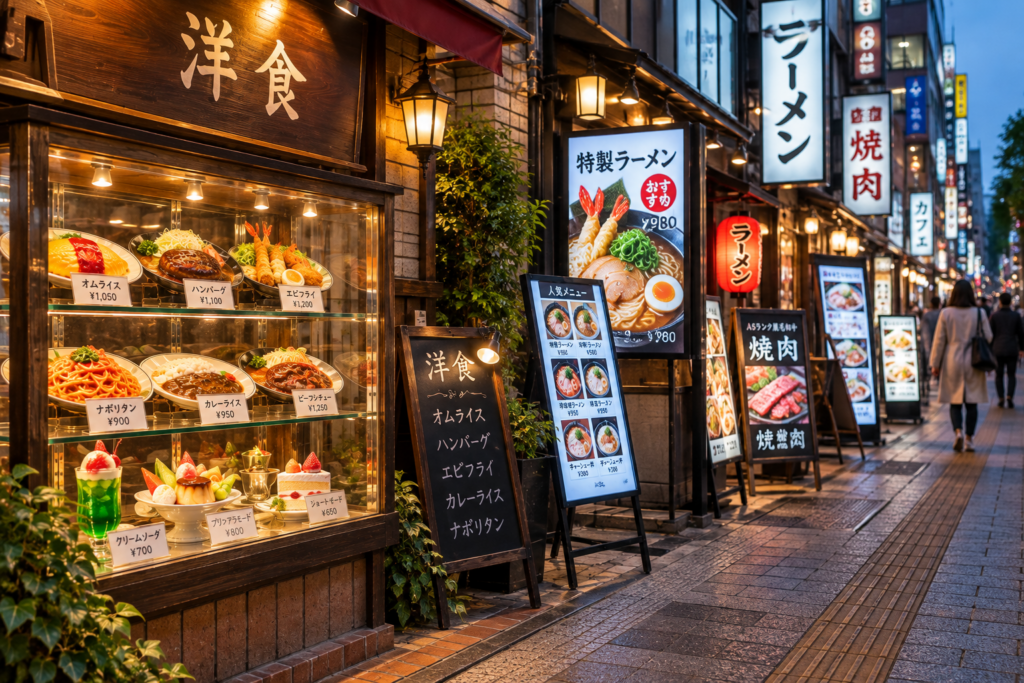
And because I see them less often, I have started to notice them differently.
When Japanese Food Samples Start to Feel Retro
As a child, I did not look at food samples and think about Japanese cultural heritage.
I thought about what I wanted to eat.
I remember being fascinated by how real they looked. After choosing something, there was a small sense of excitement while waiting for the actual dish.
Would it look like the one outside?
Now, a traditional display sometimes makes me think something quite different:
“This feels nostalgic.”
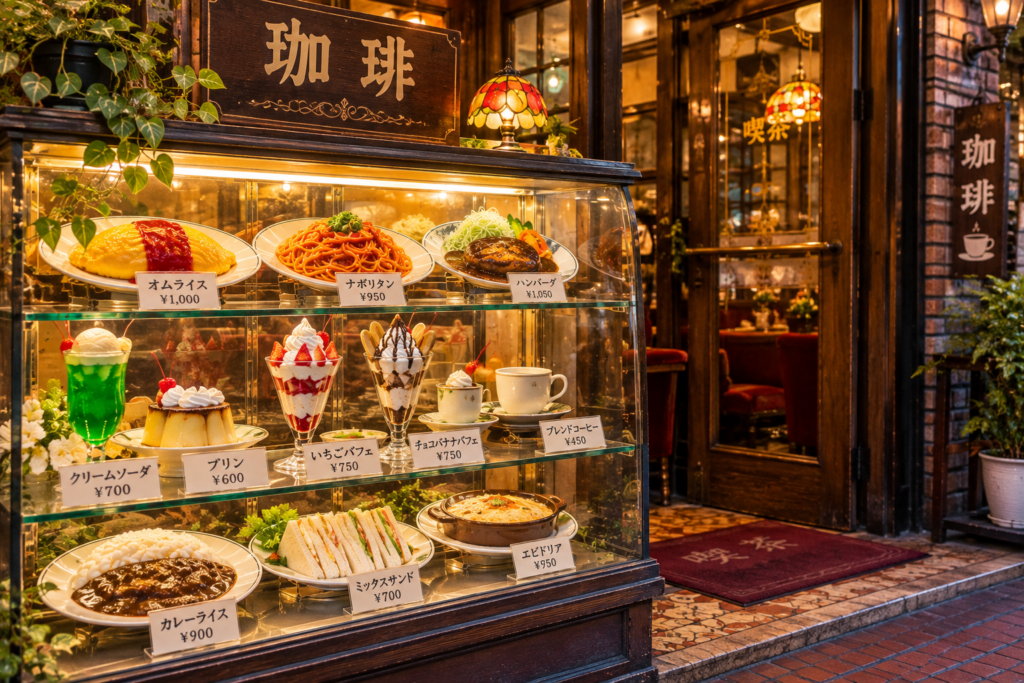
Food samples also fit naturally into today’s interest in Showa retro — restaurants and cafés that recreate elements of Japan’s twentieth-century dining culture. Old-fashioned menus, cream soda, Napolitan spaghetti, retro interiors and display cases full of food replicas can all contribute to that atmosphere.
That does not mean food samples have stopped being useful.
If I see them, I still look at them.
That is what makes their current position interesting. They can be a working sales tool and a nostalgic object at the same time.
From Restaurant Displays to Souvenirs and Tourist Experiences
Declining restaurant demand has not meant the end of the industry.
The same techniques are now used for miniature keychains, magnets and other goods. Food-sample-making workshops have become tourist activities. The craft also appears in art, exhibitions, photography and other commercial uses, while Japanese companies have explored markets outside Japan.
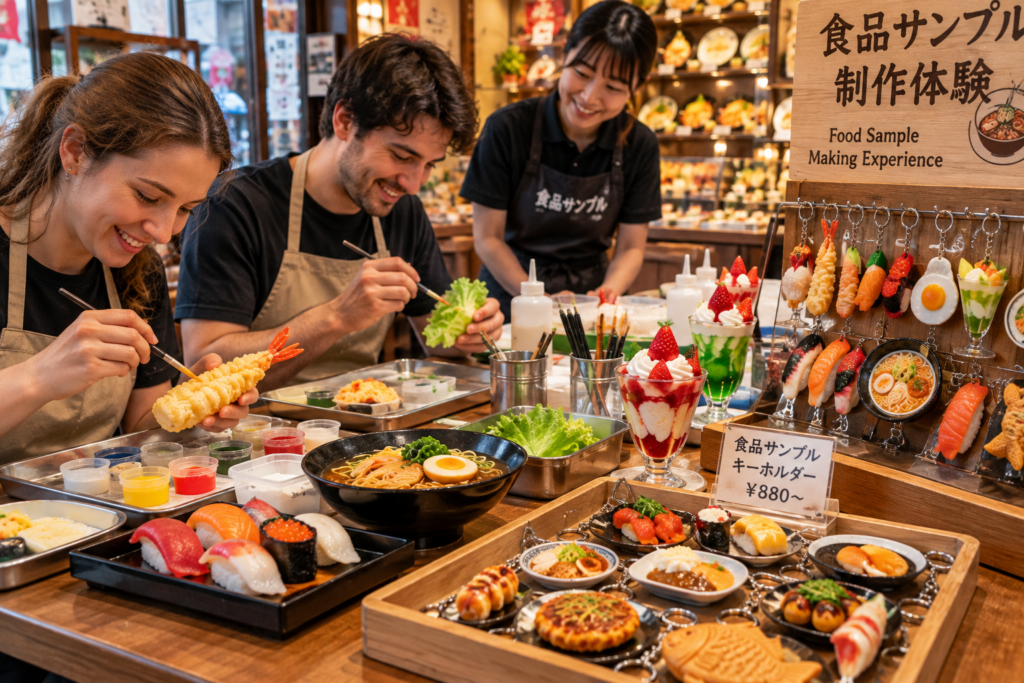
An object created to help restaurants sell meals has acquired another life as a souvenir, craft and tourist experience.
There is an interesting reversal in that.
For generations of Japanese customers, a plastic plate of curry might have been nothing more than something to glance at before deciding what to eat.
A visitor may see the same craftsmanship and want to photograph it, learn how it is made or take a miniature version home.
Sometimes it takes an outsider’s fascination to make us notice the cultural value of something we have always treated as ordinary.
Would I Miss Japanese Food Samples?
If every food sample in Japan disappeared tomorrow, would I have trouble choosing a restaurant?
Probably not.
I could look at photographs, check the restaurant online or use a tablet menu. There are plenty of alternatives.
But would I miss them?
Yes.
They were part of the restaurant landscape when I was growing up. I remember looking through the glass, deciding what looked good, ordering it and waiting to see how closely the real dish would match the fake one outside.
We do not need that experience anymore.
But I would still be sorry to lose it.
Food samples can still make someone stop outside a restaurant and suddenly feel hungry. They can still show the size and appearance of a dish without requiring a word of explanation.
At the same time, they are becoming something more than a restaurant tool: souvenirs, tourist experiences, craft objects and reminders of an older Japanese dining landscape.
Perhaps that is where shokuhin sampuru stands in Japan today.
Still useful. No longer essential. And a little more noticeable now that there are fewer of them around.