Walk into a restroom in a Japanese hotel, department store, train station, or airport, and you may find something unexpected beside the toilet: a control panel that looks more complicated than some kitchen appliances.
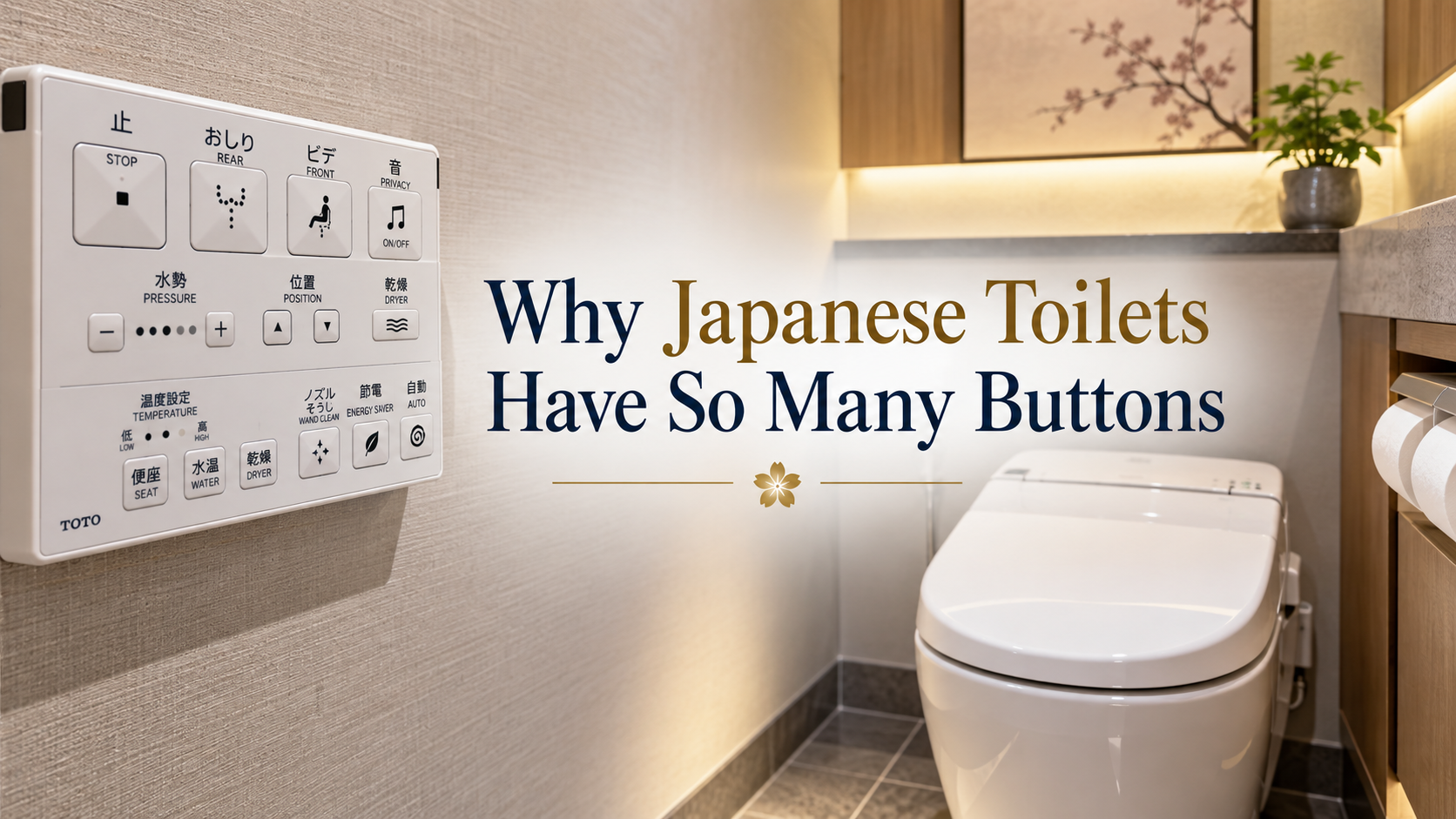
There may be buttons for rear washing, front washing, water pressure, nozzle position, seat temperature, drying, deodorizing, flushing, opening the lid, cleaning the nozzle, and even playing the sound of running water.
For a first-time visitor, the obvious question is simple: why does a toilet need all of this?
The answer is not that Japanese people use twenty different functions every time they go to the bathroom.
Japanese toilets did not start with twenty buttons. They accumulated them.
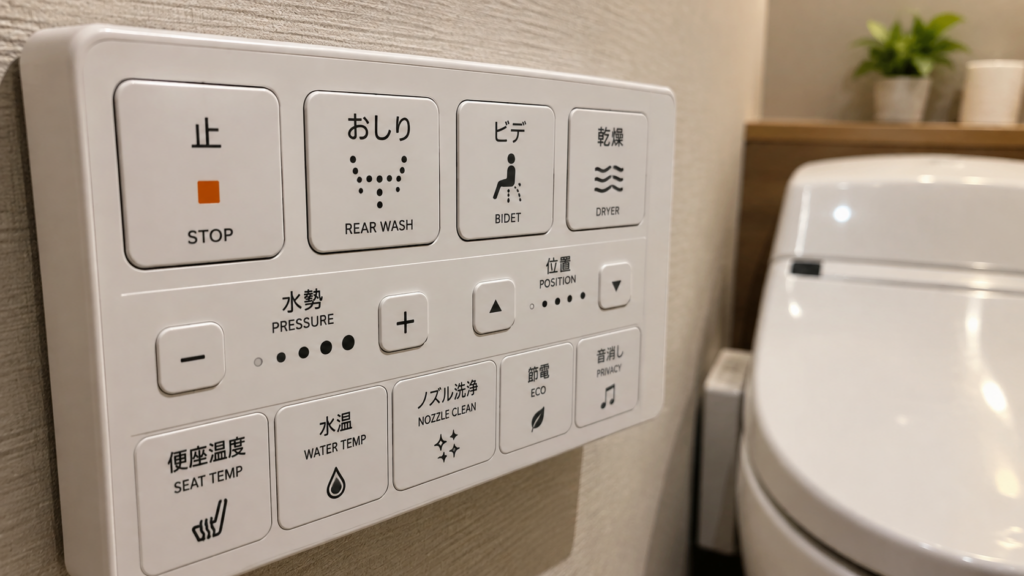
So Why Do Japanese Toilets Have So Many Buttons?
Once warm-water washing became practical, manufacturers kept adding features designed to make toilets more comfortable, cleaner, easier, quieter, or more convenient.
Washing was followed by adjustable water pressure and nozzle position. Heated seats and temperature controls became common. Some models added drying, deodorizing, automatic flushing, automatic lids, energy-saving functions, self-cleaning systems, and privacy sounds.
Each new function needed some way to control it.
Over several decades, the toilet seat evolved from a simple bathroom fixture into something closer to an electronic appliance. As the functions multiplied, so did the buttons.
Which Buttons Do You Actually Need?
The good news for travelers is that you do not need to understand everything on the panel.
A few controls matter most.
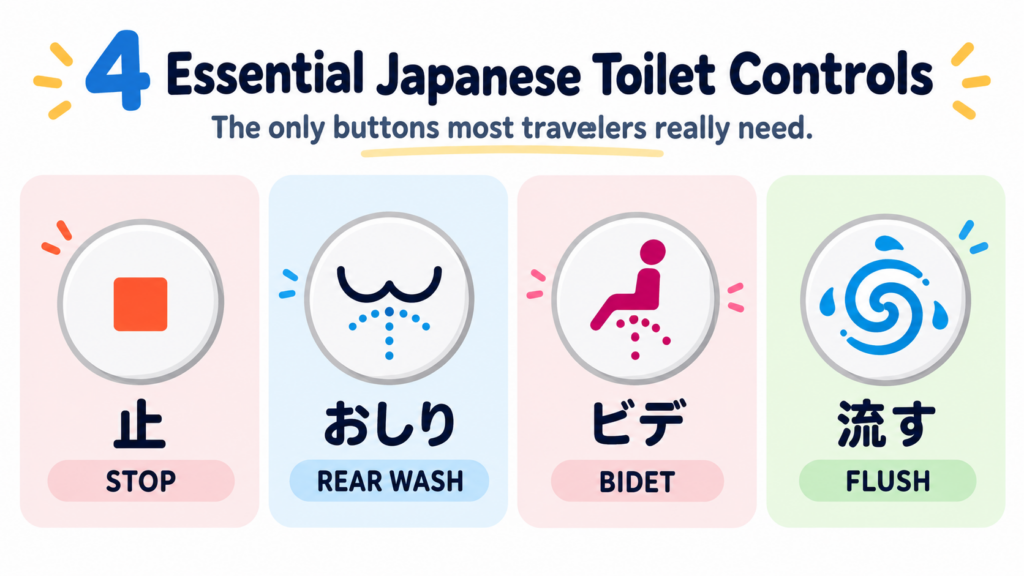
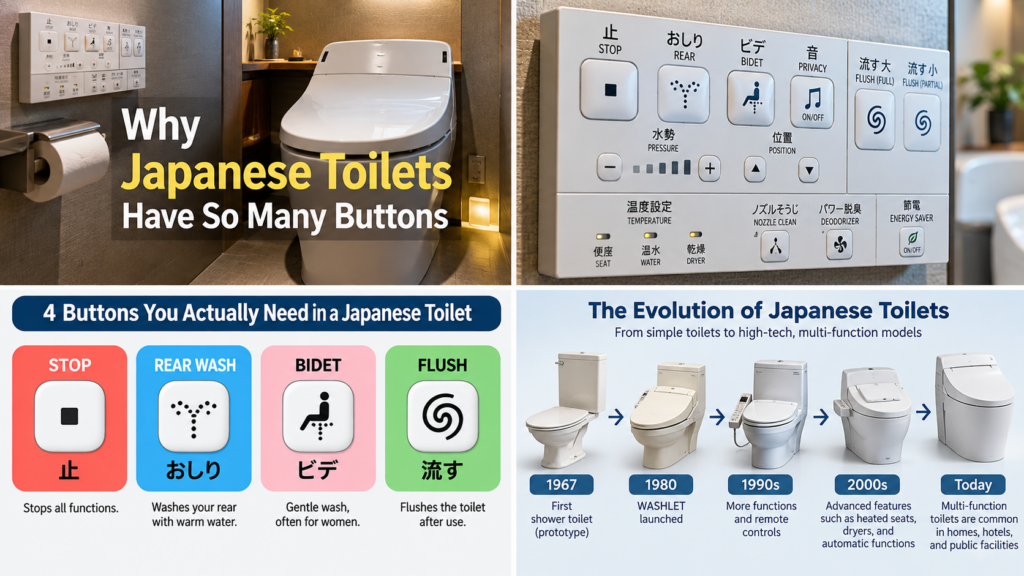
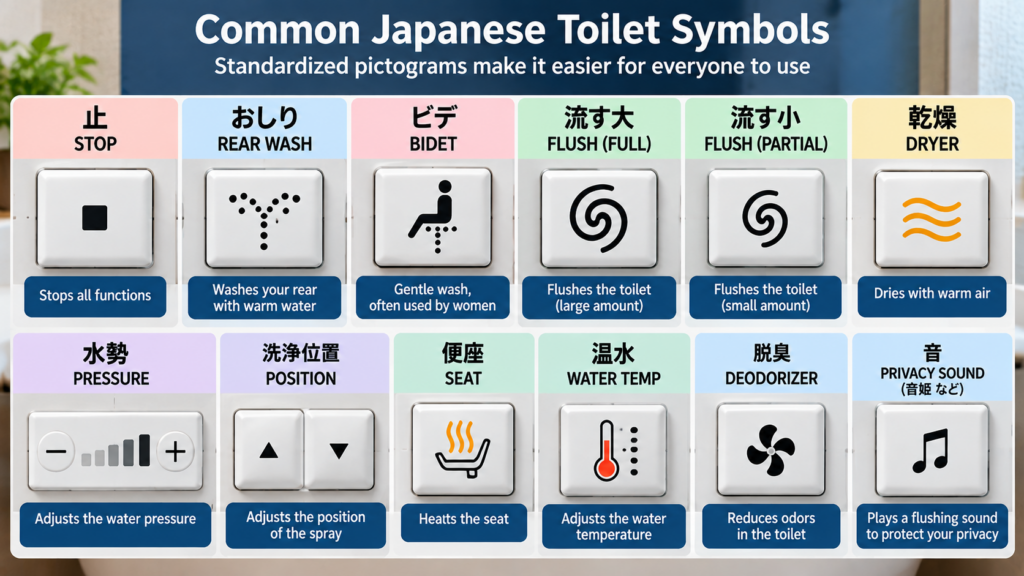
Stop — 止
Stops the washing function. If you press the wrong button and water starts spraying, look for this first.
Rear Wash — おしり
Activates washing for the rear.
Bidet / Front Wash — ビデ
Designed for front washing.
Flush — 流す
Some toilets use a button, while others use a lever, sensor, or automatic flush. You may also see 大 for a larger flush and 小 for a smaller one.
Other controls mostly adjust comfort. They may change water pressure, nozzle position, water temperature, or seat temperature. More advanced models can also offer oscillating washing, drying, deodorizing, automatic lids, and cleaning functions.
And importantly, not every Japanese toilet has all of these features.
Japanese Toilets Weren’t Always This Complicated
Japan did not invent the basic idea of washing with water after using the toilet.
Imported shower-toilet products already existed in Japan before domestic manufacturers began producing their own versions. In 1967, a predecessor of today’s LIXIL released what the company describes as the first Japanese-made shower toilet.
TOTO launched its first WASHLET in 1980.
That was an important step because the toilet seat was no longer just a seat. It combined warm-water washing with electronic temperature control, a heated seat, and warm-air drying.
From there, the functions kept expanding.
That change is easy to appreciate if you remember Japanese toilets before electronic bidet seats became normal.
When I was a child, I remember toilets as much simpler. In everyday use, there was little to think about beyond using the toilet and flushing it.
Today, a heated seat and washing functions feel like ordinary equipment.
How the Toilet Became an Appliance
A conventional toilet is mainly a plumbing fixture. Water comes in, waste goes out, and the mechanical system does most of the work.
An electronic bidet seat changes that.
Now you have electricity, heaters, sensors, motors, temperature controls, nozzles, and automatic mechanisms.
The toilet is still a toilet, but part of it has become a household appliance.
Once that happened, manufacturers had many more things they could improve.
TOTO’s product history shows the process clearly. Self-cleaning nozzles appeared in the 1980s. Remote controls and nozzle-position adjustment followed. Deodorizing, oscillating washing, energy-saving systems, automatic lids, and automatic flushing were added over time.
LIXIL describes a similar long-term process focused on comfort, easier cleaning, odor reduction, water conservation, and usability.
Seen this way, the buttons are almost a timeline. Each one represents something manufacturers decided could be made a little more comfortable, cleaner, easier, or more automatic.
Do Japanese People Really Use All Those Buttons?
Not necessarily.
I certainly do not.
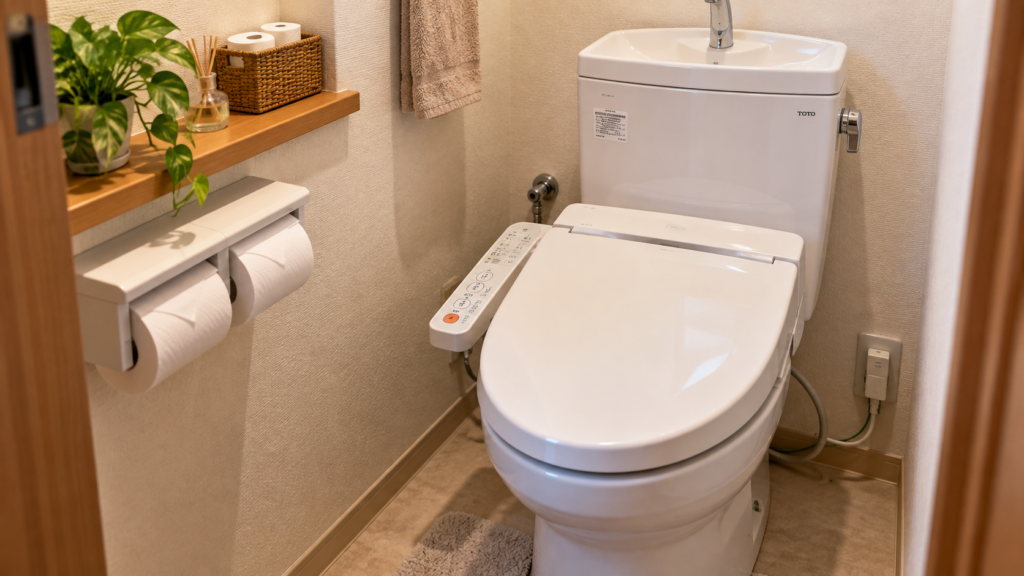
At home, my toilet has rear washing, bidet washing, adjustable water pressure, adjustable nozzle position, seat-temperature control, water-temperature control, and cleaning functions. It is an electronic seat added to an existing toilet rather than a high-end all-in-one model.
I regularly use rear washing, water-pressure adjustment, seat temperature, and water temperature. But I do not change every setting every time.
Water pressure and nozzle position usually stay where they are. Temperature is the setting I am more likely to change depending on the weather. Some cleaning functions are used only occasionally for maintenance.
So even from a Japanese user’s point of view, a panel with many buttons can look complicated.
The difference is that it does not necessarily feel difficult to use. You learn which few controls matter to you and ignore the rest.
Japan Eventually Standardized the Symbols
Those little toilet symbols are not completely random.
As the number of foreign visitors increased, inconsistent toilet controls became a usability problem. Different manufacturers could use different symbols and layouts for similar functions.
In 2017, the Japan Sanitary Equipment Industry Association introduced standardized pictograms for common toilet controls, with the stated goal of creating toilets that anyone could use with confidence.
The standardized symbols covered functions such as large flush, small flush, rear washing, bidet washing, drying, and opening or closing the seat and lid. The designs later became part of international and Japanese standards.
That means travelers do not always need to read Japanese to understand the toilet.
In my own experience, I have not had much trouble finding the flush control because the symbols are usually clear enough to recognize.
Otohime: The Button That Makes Fake Flushing Sounds
One of the most unusual Japanese toilet controls is not needed to operate the toilet at all.
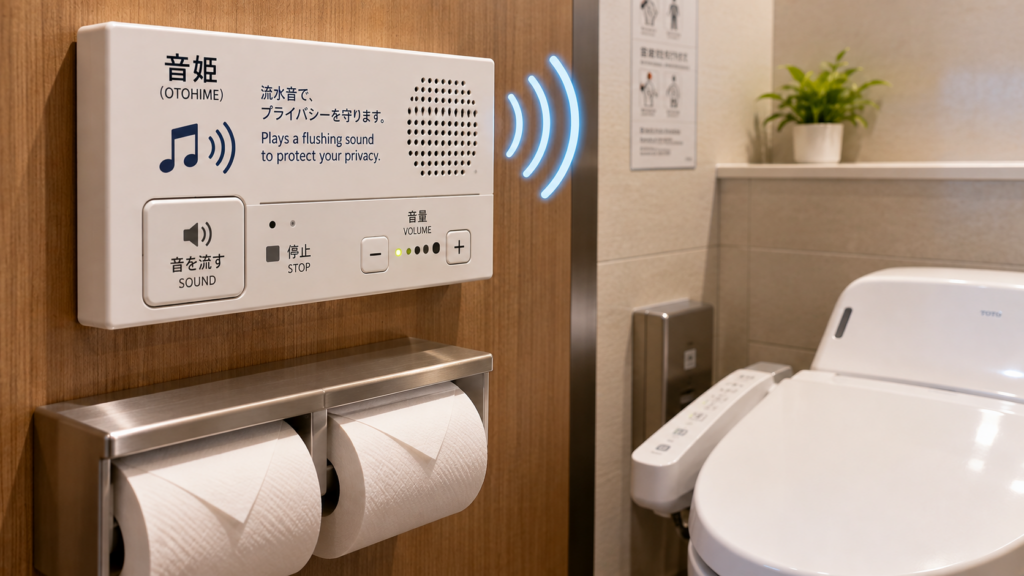
It is a privacy-sound device often known by TOTO’s product name, Otohime.
The idea grew from a real problem. Some users would flush the toilet more than once simply to cover the sound of using it, wasting clean water just to create noise.
TOTO introduced Otohime in 1988 as a way to play the sound of running or flushing water without actually flushing additional water. The product was originally promoted mainly with female users in mind.
In other words, one of Japan’s strangest toilet buttons exists partly because people were wasting real water to create privacy.
Personally, the idea feels very Japanese to me because it reflects the discomfort some people feel about others hearing natural bathroom sounds. I rarely encounter the function in men’s restrooms, and even when it is available, I do not often notice men using it.
But the button was not added simply for novelty. It addressed a specific privacy concern while reducing unnecessary flushing.
How High-Tech Toilets Became Ordinary in Japan
The most interesting thing about electronic bidet seats today may not be how advanced they are, but how normal they have become.
According to Japan’s Cabinet Office Consumer Confidence Survey, 82.5 percent of two-or-more-person households had a warm-water washing toilet seat as of March 2026.
That does not mean 82.5 percent of all toilets in Japan are electronic bidet toilets. It is a household ownership figure, not a toilet-by-toilet count.
Still, it shows how far the technology has moved from specialty product to ordinary household equipment.
That matches my own experience.
I no longer think of a warm-water washing toilet seat as a luxury. It feels like normal equipment. When I use a toilet without one, I notice the absence and find it less convenient, although it is hardly a serious problem.
At the same time, not every Japanese toilet is a futuristic all-in-one machine.
My own home is a good example. The electronic seat was added to an existing toilet. Many households use similar retrofit-style seats rather than expensive integrated models.
Public toilets also vary. A toilet in a major airport or department store may have far more features than one in an older building, small restaurant, or private home.
So the image of every Japanese toilet behaving like a spaceship is an exaggeration.
Are High-Tech Toilets Still Uniquely Japanese?
Not really.
Electronic bidet seats, smart toilets, heated seats, and similar products are now available in many countries.
TOTO began overseas sales of WASHLET in 1986, and the category has expanded internationally since then. In November 2025, cumulative global WASHLET shipments passed 70 million units.
What still surprises many visitors is not that Japan possesses technology unavailable elsewhere. It is how ordinary the technology feels once you arrive.
You may find washing functions in homes, hotels, shopping centers, airports, and other everyday spaces. What might be marketed as a premium bathroom upgrade elsewhere can feel much more routine in Japan.
One terminology point is worth knowing: WASHLET is TOTO’s brand name, not the generic name for every Japanese electronic bidet seat. LIXIL uses the name Shower Toilet, while the general category can be described as a warm-water washing toilet seat or electronic bidet seat.
What All Those Buttons Really Tell Us
It would be easy to explain Japanese toilet controls by saying, “Japanese people like complicated technology.”
But that is too simple.
The modern control panel is better understood as the result of decades of incremental improvement.
Manufacturers competed over comfort, washing performance, hygiene, cleaning, energy use, odor control, automation, and convenience. Consumers became accustomed to some of those functions, and new ones were added on top.
The result is a control panel that can look absurdly complicated when seen for the first time.
But most users do not need to master every function. They only need to know the handful they actually use.
That is probably the easiest way to understand the Japanese toilet.
The buttons are not there because every person needs twenty things to happen every time they sit down. They are there because, over roughly half a century, toilet makers kept asking the same question:
What else could we make a little more comfortable, cleaner, easier, or more automatic?
Japanese toilets did not start with twenty buttons. They accumulated them.