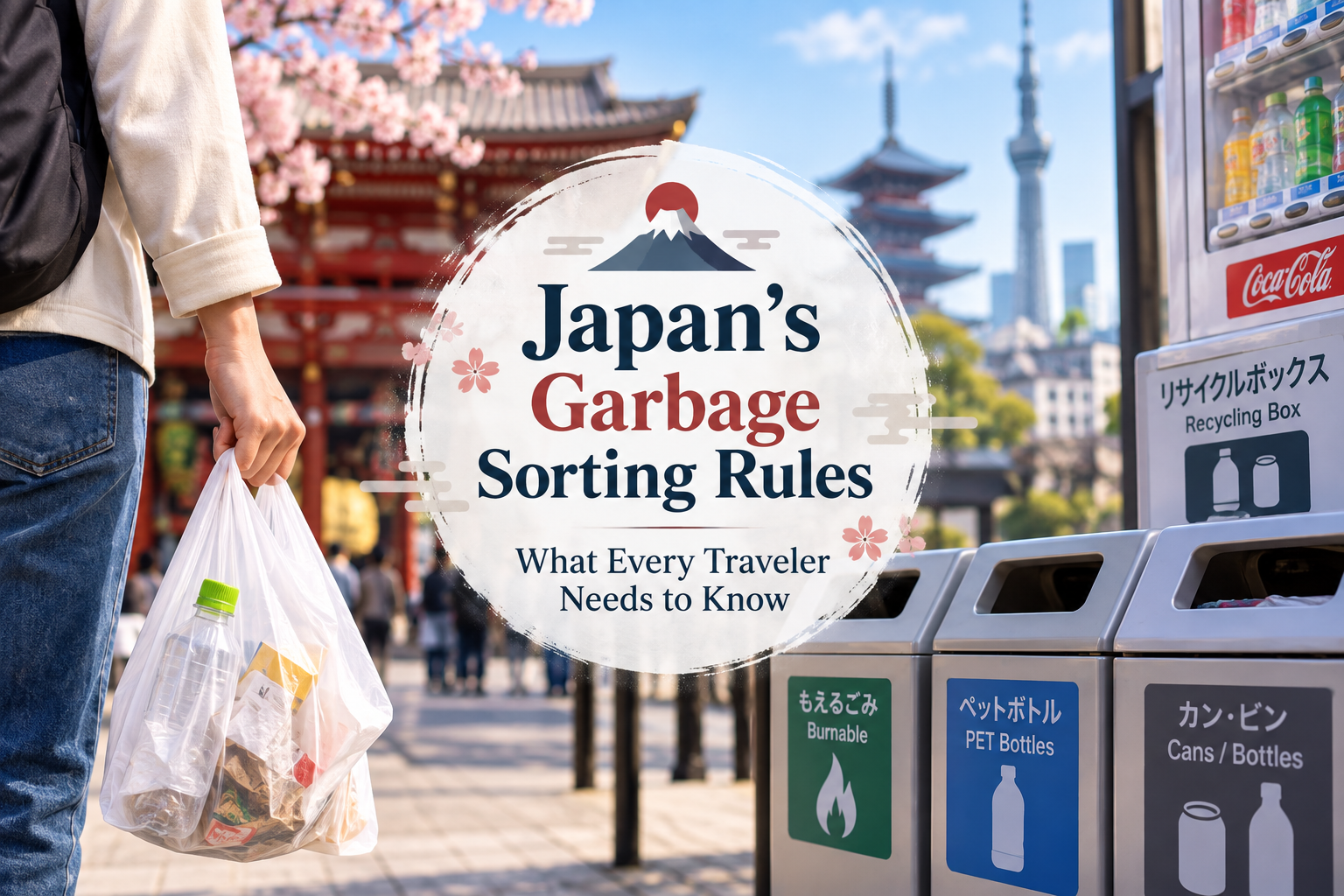
You finish a convenience-store coffee in Tokyo, look around for a trash can, and find… nothing.
So you keep walking.
Ten minutes later, you are still carrying the empty cup. Now you also have a snack wrapper in your pocket and an empty plastic bottle in your bag. You pass a vending machine and finally spot what looks like a trash can — but its openings are shaped for bottles and cans.
Can the coffee cup go in there? What about the wrapper? And why is throwing away a few pieces of trash suddenly so complicated?
This is one of those small problems that can surprise first-time visitors to Japan.
The good news is that travelers do not need to memorize Japan’s entire garbage-sorting system. In fact, there is no single nationwide household sorting system to memorize. The rules vary by municipality, and even Japanese residents sometimes have to look them up.
What travelers really need is much simpler: know what the bins in front of you are for, do not treat recycling boxes as general trash cans, and be prepared to carry your trash for a while if there is nowhere appropriate to put it.
Here is how it actually works.
Why Are Trash Cans So Hard to Find in Japan?
Yes, public trash cans really can be surprisingly difficult to find in Japan.
This is not just something foreign tourists imagine. Japan’s official tourism guidance advises visitors that public bins may be limited and recommends carrying a small bag for trash until an appropriate disposal point can be found.
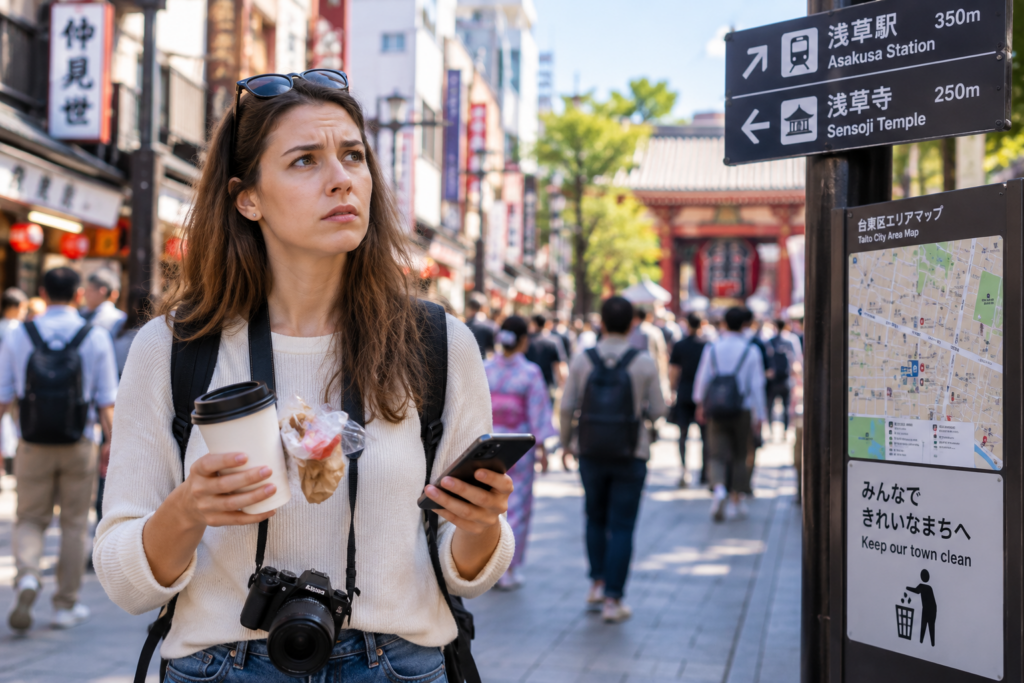
As someone who lives in Japan, I notice the shortage too.
If I have an empty bottle, food wrapper, or used tissue while I am out, I normally keep it until I find somewhere appropriate to throw it away. If I cannot find anywhere, I take it home.
That sounds inconvenient because sometimes it is.
You may have heard a popular explanation for Japan’s lack of trash cans: that they disappeared after the 1995 Tokyo subway sarin attack.
There is some truth behind that story, but it is too simple.
Security concerns did lead to the removal of station trash cans after the attack. Some later returned, and further anti-terror measures in the 2000s also led to removals and redesigned bins. Today, security is part of the history behind Japan’s station trash cans, but one event alone does not explain every missing bin across the country.
The useful lesson for a traveler is simpler: do not assume there will be a public trash can exactly when you need one.
Where Can Travelers Actually Throw Away Trash?
Japan does have trash cans. They are just not distributed like public street furniture in every neighborhood.
Depending on where you are, you may find bins at stations, transportation facilities, tourist attractions, shopping facilities, convenience stores, or places selling food and drinks. Availability varies considerably.
The easiest strategy is to deal with trash when you have a legitimate opportunity rather than assuming you will find another bin five minutes later.
If you buy food at a place that provides a disposal area for customers, use it before leaving when possible. This is especially useful with messy items such as cups, trays, skewers, and food containers.
If you are already carrying trash and cannot find an appropriate bin, keep it with you.
A small plastic bag can be surprisingly useful. I do not personally walk around every day with a special “trash bag,” but I sometimes carry one, and I may keep a plastic bag I receive while traveling or shopping and reuse it for trash later.
That is more realistic than imagining that every Japanese person has a dedicated garbage pouch ready at all times.
The Box Next to a Vending Machine Is Probably Not a Trash Can
This is an easy mistake to make.
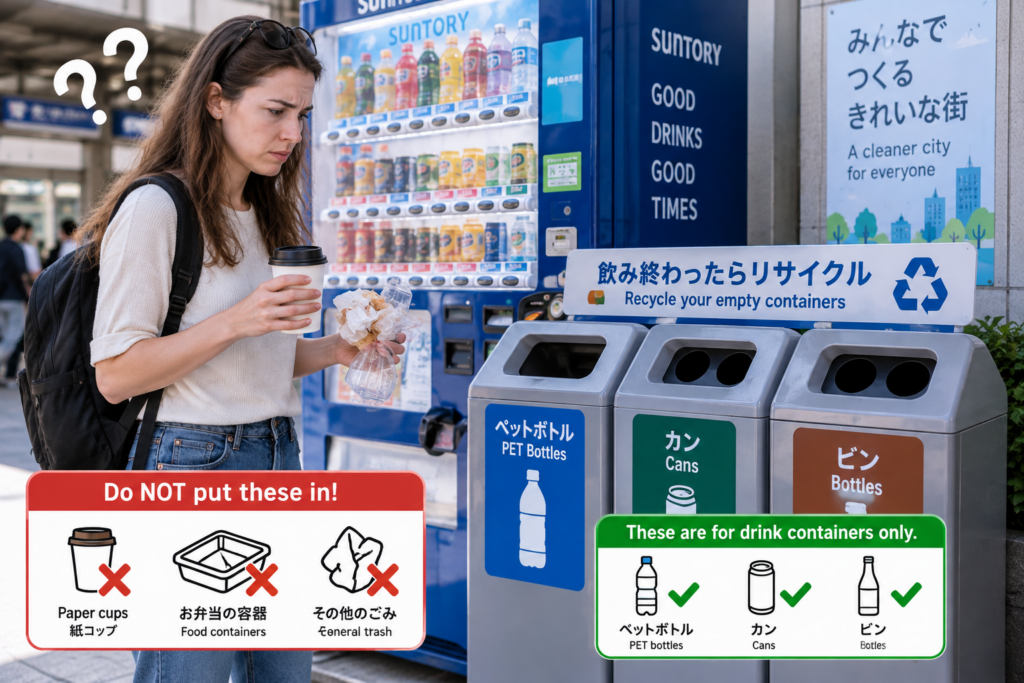
Next to many vending machines, you will see boxes with round openings for bottles or cans. To a traveler desperately holding an empty coffee cup and snack wrapper, they can look like public trash cans.
They are not.
These are collection or recycling boxes intended for beverage containers such as cans, bottles, and PET bottles. Local governments and the beverage industry explicitly distinguish them from ordinary garbage bins.
Do not put tissues, food containers, plastic bags, cigarette waste, or other general trash into them.
A useful rule is:
Vending-machine recycling box ≠ general trash can.
Look at the openings, pictures, and labels before putting anything inside.
What About Convenience-Store Trash Cans?
Convenience stores can be another source of confusion.
Some stores provide bins and some do not. Their location also varies: they may be inside the store, outside, or unavailable entirely.
The important point is not to think of a convenience-store bin as a municipal public trash can.
Personally, I basically think of a store’s trash cans as being there for customers and for waste associated with purchases from that kind of visit. If I were carrying unrelated trash and wanted to use a store’s bin, I would feel more comfortable buying something there first.
Bringing a bag of household garbage to a convenience store, however, would be completely different. That is not what those bins are for.
For travelers, the safest approach is simple: check the signs, respect the store’s rules, and do not assume every convenience store must accept whatever trash you are carrying.
Eating on the Go? Think About the Trash Before You Walk Away
This matters more than it sounds.
Imagine buying a snack, drink, or street food at a tourist area. You finish it and walk away, assuming you will throw the packaging away at the next corner.
Then there is no next trash can.
Now you are carrying a sauce-covered tray or a sticky cup around a temple district.
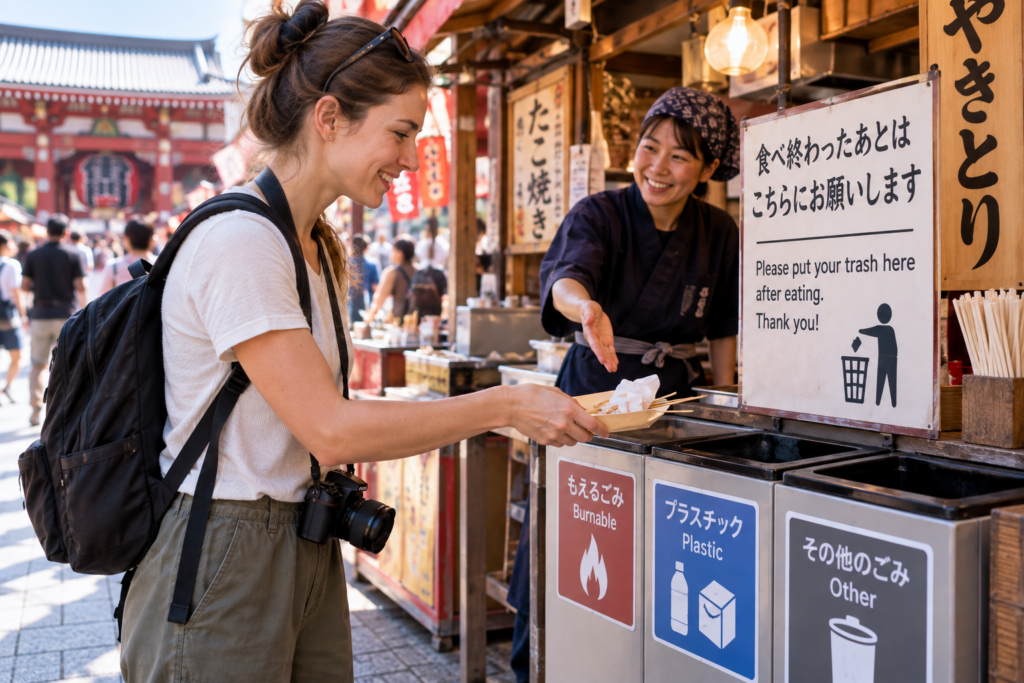
When a food stall, shop, event, or facility provides a designated collection point, disposing of your waste there before leaving can save you a lot of trouble.
This is particularly useful at festivals and busy sightseeing areas, where temporary or venue-specific disposal systems may be provided.
Do not assume the same arrangement exists everywhere, though. Follow the signs and instructions at the location you are visiting.
At a Hotel, Follow the Hotel’s System
For ordinary travelers, your hotel is often the simplest place to deal with the small amount of trash you have accumulated during the day.
But there is no need to invent your own sorting system.
Use the bins and instructions provided by the property. If separate bins are provided for bottles, cans, or other recyclables, use them. If you are unsure about something unusual, ask the staff.
The same principle is especially important at vacation rentals and other accommodation where guests may be given specific disposal instructions.
Do not assume that every property uses exactly the same system.
The Big Secret: Japan Does Not Have One Garbage-Sorting System
This is where Japan’s reputation for complicated garbage sorting becomes more interesting.
Household waste rules are set and administered locally. That means the categories, collection schedules, and detailed instructions can differ from one municipality to another.
So there is no single chart that tells every household in Japan exactly what counts as burnable, non-burnable, recyclable plastic, or oversized waste.
This can confuse Japanese people too.
I have moved from an area with relatively simple sorting rules to one with more detailed rules. At first, I was checking the local instructions almost every day.
Even now, I sometimes have to look things up.
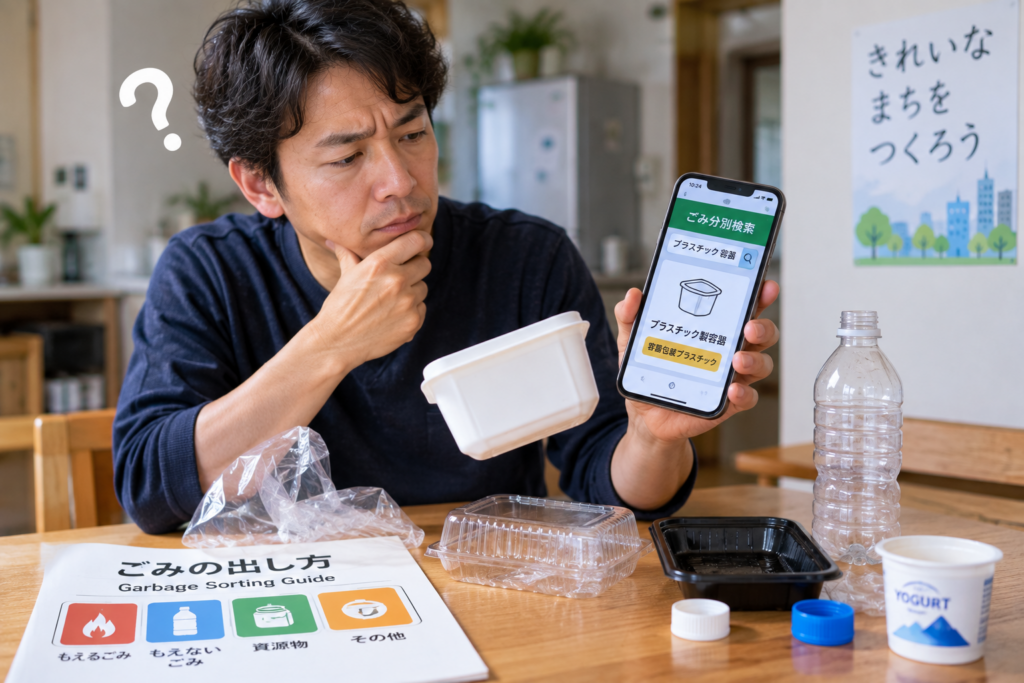
Plastic products can be especially confusing: is this particular item burnable waste or a recyclable plastic resource? I have also wondered whether certain larger items count as non-burnable waste or oversized garbage.
When I do not know, I use information provided by my municipality. Where I live, there is even an official garbage-sorting app that can tell residents collection days, categories, and how individual items should be disposed of.
That tells you something important about garbage sorting in Japan:
Japanese people do not necessarily know every rule by instinct. We know the rules we use regularly, and when something unusual appears, we may check.
Why Plastic Can Be Particularly Confusing
Plastic is a good example of why simple explanations of Japanese garbage sorting often fail.
For years, plastic containers and packaging could be collected separately while other plastic products were treated differently, sometimes as burnable waste. Japan’s Plastic Resource Circulation Act created a framework that allows municipalities to collect a broader range of plastic products for recycling.
But that did not instantly create one identical rule across the country.
Municipalities are changing their systems at different times and in different ways.
My own city provides a good example: local authorities announced plans to expand the range of plastic products collected as resources starting in October 2026.
So if you read an old blog post saying, “In Japan, this kind of plastic always goes in burnable waste,” be careful.
The correct answer may depend on both the city and the date.
Even a PET Bottle Is Not as Simple as It Looks
PET bottles are one of the most recognizable recycling categories in Japan, but even here the details matter.
A common recycling process is to remove the cap and label, lightly rinse the bottle, and put the bottle into the appropriate PET collection. But exactly how the cap, label, and bottle should be handled depends on local rules.
And here is a confession.
When thinking about this article, I initially described my own routine as removing the cap and label and throwing them away as burnable waste.
Then I checked my municipality’s current rules.
That was not the correct category where I live.
The cap and label are currently handled as plastic packaging, and the rules are changing again as the city introduces a new plastic-resource system.
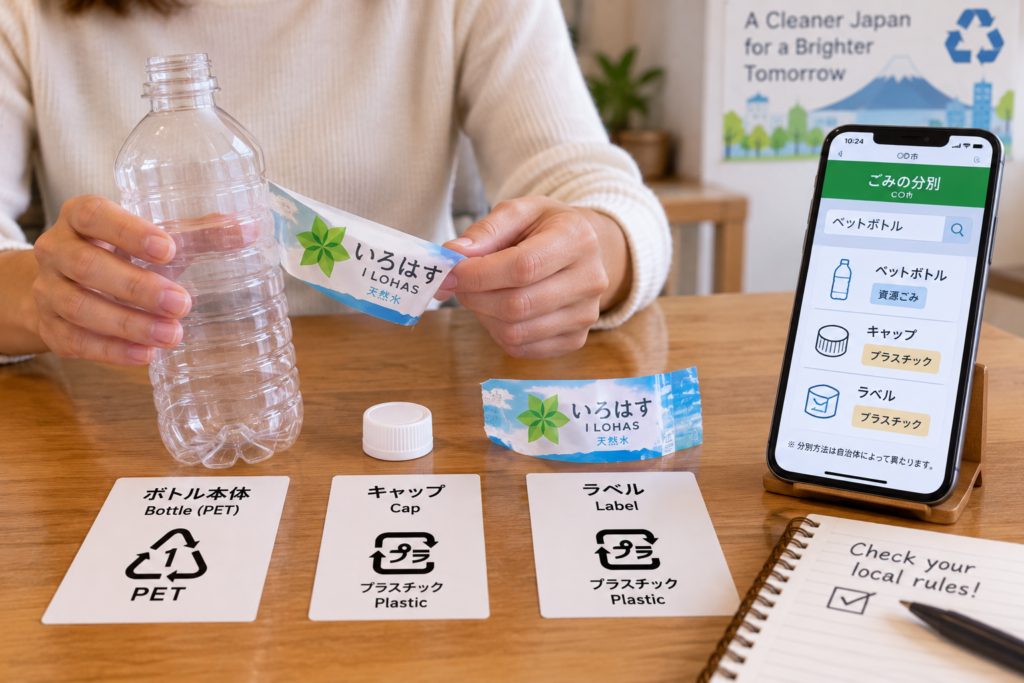
I have lived with Japanese garbage sorting for decades, and I still got that detail wrong.
That may be more useful for a visitor to know than another long list of rules.
If a Japanese resident can occasionally need to check the official instructions, nobody expects a tourist on their first week in Japan to understand the entire waste-management system.
“Burnable” Does Not Simply Mean “Can Catch Fire”
Another potential source of confusion is the English translation of categories such as moeru gomi or moyasu gomi — usually translated as “burnable” or “combustible” garbage.
It is tempting to interpret that literally.
Plastic burns, so plastic must be burnable garbage, right?
Not necessarily.
These labels are waste-management categories, not a science experiment about whether an object can physically catch fire. The correct category depends on how a municipality collects, processes, and recycles different materials.
This is another reason not to guess based only on what something is made from.
Useful Japanese Words on Trash Bins
You do not need to study garbage vocabulary before visiting Japan, but recognizing a few words can help:
USEFUL WORDS ON TRASH BINS
- 燃えるごみ / もえるごみ — burnable garbage
- 燃えないごみ / もえないごみ — non-burnable garbage
- 缶 — cans
- びん — glass bottles
- ペットボトル — PET bottles
- プラスチック / プラ — plastic
The pictures and shapes of the openings can often be more useful than the English translation.
If you are still unsure, do not force an item into the closest opening just because it looks vaguely correct.
What Should You Do If You Cannot Find the Right Bin?
Keep the trash.
That really is the answer sometimes.
Put it in a small bag, keep it in your backpack or shopping bag, and dispose of it later when you find an appropriate place or return to your accommodation.
This is what I do too.
It may feel strange if you come from somewhere with public trash cans on nearly every block, but after a while it becomes another small part of moving around Japan.
You do not need to become an expert in municipal waste policy.
You just need to resist the temptation to turn the first container you see into a trash can.
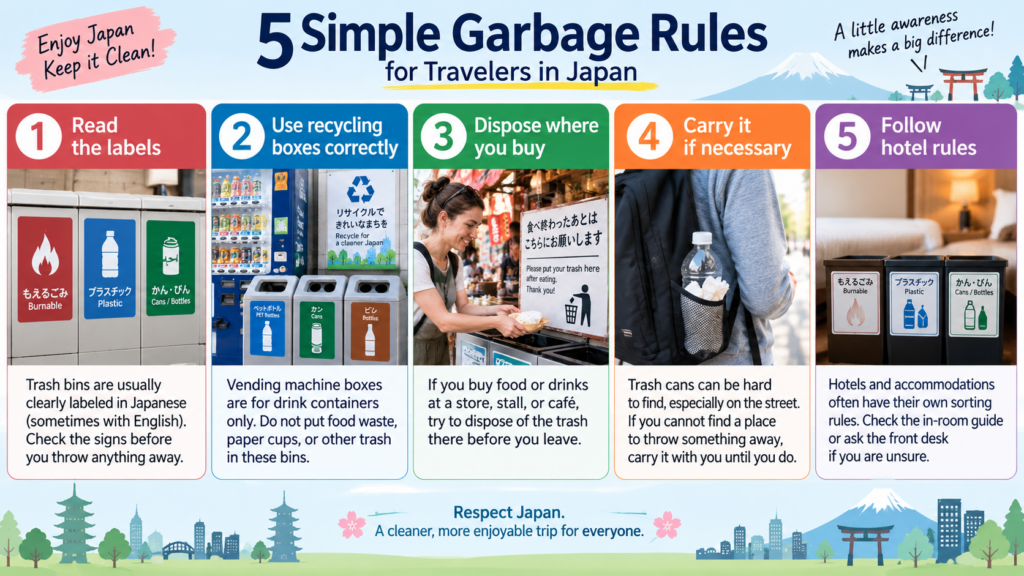
Five Simple Garbage Rules for Travelers in Japan
If you remember nothing else from this article, remember these five things:
FIVE SIMPLE RULES
- Read the bin labels and follow the categories shown.
- Do not use vending-machine recycling boxes for ordinary trash.
- If the place where you buy food provides a proper disposal point, consider using it before you leave.
- If you cannot find an appropriate bin, keep your trash with you and dispose of it later.
- At hotels and other accommodation, follow the property’s disposal instructions.
The Rules Are Complicated. Your Trip Does Not Have to Be.
Japan’s garbage system can look intimidating from the outside.
There are different categories, different collection days, different municipal rules, changing plastic policies, and recycling boxes that look suspiciously like trash cans.
But most of that complexity matters far more to residents than to short-term visitors.
As a traveler, you do not need to memorize what every Japanese city does with plastic bottle caps or learn which day non-burnable garbage is collected.
Pay attention to the bin in front of you. Respect the rules of the shop, station, hotel, or facility you are using. And if there is nowhere appropriate to throw something away, carry it for a while.
Japanese people sometimes do exactly the same thing.
And if the sorting rules still seem confusing, remember: we sometimes have to look them up too.