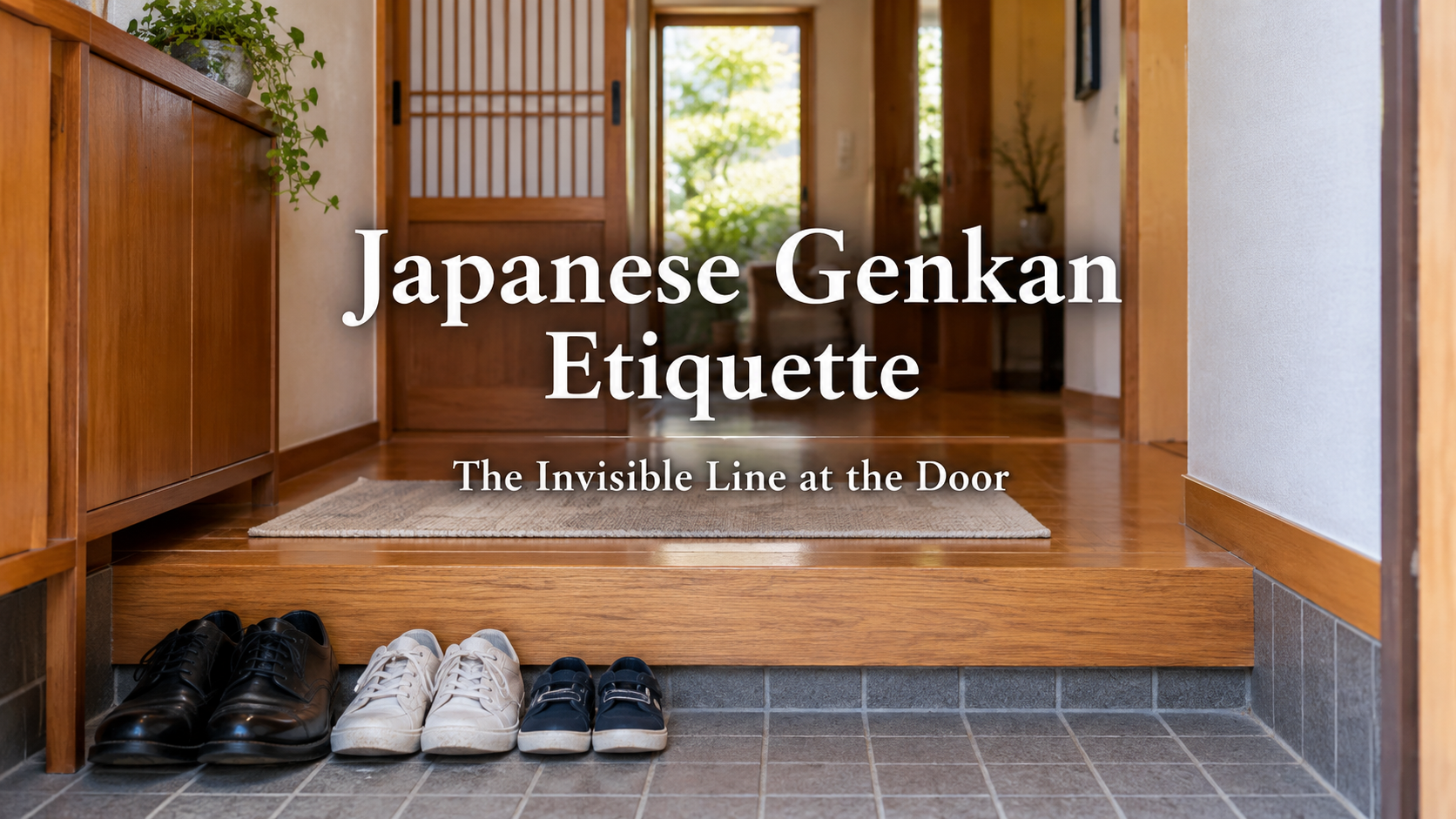
Japanese Genkan Etiquette: The Invisible Line at the Door
Taking off your shoes is the easy part. Knowing where your feet—and your belongings—go afterward is what matters.
When I was a child, my mother often warned me not to step down onto the entrance floor barefoot.
The lower entrance floor was where outdoor shoes belonged, and I wasn’t supposed to step onto it without shoes. At the time, it was just another household rule.
These days, I visit patients in their homes as a licensed massage therapist. I still pay attention to that same boundary, not only when removing my shoes but also when deciding where to put my work bag.
For someone visiting Japan, the familiar advice to “take off your shoes” leaves out an important detail: what happens to your feet after the shoes come off?
What Is a Japanese Genkan?
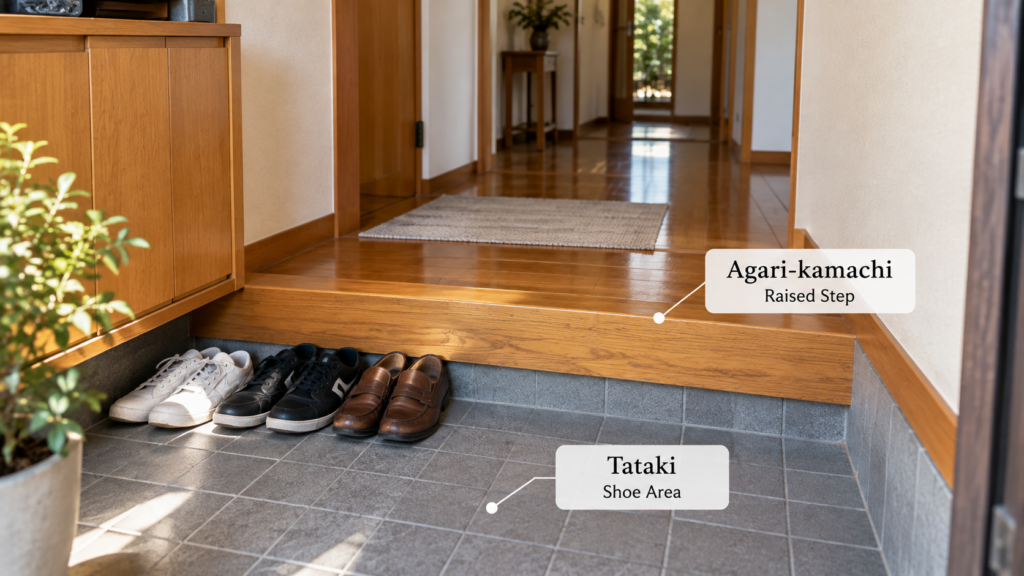
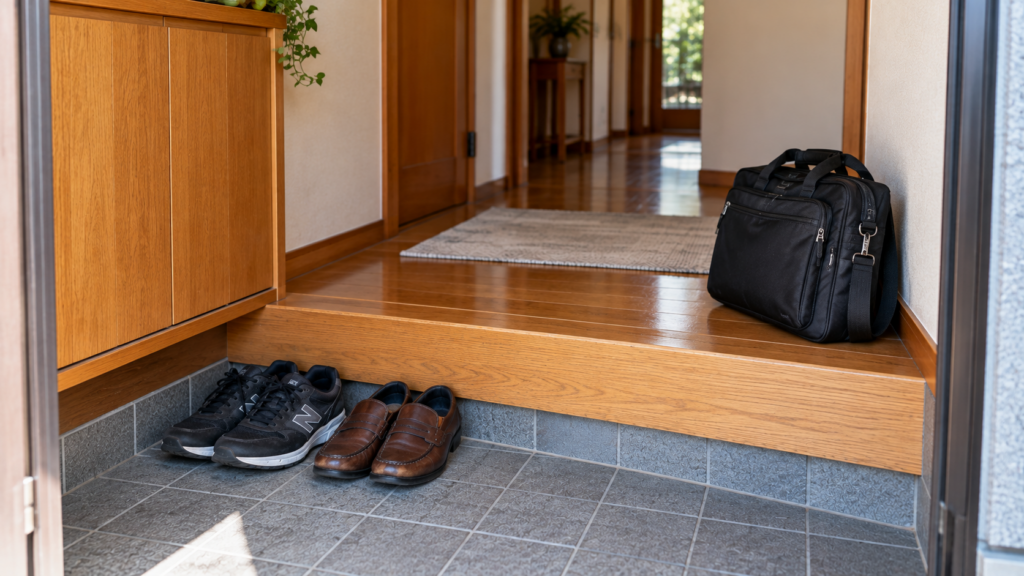
A genkan (玄関) is the entrance area of a Japanese home. In a typical house or apartment, it has a lower floor where outdoor shoes are removed and a raised floor leading into the living space.
The lower area is commonly called the tataki (たたき). In modern homes, it is often tiled or finished with another durable, easy-to-clean material.
The edge of the raised floor is called the agari-kamachi (上がり框). It marks the transition from the shoe area to the interior.
The step can be small or quite noticeable, depending on the building.
Through my work visiting patients, I have seen genkan areas of many sizes. Some are narrow, with barely enough room to remove your shoes. Others, particularly in detached houses, offer more space.
I also notice how people adapt their entrances to their physical needs. In homes where residents have difficulty lifting their legs, I often see an additional step, a ramp, or a handrail near the entrance. These features can make it easier for residents to enter and leave their homes.
For those residents, the genkan is more than a place to leave shoes. Its layout can make a real difference to everyday mobility.
Why Do Japanese People Take Off Their Shoes?
Traditional Japanese houses commonly had raised floors, including rooms covered with tatami mats. People sat, ate, relaxed, and slept close to the floor. Keeping outdoor dirt away from those living surfaces made practical sense.
Today, many homes have wooden or other hard flooring, but removing outdoor shoes remains widespread. Shoes can carry sand, mud, dust, and other debris indoors. Leaving them at the entrance helps keep living areas cleaner.
There is a related concern for cleanliness in Japanese bathing customs: people generally wash before getting into a shared bathtub, helping keep the bathwater clean. The practices are different, but both involve paying attention to what enters a clean space.
I grew up removing my shoes at the entrance, and I was taught to arrange them neatly afterward. I still do that almost every time.
The Invisible Line Most Visitors Miss
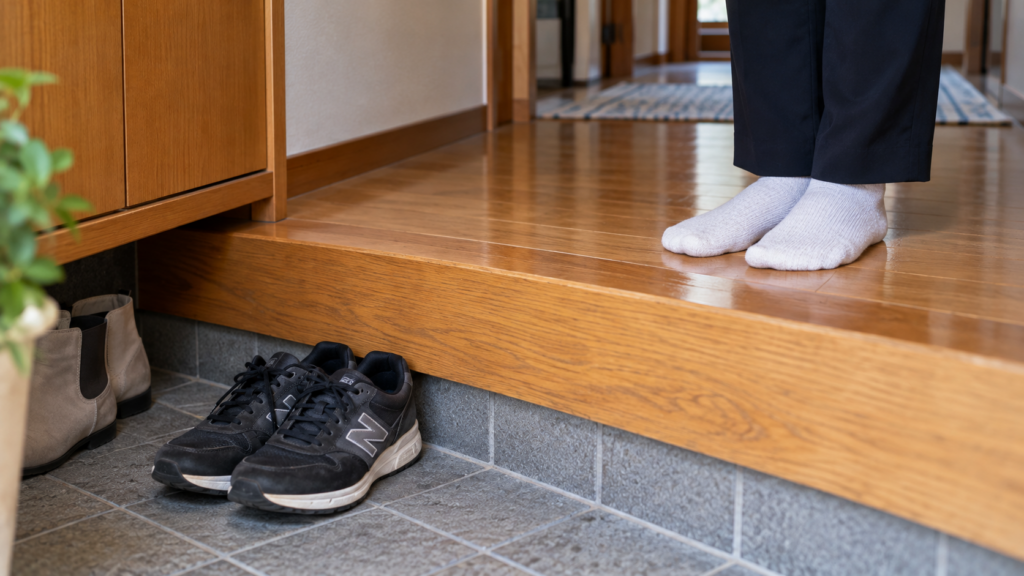
Here is the detail that can catch visitors off guard: the tataki remains the outdoor-shoe area even after you have taken off your shoes.
Imagine removing your shoes, stepping into the house, and then stepping back down onto the tataki in your socks to move your shoes out of the way.
Your socks may pick up dirt from the same surface that outdoor shoes have touched. When you step inside again, you can carry that dirt onto the indoor floor.
The same rule applies whether you are barefoot or wearing socks.
The raised floor is where you stand without outdoor shoes. The tataki is where those shoes belong.
I see the same distinction in another part of my working routine.
Why My Work Bag Never Goes on the Tataki
I have worked as a nationally licensed anma massage shiatsu practitioner for around 20 years. My work includes visiting patients in their homes. If you are curious about the profession, I explain how licensed massage differs from other services in Japan in another article.
When I arrive at someone’s home, I carry a bag containing items I need for treatment. I avoid placing that bag on the tataki.
Instead, I put it on the raised indoor side near the entrance. Later, I move it to a place in the room where it will not get in anyone’s way.
If I leave the bag on the tataki, its bottom may pick up sand or dirt. Carrying it into the patient’s room could transfer that dirt onto the indoor floor.
This is my own precaution, rather than a formal rule every visitor must follow.
A backpack, shopping bag, or suitcase can pick up dirt too. Think about where its bottom has been before placing it on someone’s floor. If you arrive with a wheeled suitcase, ask your host where to leave it instead of rolling dirty wheels across the indoor flooring.
How to Remove and Arrange Your Shoes
Taking your shoes off without putting your socks on the tataki can feel awkward the first time. Here is one way to do it:
- Stand on the tataki while wearing your shoes. Stop before the raised indoor floor.
- Slip off one shoe and put that foot directly onto the raised floor. Keep your other foot in its shoe.
- Remove the second shoe and step up completely. Neither sock needs to touch the tataki.
- Turn around and arrange your shoes. Point their toes toward the entrance door and move them to the side if there is room.
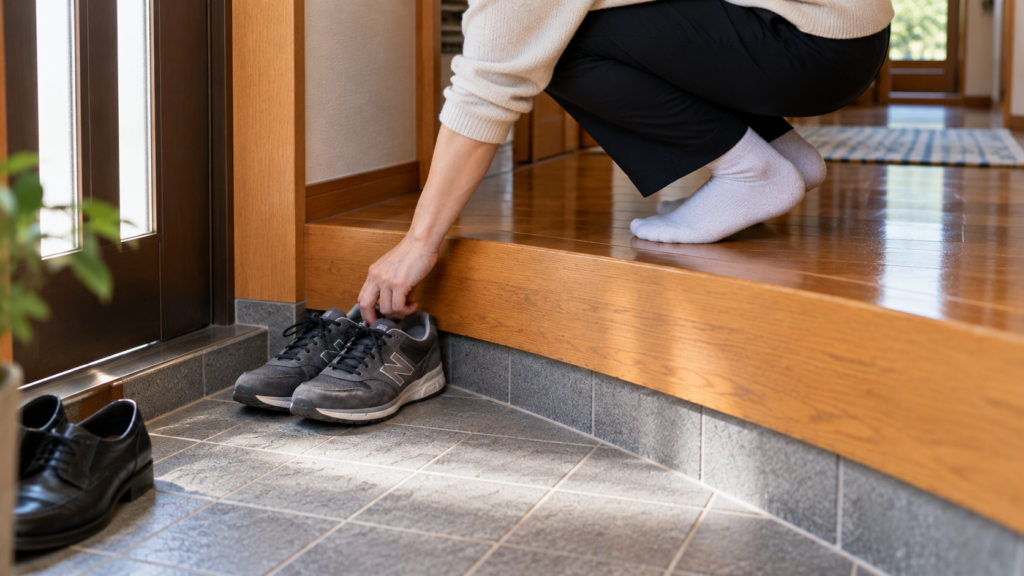
That last step is part of my usual routine. I remove my shoes, step inside, turn around, and straighten them. The arrangement does not have to be perfect. Leave your shoes tidy and avoid blocking the entrance.
With lace-up shoes or boots, you may need more time. If there is a suitable step or seat, sitting down can help. Be careful on high or narrow steps, and ask your host if you need assistance.
If you are packing for Japan, slip-on shoes make frequent footwear changes much easier.
One other useful preparation: wear clean socks without holes. If you are wearing sandals and plan to visit someone’s home, carrying a pair of socks is a considerate option.
Where Do You Need to Remove Your Shoes in Japan?
You will not need to take off your shoes in every Japanese building. Rules vary by location and sometimes by room.
| Place | What to Expect |
|---|---|
| Japanese homes | Outdoor shoes are normally removed at the genkan. |
| Traditional ryokan | Shoes are often removed at a designated entrance. In larger properties, that point may be beyond the lobby. |
| Western-style hotels | Shoes are generally worn in lobbies and corridors. In guest rooms, check for a raised entrance step and follow the property’s instructions. |
| Airbnb and rental homes | Many residential properties expect guests to remove shoes. Check the house rules and look for a designated shoe area. |
| Restaurants | Most allow outdoor shoes, but some tatami rooms and private dining areas require shoes to be removed. |
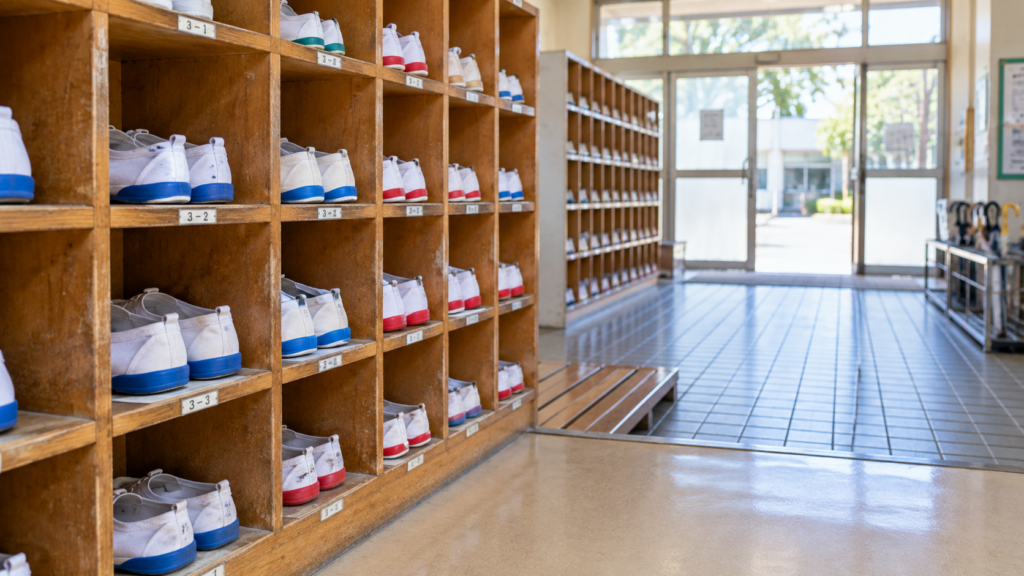
| Schools | Students commonly change into indoor shoes called uwabaki. |
| Temples and shrines | Some interior areas require shoes to be removed; outdoor grounds generally do not. |
| Clinics and other facilities | Some require a change of footwear or provide slippers; others allow outdoor shoes. |
In a hotel room, a raised step near the door often indicates where outdoor shoes should come off, even if the lobby and corridors are shoes-on areas. However, not every hotel room has the same layout. Follow the room’s instructions rather than relying on slippers alone.
At a restaurant or ryokan, look for signs, shoe shelves, or a designated place to change footwear. When in doubt, ask a staff member.
Slippers, Greetings, and Small Mistakes
Not Every Japanese Home Uses Slippers
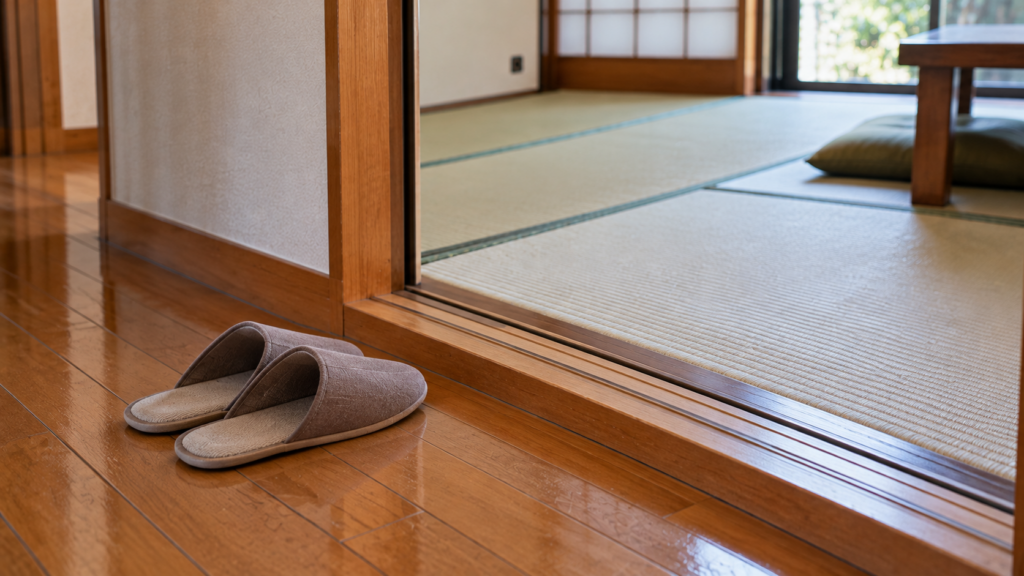
Some Japanese households offer slippers to guests. Others do not.
My own home does not normally use slippers, so we do not prepare them for visitors. When I visit someone else’s home, I follow that household’s preference.
If slippers are provided, they are generally worn on ordinary indoor flooring but removed before stepping onto tatami mats.
Some homes and accommodations also provide separate toilet slippers. These should stay in the toilet area. Forgetting to change out of them before returning to the hallway is an easy mistake to make.
What Should You Say When Entering?
When entering someone’s home, you can say ojama shimasu (お邪魔します). It is a polite expression acknowledging that you are entering another person’s space.
I normally say it as I step inside.
When leaving, you can say ojama shimashita (お邪魔しました). It is a polite way to acknowledge your visit and thank your host for their hospitality.
You do not need perfect Japanese to be a considerate guest. A greeting and a willingness to follow your host’s lead go a long way.
What If You Make a Mistake?
If you accidentally step onto the tataki in your socks or forget to change out of toilet slippers, correct the mistake when you notice it.
A brief sumimasen (すみません), meaning “excuse me” or “sorry” in this situation, is appropriate.
Follow your host’s guidance and carry on. A small mistake does not need to become a major incident.
The Line I Cross Every Working Day
Before entering a patient’s home, I remove my shoes and leave them neatly to one side. I keep my work bag off the tataki. In some homes, I also notice the steps, ramps, or handrails that help residents move through the entrance safely.
These actions are part of my working day, but they reflect the same lesson my mother taught me as a child.
The genkan has a place for outdoor shoes and a place for the people who live inside. Once you recognize that line, the etiquette is much easier to follow.