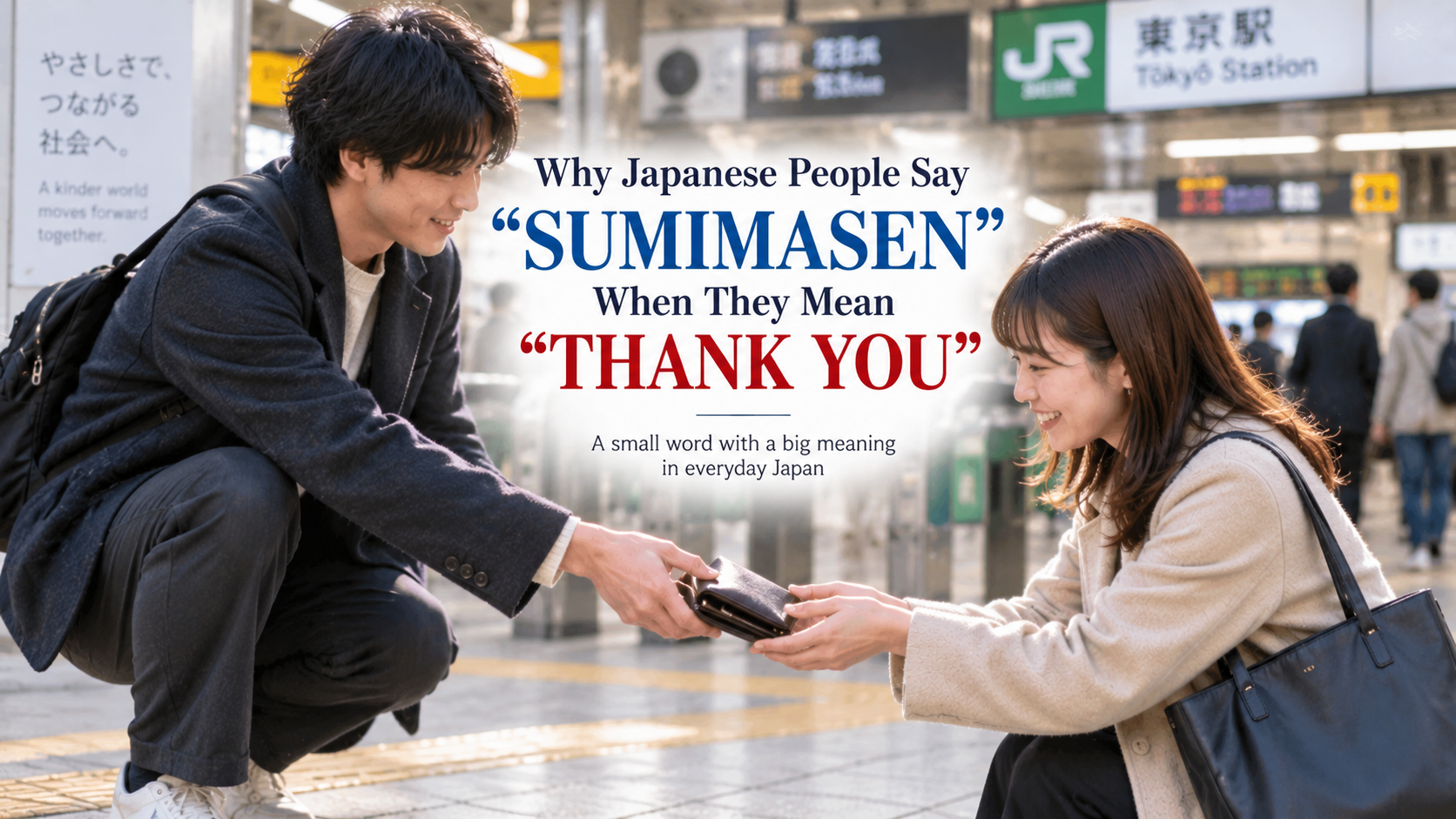
Imagine you drop something in a train station in Japan. A stranger notices, picks it up, and hands it back.
You expect:
“Arigatou gozaimasu.” — Thank you very much.
And you may hear exactly that. But you might also hear:
“Ah, sumimasen.”
If you learned sumimasen as “sorry” or “excuse me,” this can sound backwards. Why apologize to someone who just helped you?
Because sumimasen does not fit neatly into one English translation. It can be an apology, a way to get someone’s attention, a polite “excuse me,” and, in some situations, an expression of gratitude.
But that does not mean sumimasen secretly means “thank you.”
The real explanation is more interesting.
Sumimasen Is More Than “Sorry”
Japanese learners are often introduced to sumimasen as “sorry” or “excuse me.” Both are useful translations.
Bump into someone? Sumimasen.
Need to get a restaurant server’s attention? Sumimasen!
Need to squeeze past someone on a crowded train? Sumimasen.
In everyday speech, you will also hear suimasen, a common conversational variation. I personally use suimasen quite often when speaking.

The important point is that these are not all the same social act.
When I say suimasen while passing in front of someone, for example, I do not feel that I am making a serious apology. To me, it is closer to “excuse me” or “pardon me.”
That flexibility is why translating every sumimasen as “sorry” can be misleading.
So Why Say Sumimasen Instead of Arigatou?
Think about two sides of a favor.
First, you received something positive. Someone picked up the item you dropped, helped you with a task, or made an extra effort for you.
That naturally invites arigatou: thank you.
But there is another side. The other person spent time, attention, or effort on you.
Sumimasen can acknowledge that side too.
This is not a rigid grammar rule, and Japanese speakers are not consciously calculating which social meaning to activate every time they speak. Research on Japanese expressions of gratitude has nevertheless found that sumimasen can be used when a speaker recognizes not only the benefit received but also the effort or burden on the other person.

The simplest way I can describe the feeling in English is:
“You went out of your way for me — thank you.”
That is much closer to how gratitude-related suimasen feels to me than simply “I’m sorry.”
What “Sumimasen” Actually Feels Like to Me
This is where textbook explanations can make everyday Japanese sound more systematic than it really is.
As a native Japanese speaker, I do not feel that I am constantly saying sumimasen. And I certainly do not feel that I am constantly apologizing.
My choice changes with the situation.
If someone picks up something I dropped, I might say arigatou gozaimasu or suimasen.
If a stranger holds an elevator door open for me, arigatou gozaimasu feels completely natural.
If I need to pass in front of someone in a crowded space, I would probably say suimasen. In that situation, the feeling is closer to “excuse me.”
If a coworker helps me, I personally tend to use arigatou more often than sumimasen.
And with family or close friends, I am less likely to use sumimasen for an ordinary favor. Depending on the relationship and situation, I might say arigatou, gomen (“sorry”), warui ne (“sorry about that” / “thanks for that”), or something similarly casual.
There is no little switch in my head labeled APOLOGY, GRATITUDE, and EXCUSE ME. The words come out naturally according to the situation and relationship.
That is an important part of understanding sumimasen: native speakers may analyze it much less than language learners do.

Sumimasen Does Not Replace Arigatou
If sumimasen can express gratitude, why not use it whenever you mean “thank you”?
Because Japanese people still say arigatou all the time.
Sumimasen is not a substitute you can drop into every situation where English uses “thank you.”
Imagine someone gives you a birthday present.
Arigatou!
Perfectly natural.
Sumimasen alone could feel different and, depending on the situation, odd or incomplete.
Now imagine someone has gone to considerable trouble to bring you something. You might hear:
Wazawaza sumimasen.
Wazawaza means something like “going to the trouble” or “making a special effort.” The focus is no longer only on the gift. You are also recognizing what the other person did to make it happen.

You might even say:
Wazawaza sumimasen. Arigatou gozaimasu.
That combination sounds much less mysterious once you stop treating sumimasen as a literal English “sorry.”
Why Say Both Sumimasen and Arigatou Gozaimasu?
You may hear:
Sumimasen, arigatou gozaimasu.
A word-for-word English rendering — “Sorry, thank you very much” — sounds stranger than the Japanese actually feels.
The two expressions can highlight different parts of the interaction: sumimasen can acknowledge the other person’s trouble or consideration, while arigatou gozaimasu directly expresses thanks.
But native speakers do not necessarily separate those functions consciously.
For me, saying both can simply feel like emphasizing my appreciation.
That is worth remembering because explanations of Japanese sometimes make ordinary conversation sound as though speakers are constantly calculating social obligations.
Usually, we are just talking.
Are Japanese People Really Apologizing All the Time?
From an English-speaking perspective, repeated sumimasen can create the impression that Japanese people are constantly saying “sorry.”
But that assumes every sumimasen is doing the same job as the English word.
It is not.
Sometimes it really is an apology. Sometimes it means “excuse me.” Sometimes it gets someone’s attention. Sometimes it acknowledges that another person has done something for you. And sometimes those meanings overlap.
When I use suimasen after someone has helped me, the feeling is usually much closer to gratitude than to admitting that I did something wrong. It often comes out almost automatically.
So reducing the phenomenon to “Japanese people apologize a lot” misses what is interesting about the word.
The real surprise is how much social work one ordinary expression can do.

One Word, Several Everyday Situations
Here is a practical way to see how context changes the meaning:
| Situation | What you might hear | Closest English feeling |
|---|---|---|
| You accidentally bump into someone | Sumimasen. | “Sorry.” |
| You call a restaurant server | Sumimasen! | “Excuse me.” |
| You pass someone in a crowded space | Suimasen. | “Excuse me / pardon me.” |
| Someone picks up something you dropped | Suimasen. | “Thanks / sorry to trouble you.” |
| Someone makes a special effort for you | Wazawaza sumimasen. Arigatou gozaimasu. | “You went to the trouble — thank you.” |
The word itself barely changes.
The situation does.
Does Social Distance Matter?
Yes, although there is no simple formula.
Research on Japanese gratitude expressions suggests that social relationships and status can affect whether speakers choose arigatou, sumimasen, or a combination.
My own everyday usage changes depending on who I am speaking to as well.
With strangers, sumimasen or suimasen works naturally in many brief public interactions. With family and close friends, I am less likely to use it for an ordinary favor.
That does not mean sumimasen is simply “more polite” than arigatou. Arigatou gozaimasu is itself perfectly polite.
What happened, who you are speaking to, and what part of the interaction you are acknowledging all matter.
What Should Travelers to Japan Say?
If you are visiting Japan, you do not need to master every nuance before opening your mouth.
Arigatou gozaimasu is a safe and natural way to thank someone.
Sumimasen is extremely useful when you need to say “excuse me,” get someone’s attention, apologize for a small inconvenience, or politely move through a crowded space.
And if you hear a Japanese person respond to a favor with sumimasen, do not automatically assume they feel guilty. They may be acknowledging the favor in a way English does not package into one obvious word.
You also do not need to force sumimasen into a situation just to sound more Japanese. If someone helps you and your instinct is to say arigatou gozaimasu, that is completely natural.

Why This Tiny Word Is So Easy to Misunderstand
The difficulty with sumimasen is not that Japanese has a mysterious word that somehow means both “sorry” and “thank you.”
The problem is expecting one English word to cover everything sumimasen can do.
English speakers might choose among “sorry,” “excuse me,” “thank you,” “I appreciate it,” “thanks for going to the trouble,” and “pardon me.”
Japanese can use sumimasen across parts of that territory, depending on the situation.
So when a Japanese person receives a favor and says suimasen, they may not be thinking:
“I did something wrong.”
The feeling may be closer to:
“You did that for me.”
“You went to the trouble.”
“I appreciate it.”
Or simply:
“Thank you.”
The next time you hear sumimasen, do not look only at the dictionary translation.
Look at what just happened between the two people.
That is where the meaning is.