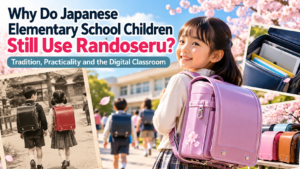
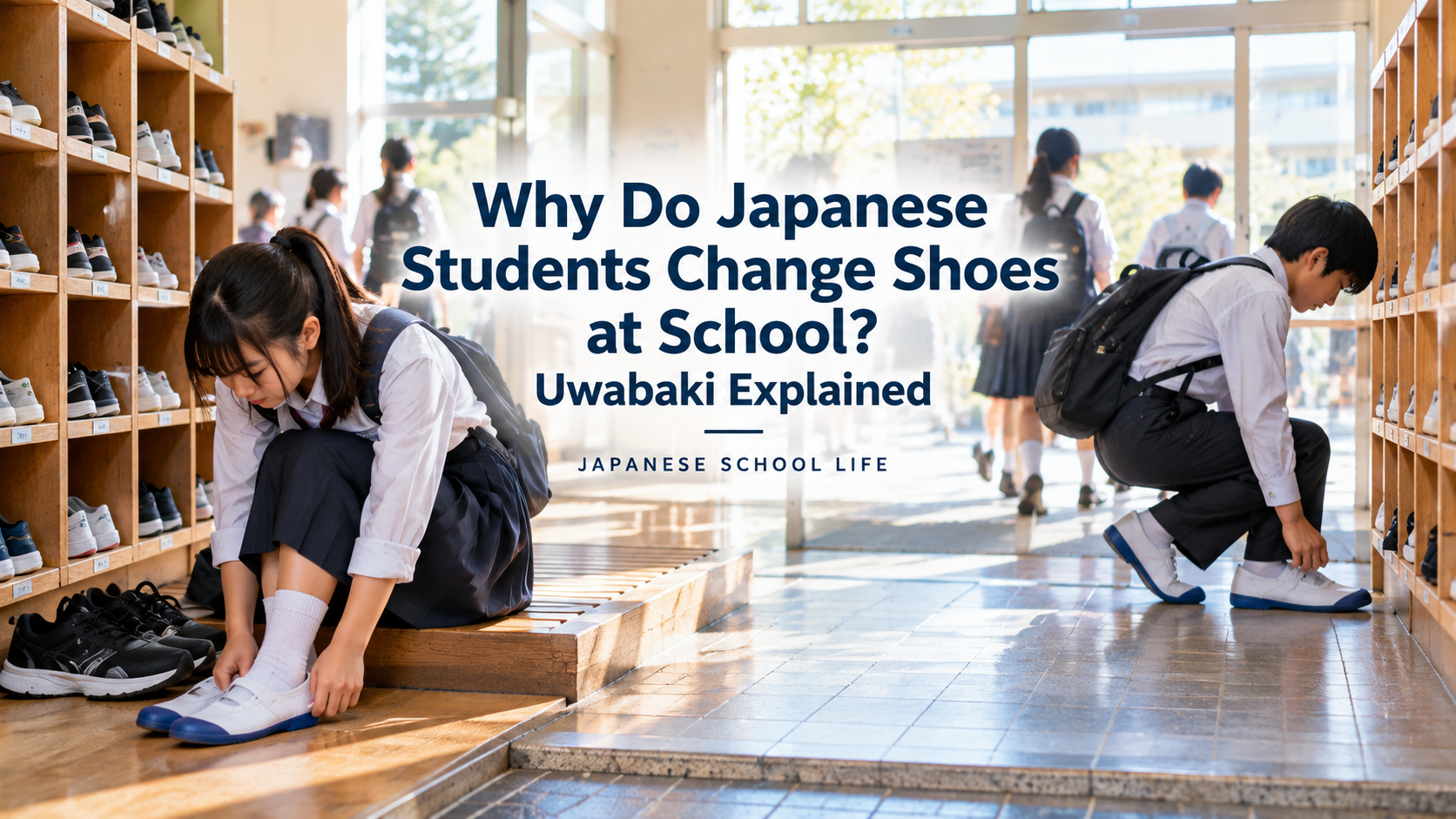
If you’ve watched a Japanese school anime or seen photos of schools in Japan, you may have noticed something unusual near the entrance: rows of shoe lockers, students taking off their outdoor shoes, and simple white shoes worn inside the building.
Those indoor shoes are commonly called uwabaki (上履き).
To a Japanese student, changing into uwabaki can feel so ordinary that it barely seems worth explaining. You arrive at school, change your shoes, and head to class.
But from outside Japan, the routine raises some obvious questions.
Why change shoes at all? Why do so many uwabaki look alike? Why do students sometimes need yet another pair for the gym? And are those anime scenes involving love letters and Valentine’s chocolate in shoe lockers based on reality?
The answers reveal quite a lot about everyday Japanese school life.
QUICK ANSWER
Uwabaki (上履き) are indoor shoes used in many Japanese schools. Students typically change from outdoor shoes near the school entrance and store their outdoor footwear in individual shoe compartments. Rules vary by school, and some schools no longer require separate indoor shoes.
What Are Uwabaki?
Uwabaki are indoor shoes used in many Japanese schools.
One of the most familiar styles is a simple white canvas shoe with a rubber sole and colored accents. This is also the type I wore.
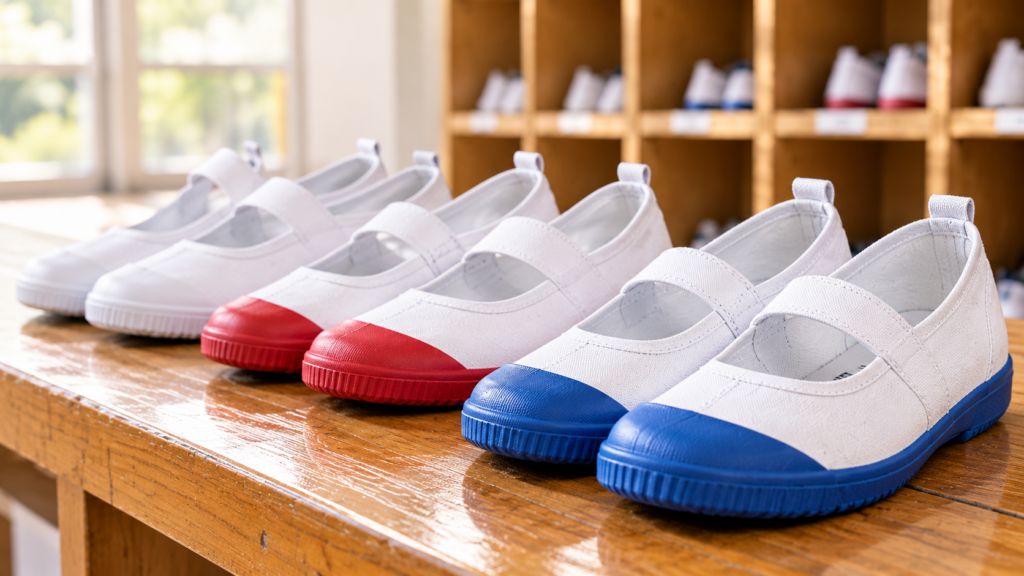
At my elementary school, boys wore blue-accented shoes and girls wore red-accented ones. From junior high school onward, colors were assigned by school year instead.
So there is no universal rule that a particular uwabaki color always means the same thing.
We also wrote our names on them.
In elementary school, my family name was written on the toe and heel. In junior high and high school, I remember writing it on the heel or inside the shoe.
Schools commonly ask students to label personal belongings with their names, so writing directly on school items is nothing unusual for many Japanese children.
Why Do Japanese Students Change Shoes at School?
The easiest way to understand uwabaki is to follow a student into school.
My routine was simple:
Outdoor shoes → shoe locker → uwabaki → classroom
Each student had an individual shoe compartment near the entrance. I took off my outdoor shoes, stored them there, changed into my uwabaki, and headed inside. At the end of the day, I reversed the process.
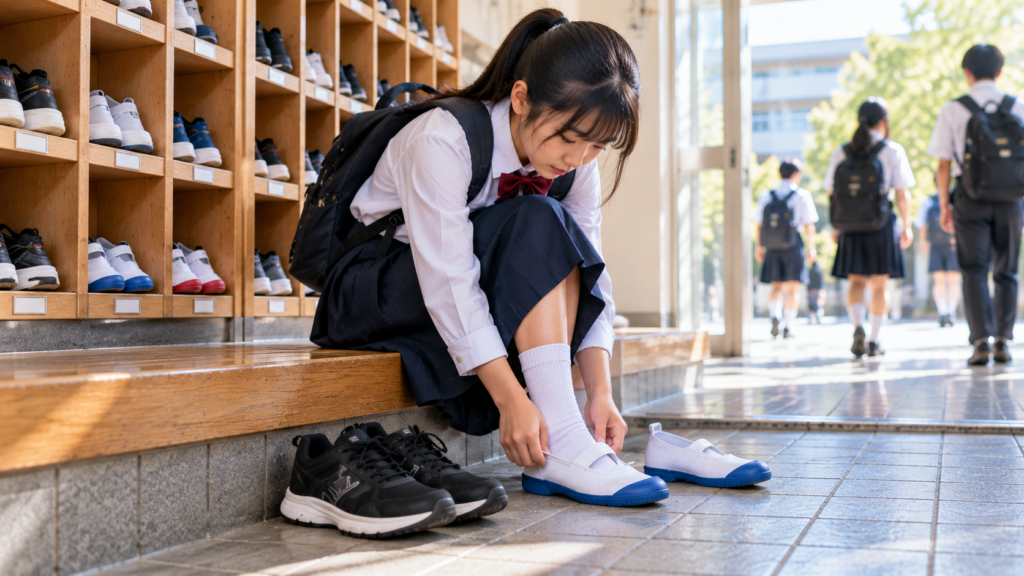
These shoe-storage areas are commonly associated with the word getabako (下駄箱). Despite the name—geta are traditional Japanese wooden footwear—the compartments in a modern school simply hold students’ outdoor shoes.
The basic idea may feel familiar if you have ever entered a Japanese home.
At home, the genkan (玄関) marks a clear transition between outside and inside. Outdoor shoes generally do not continue into the main living area.
A school is not a home, and this does not mean that school footwear customs simply come from the household genkan. But the distinction between outdoor and indoor space is a familiar one in Japan.
There is also a practical benefit. Shoes that have been outside do not continually carry dirt, mud, and water through classrooms and corridors.
Still, reducing the custom to “Japanese people value cleanliness” would be too simplistic. Uwabaki make more sense as a combination of practical cleanliness, school routine, and a familiar separation between outdoor and indoor spaces.
Sometimes Uwabaki Aren’t Enough
Changing into indoor shoes does not necessarily mean you are finished changing shoes for the day.
In elementary school, I did not have separate gym shoes. From junior high school onward, however, I did.
I brought them with me to the gymnasium and changed just before entering.
ONE STUDENT, MULTIPLE SHOES
Outdoor shoes → Uwabaki → Gym shoes
Depending on the school and activity, a student may change from outdoor shoes into uwabaki—and then change again before entering the gym.
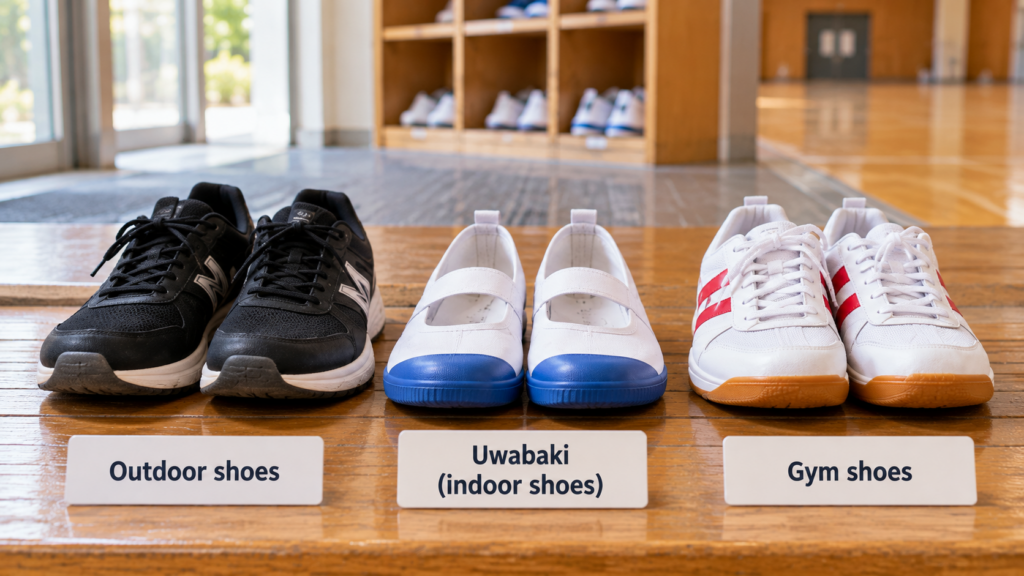
Toilets add another variation. Some schools use separate toilet slippers, while others allow students to keep their regular indoor shoes on. I experienced different rules at different schools.
Teachers did not necessarily wear the same white uwabaki as students, either. From what I remember, many used sneakers or similar shoes reserved for indoor use, while some wore sandals.
Visitors also encounter the indoor-outdoor divide. During events such as class observations, some parents brought their own slippers, while schools could also provide slippers for visitors.
The details vary, but the basic idea is easy to understand: different parts of a school can have different footwear rules.
The Friday Uwabaki Routine
Uwabaki do not stay white for long.
For me, Friday usually meant taking them home.
I would bring my uwabaki back from school and scrub them myself with a brush, then take them back for the following week.
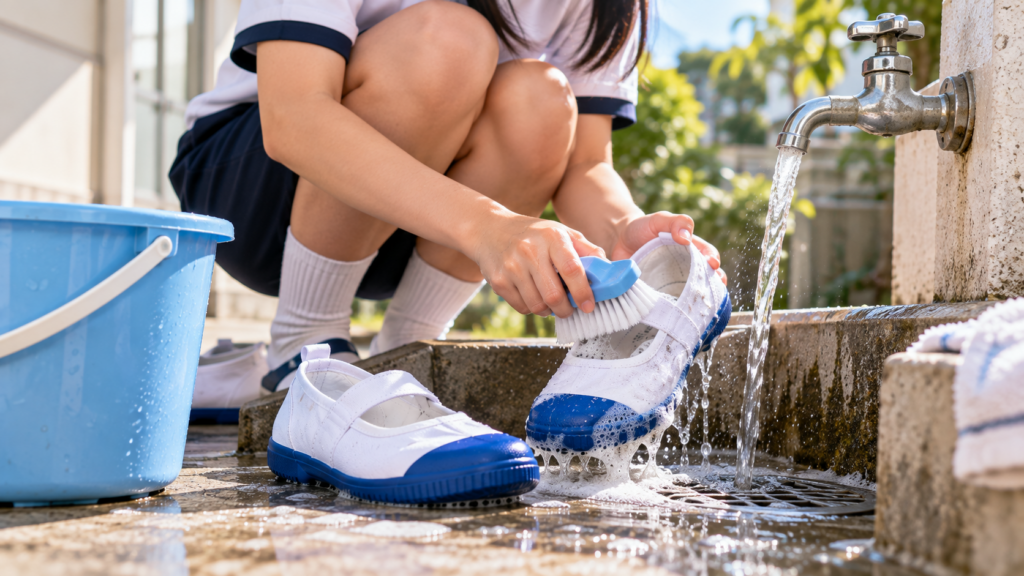
“Usually” is important.
There were also Fridays when I simply left them at school.
That small detail is worth mentioning because Japanese school customs can sometimes sound more ritualized from overseas than they feel to the children actually doing them. Sometimes a child is simply a child who leaves his shoes at school.
Students can forget to bring them back, too.
When I forgot my uwabaki, I told a teacher and borrowed slippers.
No cultural crisis. I had simply forgotten my shoes.
This weekly routine also explains another common school item: an uwabaki bag, used to carry indoor shoes between school and home. Japanese government school-expenditure surveys even list indoor shoes and bags for carrying them among school-related items.
For many children, uwabaki become part of the rhythm of the school week: wear them around school, take them home periodically, wash them, and bring them back.
Are Those Anime Shoe-Locker Scenes Real?
This is where everyday school life and fiction meet.
The rows of shoe lockers seen in anime and manga are not an invention. Japanese schools really can have entrance areas filled with individual compartments for students’ shoes, and students really do change footwear there.
The amount of drama taking place around them is another matter.
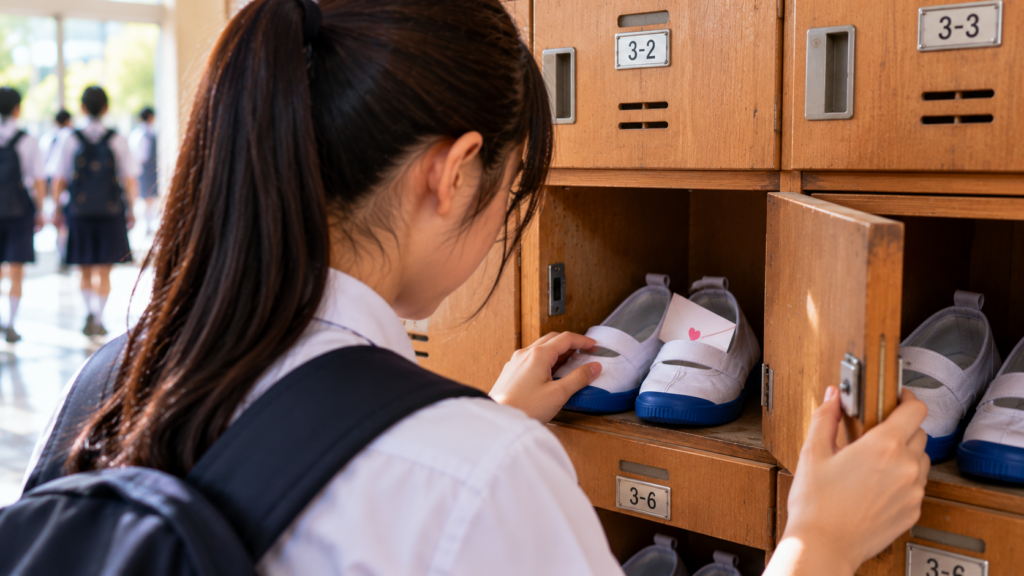
A familiar fictional image—not necessarily an everyday school experience.
Anime and manga sometimes turn the shoe locker into a convenient setting for romance—a place to leave a note, a love letter, or even a Valentine’s surprise.
The setting is real. The frequency of those events is harder to generalize.
In my own school life, I heard about a friend putting a love letter into someone’s shoe locker, but I never actually witnessed it.
As for Valentine’s chocolate, I do not remember seeing or hearing about anyone around me putting it into a shoe locker.
Most of the time, my shoe locker was exactly what it sounds like:
a place for shoes.
That contrast is more useful than simply asking whether anime is “accurate.” Fiction can take an entirely real piece of Japanese school life and use it as the stage for something much more dramatic.
Not Every Japanese School Does It the Same Way
Uwabaki are common, but they are not a universal rule followed identically by every Japanese school.
Schools can differ in the type of indoor footwear they require, how colors are assigned, whether separate gym shoes are needed, whether toilets have dedicated slippers, and even whether students change into indoor shoes at all.
NOT EVERY SCHOOL USES UWABAKI
Some Japanese schools use a “one-shoe” system instead, allowing students to remain in the shoes they wore to school. Uwabaki are common, but they are not universal.
Schools in Tokyo’s Shinagawa Ward, for example, have experimented with or introduced this system. Reported reasons include reducing congestion around shoe lockers, making movement between indoors and outdoors easier, reducing the need to wash uwabaki, and lowering the burden of buying additional footwear.
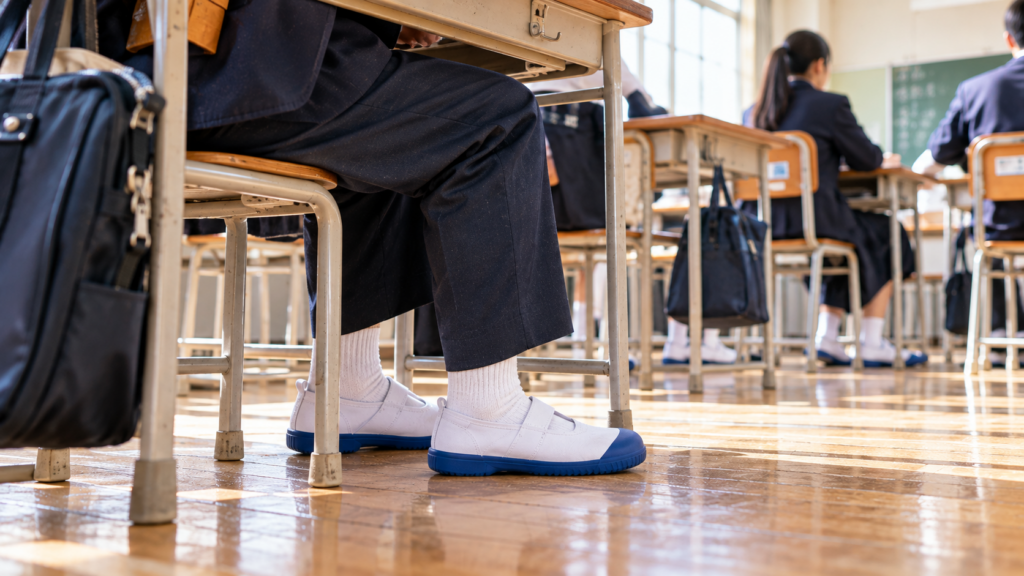
So while changing into uwabaki remains a familiar part of Japanese school life, it should not be treated as a rule followed by every school in Japan.
My own experience included blue and red shoes in elementary school, year-based colors later, separate gym shoes from junior high school onward, different toilet rules at different schools, and regular trips home with my uwabaki for a scrub with a brush.
Another Japanese student may remember a different system.
Common customs exist, but individual schools still make their own rules.
A Small Pair of Shoes Tells a Bigger Story
Uwabaki are an extremely ordinary object.
For most Japanese students, changing shoes at school is probably not something they spend much time thinking about. I certainly didn’t.
But viewed from outside Japan, that ordinary habit connects several parts of everyday school life: the boundary between outdoors and indoors, the shoe lockers at the entrance, names written on personal belongings, different footwear for different spaces, and the regular trip home for washing.
It also shows how anime can work as a window into Japan.
The romantic event happening at the shoe locker may be fiction, but the locker—and the shoes inside it—are very real.
So the next time you see a student in a Japanese school anime stop at a wall of shoe lockers and change into a pair of simple white shoes, you’ll know what they are.
They’re uwabaki—one of the most ordinary signs that the Japanese school day is about to begin.