
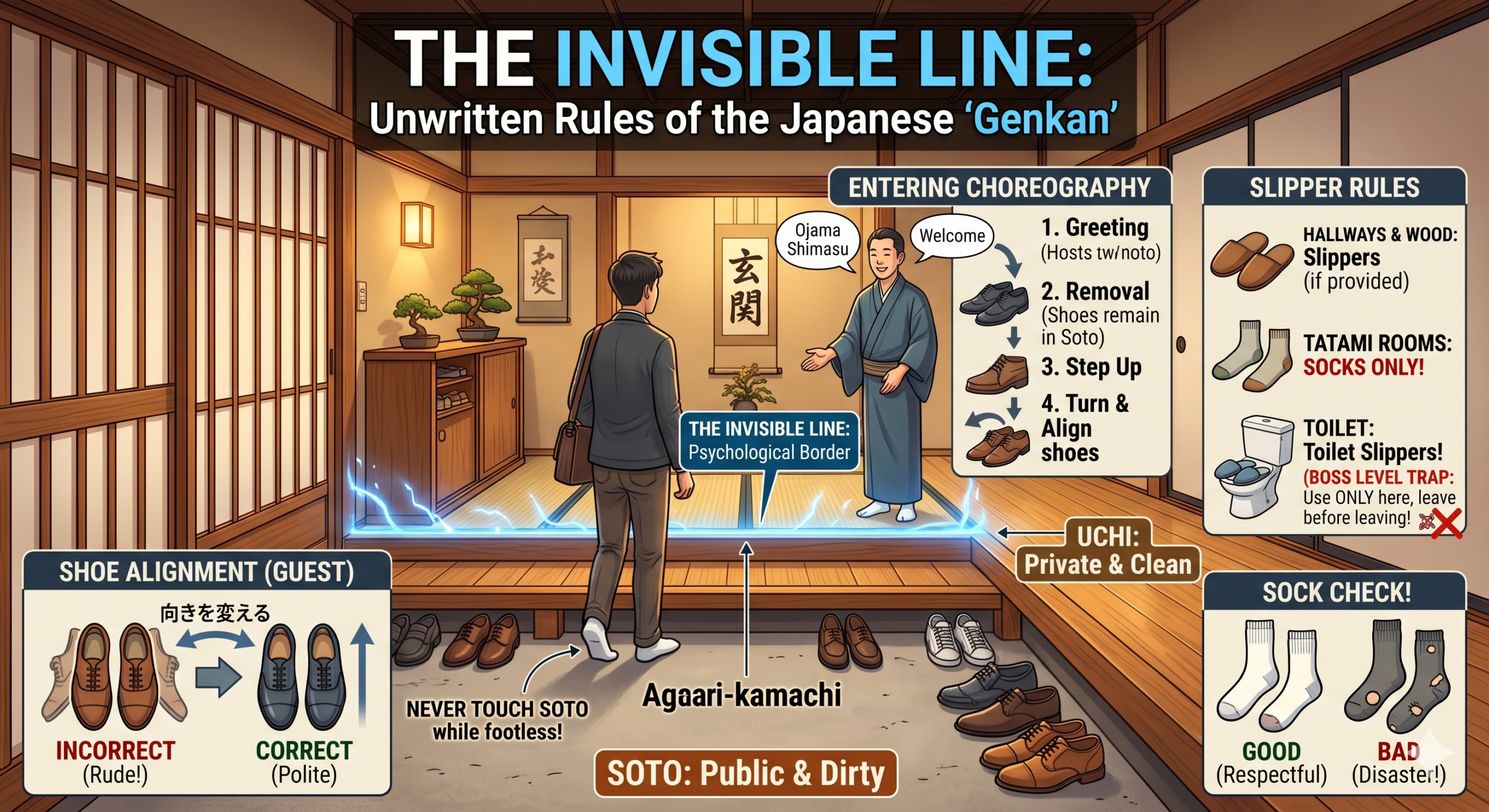
Imagine stepping through the front door of your home after a long, exhausting day. If you live in North America or Europe, you might walk straight into the living room, perhaps kicking off your shoes near the sofa, or you might even walk all the way to your bedroom with your sneakers still laced up. Your home is your castle, and the floor is simply the floor.
In Japan, however, crossing the threshold of a house is not merely a physical movement; it is a profound cultural transition. Before you can enter the living space of any Japanese home, apartment, school, or even certain clinics and restaurants, you must first pass through a highly ritualized decompression zone.
This space is called the genkan .
To a visitor, it might just look like a small entryway where people leave their shoes. But to understand the genkan is to understand one of the most fundamental psychological and cultural blueprints of Japanese society: the strict division between the outside world and the inside sanctuary. Let us decode the invisible lines, the unwritten rules, and the occasional traps of the Japanese entryway.
The Physical and Psychological Border
To grasp why the genkan is so important, you must first understand the Japanese concepts of Soto and Uchi.
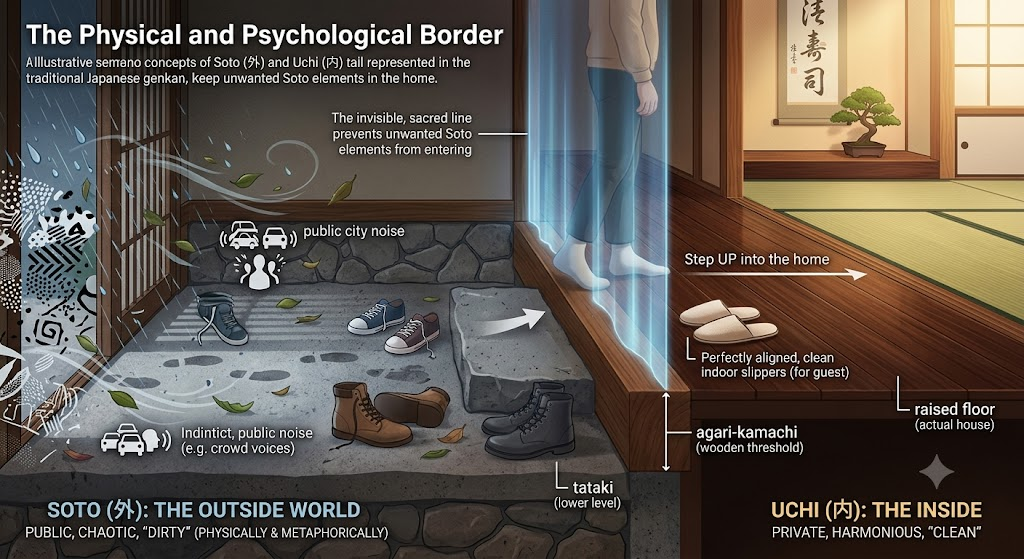
Soto refers to the outside world. It is public, chaotic, and inherently “dirty” (both physically and metaphorically). Uchi refers to the inside. It is private, harmonious, and “clean.” The genkan serves as the absolute border control between these two dimensions. It is the architectural manifestation of leaving the chaos of the outside world behind before stepping into the purity of the home.
Physically, a traditional genkan is designed to enforce this separation. When you open the front door, you step onto a lower level called the tataki. Historically made of pounded earth, modern tataki are usually made of concrete, tile, or stone. This lower level is still considered Soto (outside).
A few inches above the tataki is the raised floor of the actual house, often marked by a wooden threshold called the agari-kamachi. This raised floor is Uchi (inside). The vertical drop between the two floors is the invisible, sacred line. You do not simply walk into a Japanese home; you step up into it.
The Choreography of Entering: A Professional’s Perspective
Understanding the rules of the genkan in theory is easy, but executing them flawlessly requires a specific choreography.
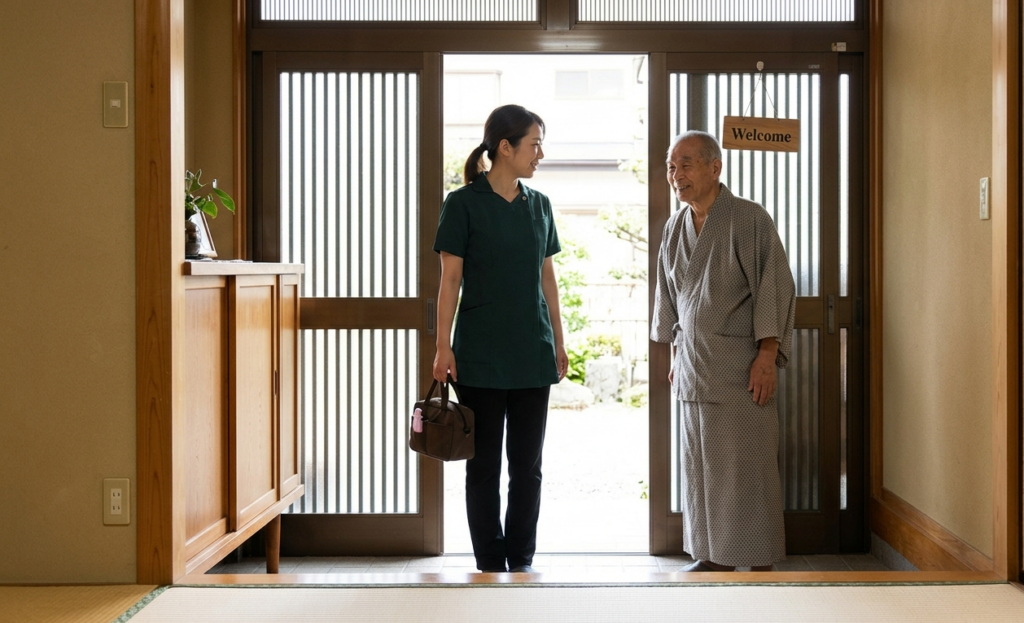
In my daily routine as a visiting massage therapist, I travel across various neighborhoods in Saitama Prefecture, primarily within Saitama City, visiting the private homes of my clients. From modern high-rise apartments to deeply traditional, decades-old wooden houses, the genkan is the very first interaction I have with my client’s personal sanctuary.
Because I cross these invisible borders multiple times a day, I have learned that the way you handle yourself in the genkan instantly communicates your level of respect, professionalism, and cultural awareness. When you visit a Japanese home, you are performing a silent dance, and the steps are non-negotiable.
Here is the exact sequence of a polite entry:
- The Greeting: As you open the door, you call out, “Gomen kudasai” (Excuse me, is anyone home?) or “Ojama shimasu” (I am going to disturb you).
- The Removal: You step onto the lower tataki and remove your shoes. Crucial rule: You must never, ever let your bare feet or socks touch the dirty tataki once your shoes are off. You must slip your foot out of the shoe and place it directly onto the raised floor.
- The Turn: This is where many foreigners make a mistake. You might be tempted to turn your back to your host to align your shoes facing the door. In Japanese etiquette, pointing your backside directly at your host immediately upon entering is considered rude. Instead, you step up onto the raised floor facing the host, kneel down at an angle, and gracefully turn your shoes around with your hands.
- The Alignment: You place your shoes neatly against the edge of the step, pointing directly toward the front door. This signifies that you are ready to leave smoothly when the time comes, and it keeps the entryway looking immaculate.
The Unwritten Rules and Hidden Traps
If you are planning to visit Japan, mastering the basic shoe-removal dance will win you immense respect. However, the culture of the genkan extends beyond just taking off your sneakers. There are hidden rules that you must keep in mind to avoid cultural faux pas.
1. The State of Your Socks Matters
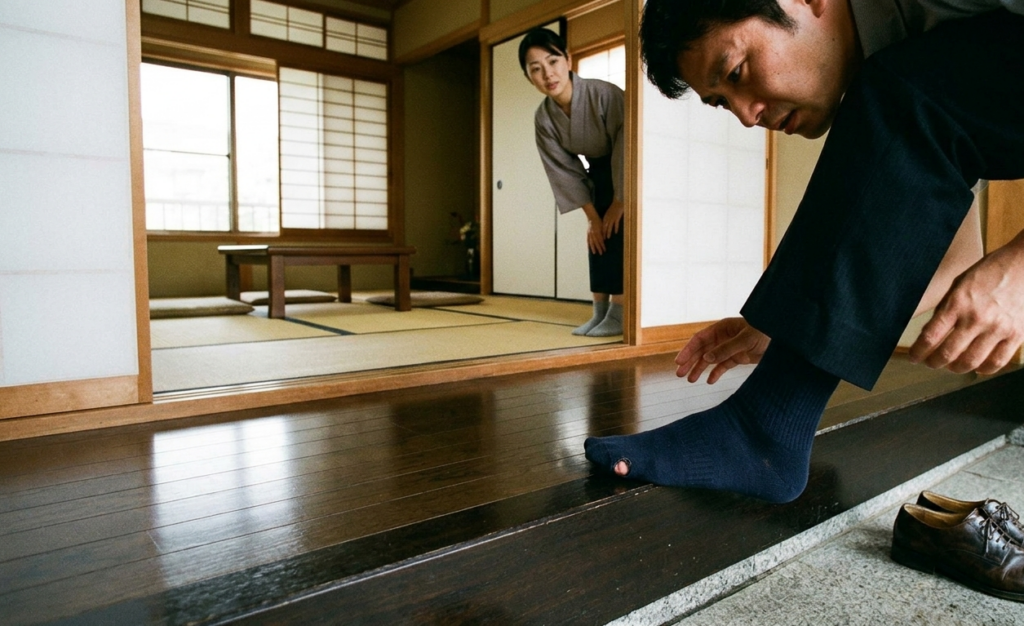
In western countries, if you have a small hole in the toe of your sock, or if your socks are mismatched, you can usually hide it inside your shoes all day. In Japan, your socks are a highly visible piece of your wardrobe. Because shoes are removed so frequently—not just in homes, but in traditional restaurants (izakaya), temples, and tea rooms—wearing clean, hole-free, and respectable socks is a daily necessity. Walking into someone’s pristine home with a gaping hole in your toe is a fast track to profound embarrassment.
2. The Slipper Situation (or Lack Thereof)
Once you step up into the Uchi (inside), your host might provide you with a pair of house slippers to wear while walking through hallways or on wooden floors. However, this is not a universal guarantee. Many modern households do not use slippers at all, expecting guests to walk around the house simply in their socks. (This is exactly why the rule mentioned above about having hole-free socks is so critical!)
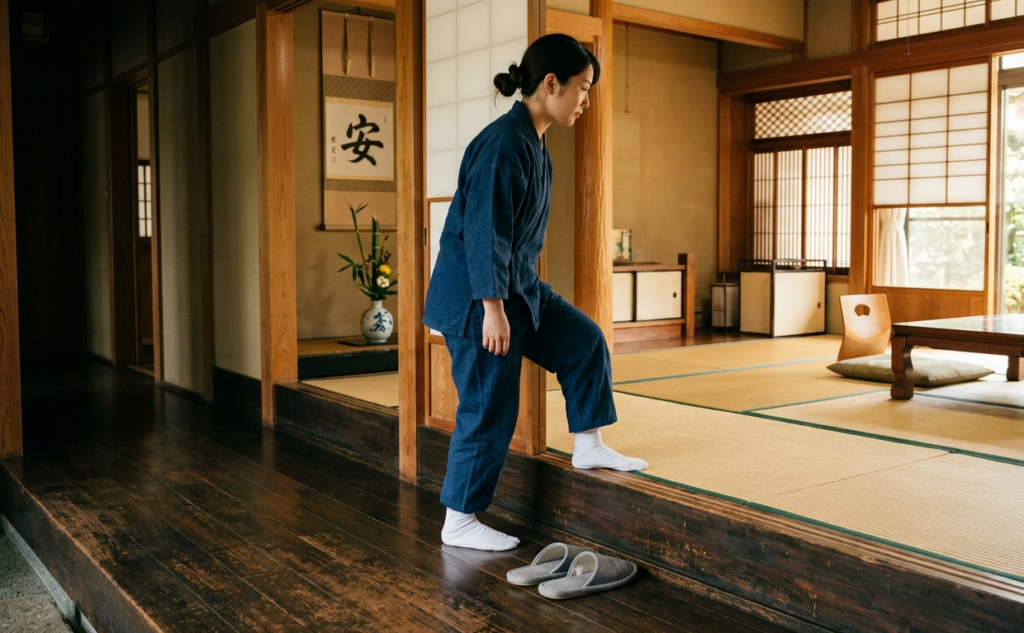
Whether you are wearing provided slippers or just your socks, there is a strict exception when it comes to Tatami mats. If you are invited into a traditional Japanese room featuring woven tatami flooring, you must take off your house slippers (if you are wearing them) before stepping onto the mats. Tatami is delicate and is considered the purest of all indoor spaces. You walk on tatami only in your socks. (While bare feet are sometimes acceptable in casual situations, wearing clean socks is always the safest and most polite choice for a guest).
3. The Boss Level Trap: Toilet Slippers
If you manage to navigate the genkan, the alignment of the shoes, and the tatami rules without making a mistake, Japan has one final test waiting for you: the bathroom.
In Japanese homes, the toilet area is considered its own micro-zone of Soto (dirty/outside) existing within the Uchi (clean/inside). Therefore, you cannot wear your regular house slippers (or your socks) directly into the restroom. Inside the bathroom, you will find a specific, dedicated pair of “toilet slippers.”
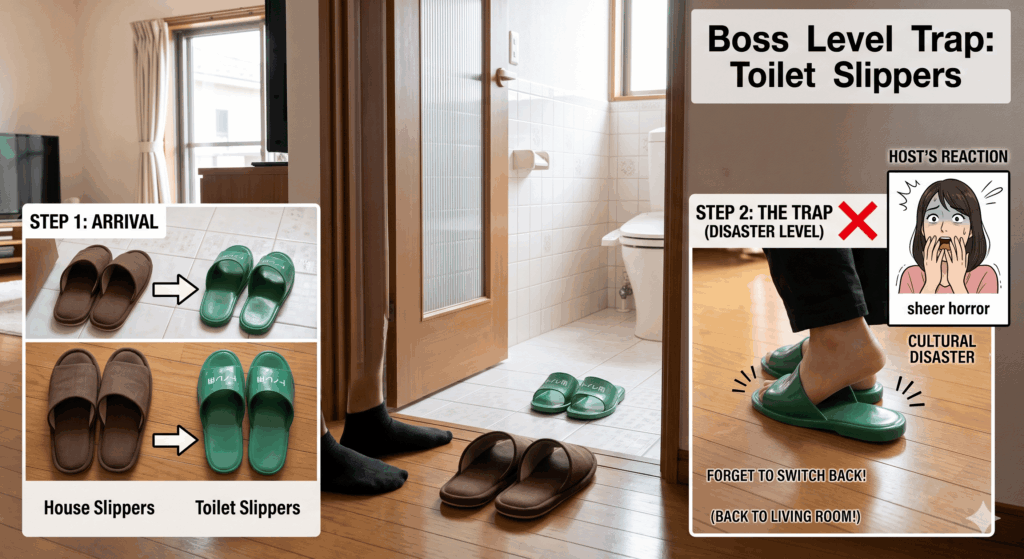
You must leave your house slippers outside the bathroom door, put on the toilet slippers, do your business, and then—this is the most critical part—take the toilet slippers off before leaving the bathroom.
Forgetting to switch back and accidentally wearing the plastic toilet slippers back into the living room or kitchen is the ultimate Japanese cultural disaster. It is the equivalent of walking across someone’s dining table with muddy boots. It happens to almost every foreigner at least once, and the look of sheer horror on your Japanese host’s face will ensure you never make the mistake again.
A Ritual of Respect and Mindfulness
As modern Japanese architecture evolves, the sprawling, grand genkan of the past are sometimes shrinking into small, flat entryways in compact city apartments. Yet, the invisible line remains unbreakable. Even if the height difference between the tataki and the living floor is only a few millimeters, the psychological boundary stands tall.
The next time you visit Japan and find yourself balancing on one foot, trying to politely spin your shoes around without falling over, remember that you are not just participating in a hygiene practice. You are participating in a centuries-old ritual of mindfulness. You are actively shedding the dust, the stress, and the chaos of the outside world, and stepping respectfully into the harmony of the home.
And whatever you do, do not forget to check your socks before you leave your hotel.
Comments