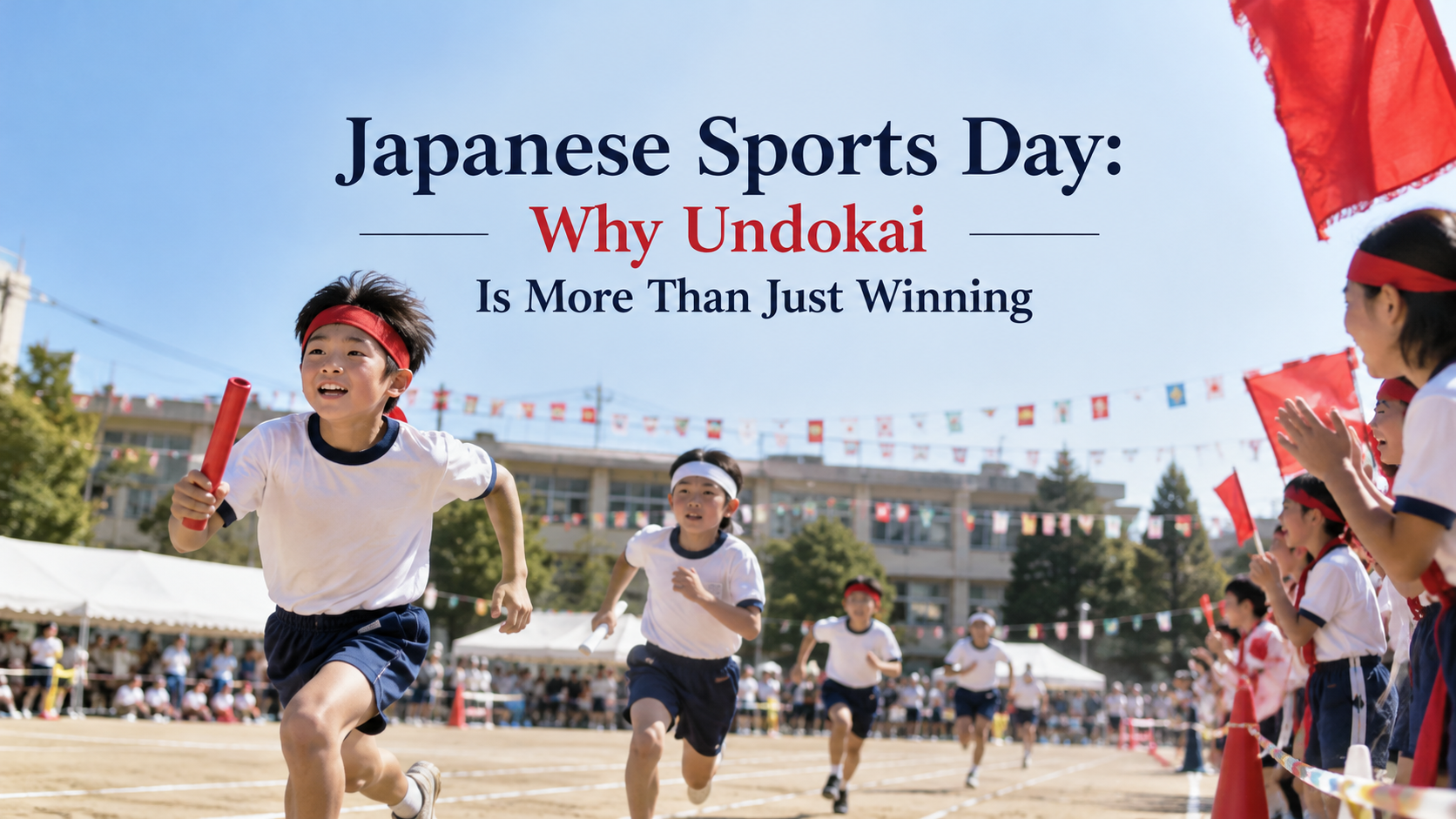
I was a fast runner when I was in school, and sports day was one of the events I genuinely looked forward to. I loved sprint races and relays. Even now, I remember the excitement of winning a relay with my teammates.
But I didn’t enjoy everything about it.
I disliked kumi taiso, the group gymnastics performances we had to rehearse repeatedly. And although I enjoyed the actual event, I often wished the practices would finish sooner.
That was Japanese sports day as I remember it: exciting, sometimes tiring, and occasionally a little frustrating.
In Japan, this event is called undokai (運動会). It combines athletic competitions with dancing, cheering, team activities, and performances that students prepare for in advance.
So why do Japanese schools put so much effort into what might seem like an ordinary sports day?
What Is Undokai? Japan’s School Sports Day
Undokai is a Japanese school sports day involving races, team competitions, and group performances. Unlike an athletics meet focused mainly on individual sporting results, it usually involves students from across the school.
Elementary schools commonly call the event undokai, while junior high and high schools often use taiikusai (体育祭), meaning sports festival. The distinction is common, but not universal.
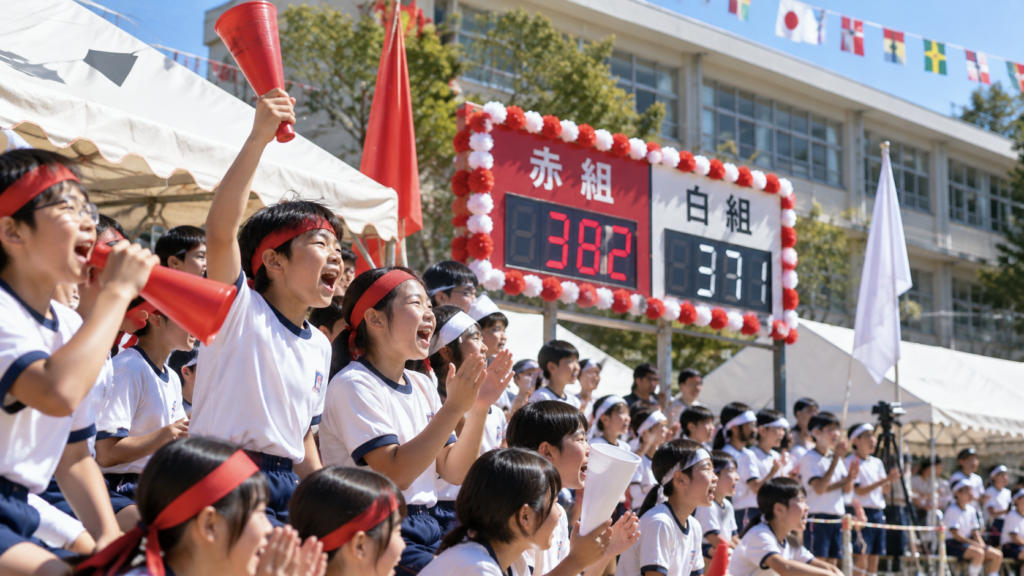
At my elementary and junior high schools, students competed in red and white teams. In high school, we had teams identified by class colors, with students from all three grades joining the same team.
Each team earned points throughout the day. There was a scoreboard, and the final result was announced at the end.
Undokai is often held in spring or autumn, although the timing varies. Mine took place in May or around September and October, depending on the school.
The modern tradition has roots in the Meiji period (1868–1912), when Western-style sports and physical education were introduced and adapted in Japan. Over time, school sports days came to include not only athletics but also gymnastics, games, dancing, and organized group activities.
What began as part of Japan’s modern physical education developed into a distinctive school event.
Why Does Everyone Participate?
One striking feature of Japanese sports day is the emphasis on participation.
At the schools I attended, everyone joined in. Being bad at sports wasn’t, by itself, a reason to skip the event.
Some children were fast, while others struggled with running. I remember classmates cheering for slower runners rather than making fun of them.
Of course, athletic ability still mattered.
Fast runners were often selected for relay teams, and being chosen felt special. I enjoyed those races because running was something I could do well.
So undokai combined two things that might seem contradictory: competition and participation.
Some students stood out as athletes, but the event wasn’t organized only for them.
Japan’s Ministry of Education identifies cooperation, responsibility, group discipline, and solidarity among the educational aims of school sports activities.
That emphasis on shared responsibility also appears in another part of Japanese school life: why Japanese students clean their own schools.
A 2026 study by Tanimoto, Kakoi, and Matsuda examined reflections from 932 students at two elementary schools and one junior high school. The researchers found themes related to personal development, relationships, and school community, with differences between age groups and students’ attitudes toward the event.
The study examined what students reported learning; it did not establish that every participant benefited equally.
That distinction matters.
When I was a child, I wasn’t thinking about cooperation or responsibility. I wanted to run well, help my team win, and enjoy the day.
And while I remember cheering for classmates who weren’t good at running, I wouldn’t assume that every child enjoys being watched or competing in front of others.
For some students, sports day can be exciting. For others, it may be something they would rather avoid.
From Relay Races to Human Pyramids
Some undokai competitions would look familiar almost anywhere.
There are sprint races, relays, tug-of-war competitions, and obstacle courses.
Others may surprise visitors who have never seen a Japanese school sports day.
In tama-ire (玉入れ), students throw small balls into baskets raised above the ground. In oodama-korogashi (大玉転がし), teams work together to roll an enormous ball across the field.
Karimono kyoso (借り物競走) is a race in which participants must find an item—or sometimes a person—matching a written instruction before returning to the finish line.
Then there are the more physically demanding activities.
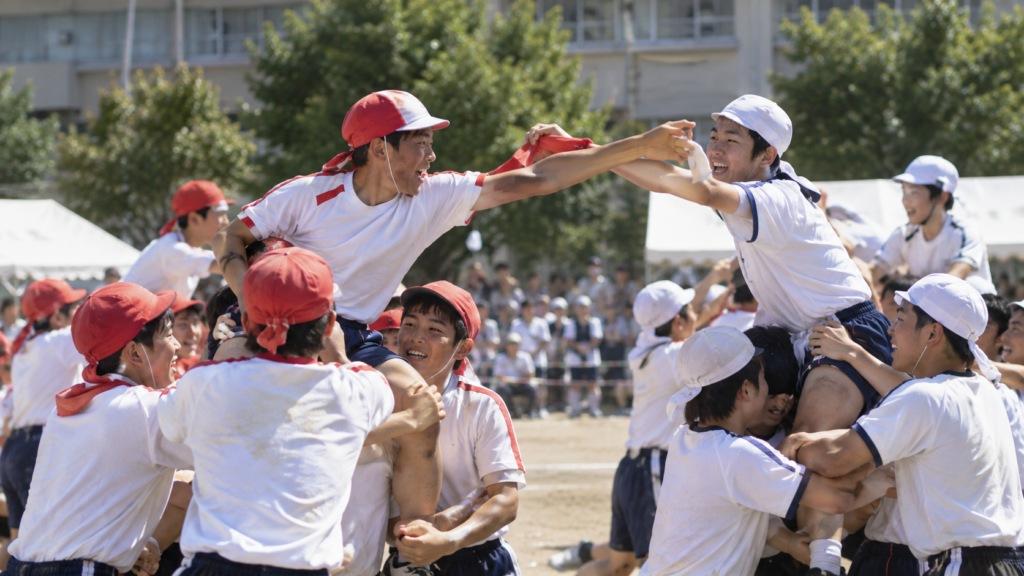
In kibasen (騎馬戦), several students form a human horse, carrying a teammate who competes against other riders, often by trying to capture their headbands.
Botaoshi (棒倒し) is a team competition in which one side defends a pole while the other tries to bring it down. It is an intense event and isn’t part of every school’s program.
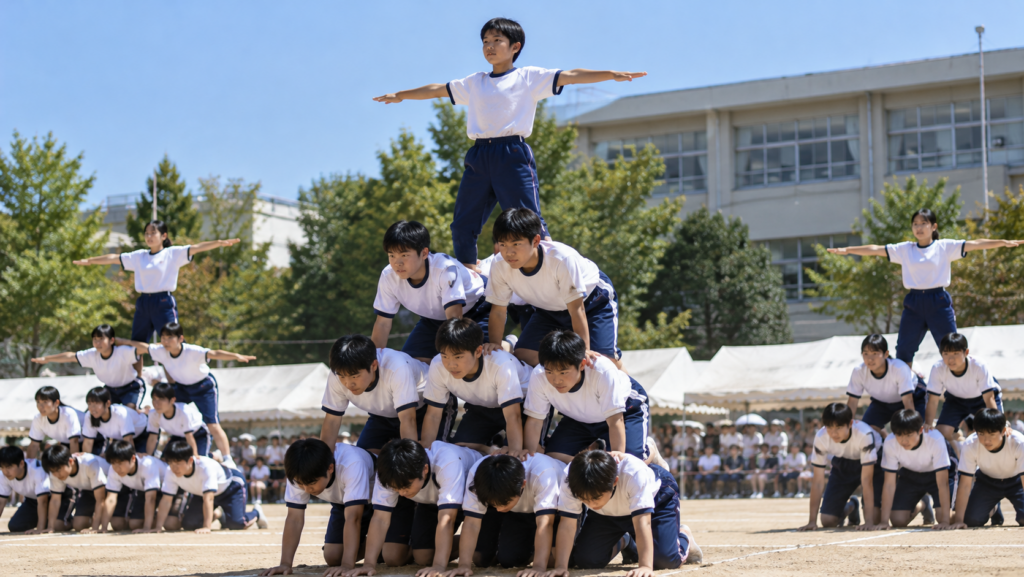
I experienced both, along with kumi taiso (組体操), a form of group gymnastics involving coordinated formations.
Some traditional routines included human pyramids, with students supporting one another in carefully arranged structures.
I never particularly liked kumi taiso.
Safety concerns have led schools and education authorities to reconsider higher-risk activities, particularly large group gymnastics formations.
Japan’s Sports Agency has repeatedly instructed schools to refrain from conducting kumi taiso when appropriate safety measures cannot be ensured.
That doesn’t mean all group gymnastics have been banned nationwide. What schools include, and how they manage the risks, varies.
Sports day also includes activities that have little to do with athletic ability.
You may see synchronized dances, cheering performances, and students waving flags or chanting for their teams.
I remember doing bamboo dancing, and younger students at my schools performed dances too.
For a child who enjoys running, the races might be the highlight. For someone else, it could be the dancing or cheering.
Undokai gives students several different ways to take part, even if not everyone enjoys every activity.
Why Do Japanese Schools Practice So Much?
For someone unfamiliar with undokai, the amount of preparation may seem surprising.
Why rehearse so much for a sports day?
At my schools, I remember preparations beginning roughly three months before the event. That is my recollection, not a standard schedule followed by Japanese schools nationwide.
Most practices took place during physical education classes. Cheering activities sometimes continued after school.
We rehearsed dances, group gymnastics, and other team activities several times. Marching and lining up required less practice, at least in my experience.
The event itself also had formal elements: an opening ceremony, speeches, a student representative’s oath, and group exercises such as radio taiso, a familiar Japanese calisthenics routine.
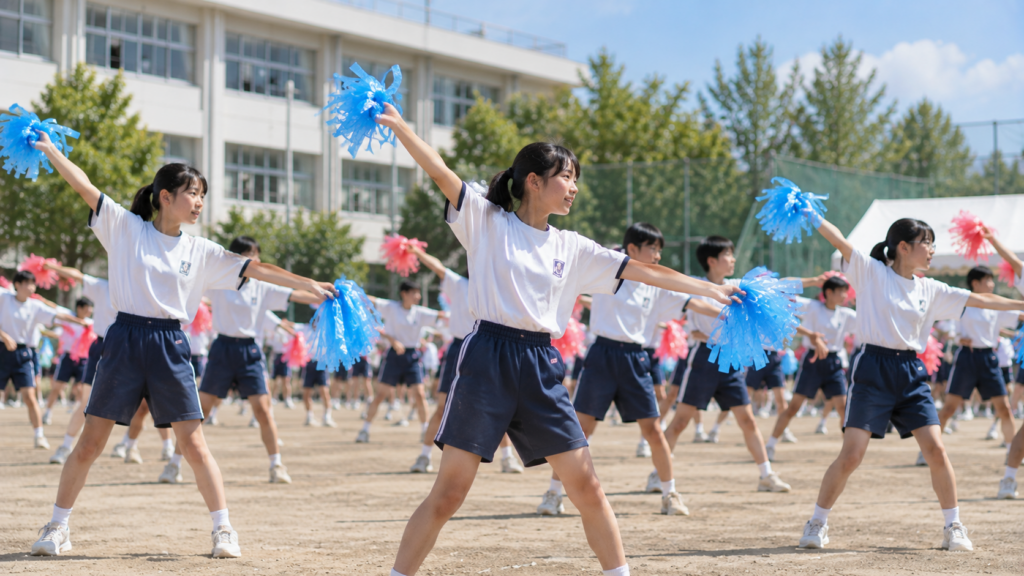
From the school’s perspective, the preparation is part of the educational experience.
Students learn to follow instructions, coordinate movements, take responsibility for their roles, and work with classmates toward a common event.
But the children’s experience may be less philosophical.
I often wanted the rehearsals to finish as quickly as possible.
I enjoyed running, but that didn’t make me enthusiastic about every dance practice or gymnastics session.
Looking back, I can understand why teachers considered the preparation important. At the time, I simply thought we were getting ready for a competition.
That difference between the school’s goals and a child’s everyday experience is something I remember from other parts of Japanese school life, too.
Curious about other everyday Japanese school customs? Learn why Japanese students change shoes at school.
When Sports Day Becomes a Family Event
At elementary school, undokai was also a family occasion.
My parents came to watch every year. Some classmates had grandparents in attendance as well.
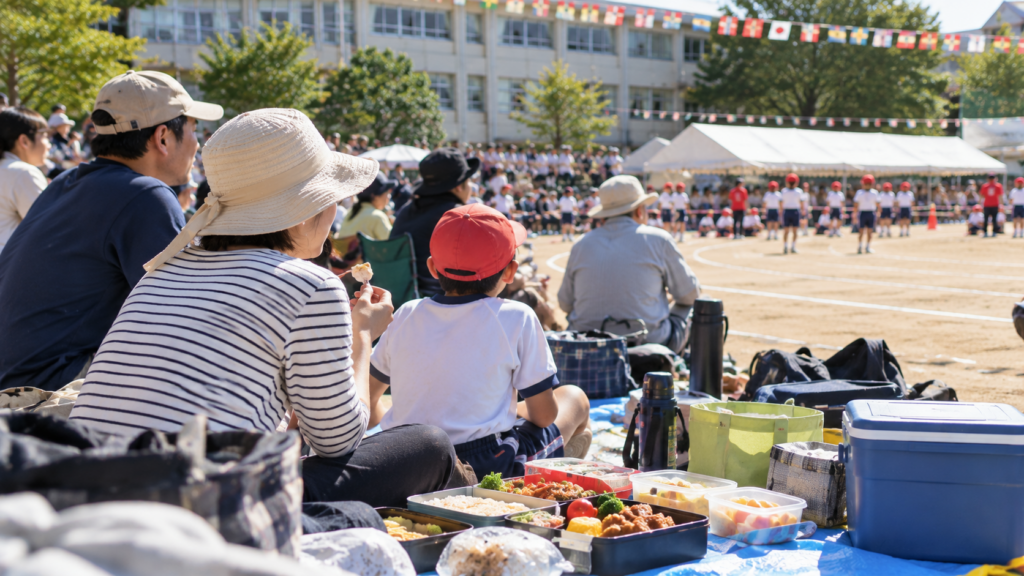
Families sometimes arrived early to secure a good viewing spot, spreading picnic sheets in designated areas of the school grounds.
Lunch could be part of the experience.
I remember homemade bento lunches containing favorite foods such as tamagoyaki, a Japanese rolled omelet, and karaage, Japanese fried chicken.
There were also competitions involving parents, so adults weren’t always just spectators.
But the atmosphere changed as I grew older.
My parents attended my junior high school sports festivals only occasionally. At my high school, people from outside the student body weren’t admitted.
The high school event felt more student-led, with teams organized by class colors and students taking a greater role in running the occasion.
These are memories from the schools I attended, not universal rules. Lunch arrangements, parent attendance, and student responsibilities differ between schools.
Still, the change was noticeable to me.
In elementary school, sports day felt partly like a family event. By high school, it was much more about classmates.
If you’re interested in other everyday responsibilities and traditions at Japanese schools, you can also read about what Japanese school lunch is really like.
How Undokai Is Changing in Modern Japan
The sports days I remember aren’t necessarily identical to those held in Japanese schools today.
Heat is an important concern.
Schools need to consider weather conditions, hydration, rest breaks, and the intensity of activities to reduce the risk of heat-related illness.
Depending on local conditions, schools may adjust event dates, shorten programs, or change how competitions are organized.
Safety concerns have also affected the choice of activities.
High human pyramids and other physically demanding performances have attracted scrutiny because of the risk of injury.
The Sports Agency’s guidance makes clear that schools should not conduct group gymnastics when appropriate safety measures cannot be ensured.
There are practical considerations, too.
A large sports day requires preparation by teachers and students. Schools must decide how much time to devote to rehearsals, how many events to include, and how to accommodate families.
Some schools have moved toward shorter programs, while others continue to hold more traditional events.
There isn’t one nationwide model that every school follows.
The details may change, but races, team competition, cheering, and shared preparation remain recognizable features of undokai.
Japan Is Bringing Undokai to Other Countries
Undokai has also traveled beyond Japan.
Through the Japan International Cooperation Agency (JICA) and its volunteer programs, Japanese-style sports days have been introduced in other countries.
In Malawi, a Japanese-style undokai was first held in 2015 under the SPORT FOR TOMORROW initiative. In May 2018, Japanese volunteers organized another event with local schools in the Kasungu district.
According to Japan’s Ministry of Foreign Affairs, one motivation was to give children an opportunity to work enthusiastically toward a shared activity with their classmates.
In Timor-Leste, JICA volunteers have also organized undokai events with local students and educators.
A December 2024 JICA report described an event involving approximately 60 students from four schools, with activities including an obstacle course, ball toss, tug-of-war, and relay races. Local university students helped with the organization.
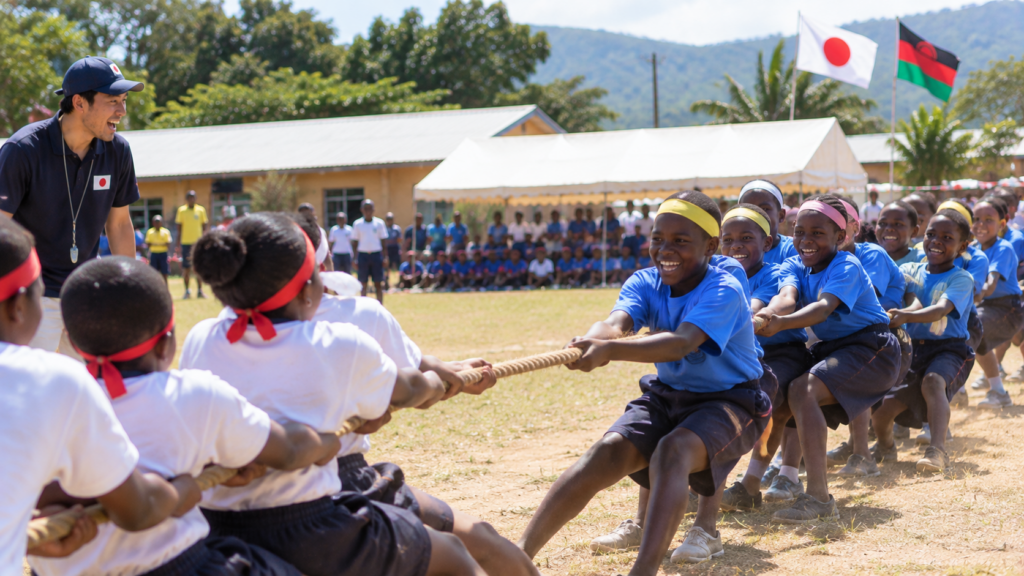
The idea isn’t necessarily to reproduce a Japanese sports day exactly.
The activities can be adapted to local schools, resources, and communities.
There is an interesting connection to undokai’s history.
Japan developed its own school sports tradition partly from Western-style athletics. Today, elements of that tradition are being introduced elsewhere.
And the part being shared isn’t simply the races. It’s the experience of preparing, participating, and working together.
More Than a Day of Sports
When I think back to my own school sports days, I remember running in relays, winning with my teammates, and feeling pleased that I could contribute something I was good at.
I also remember the rehearsals I wanted to finish and the group gymnastics I didn’t enjoy.
At the time, I wasn’t thinking about educational goals.
It was a competition, and we were all getting ready for it together.
That’s probably how I would explain undokai to someone who had never experienced it.
The teachers may have seen lessons in cooperation and responsibility. We were more concerned with running, cheering, and winning.
And for me, at least, the relay victory is still the part I remember best.
Sources and Further Reading
- Ministry of Education, Culture, Sports, Science and Technology — Special Activities and School Events
- Tanimoto, Kakoi & Matsuda (2026) — What Do Students Learn from Undokai?
- Sports Agency — Preventing Accidents in School Physical Activities
- A Study on the Development of School Undokai in Japan
- Ministry of Foreign Affairs — Japanese-Style Sports Day in Malawi
- JICA — Sports Is a Language: What I Learned Through UNDOKAI