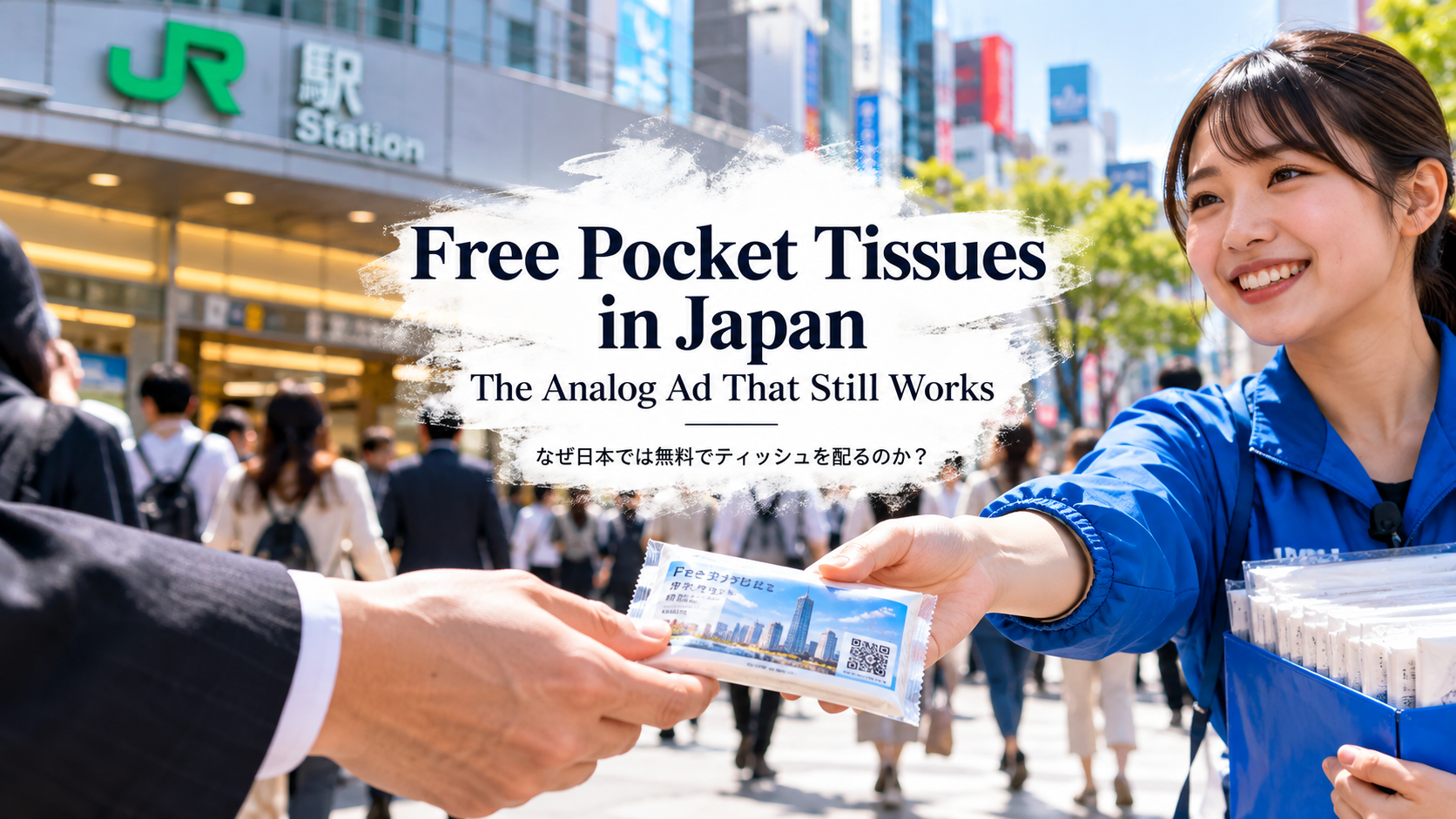
Walk out of a busy train station in Japan and you may see someone handing small packets to commuters. They can look like flyers from a distance, but inside the plastic wrapper is something more useful: pocket tissues.
And they are free.
For visitors, the obvious question is why a company would pay to give tissues to strangers. For me, the scene hardly feels unusual. I have seen people handing out free pocket tissues near stations and shopping areas since I was a child. I still see them today, and I received a pack outside a station as recently as September 2026.
I do think they are a little less common than they were 10 or 20 years ago. Still, the practice has not disappeared.
The reason has a lot to do with the difference between being handed an advertisement and being handed something you might actually use.
They’re Free Because the Tissue Is the Advertisement
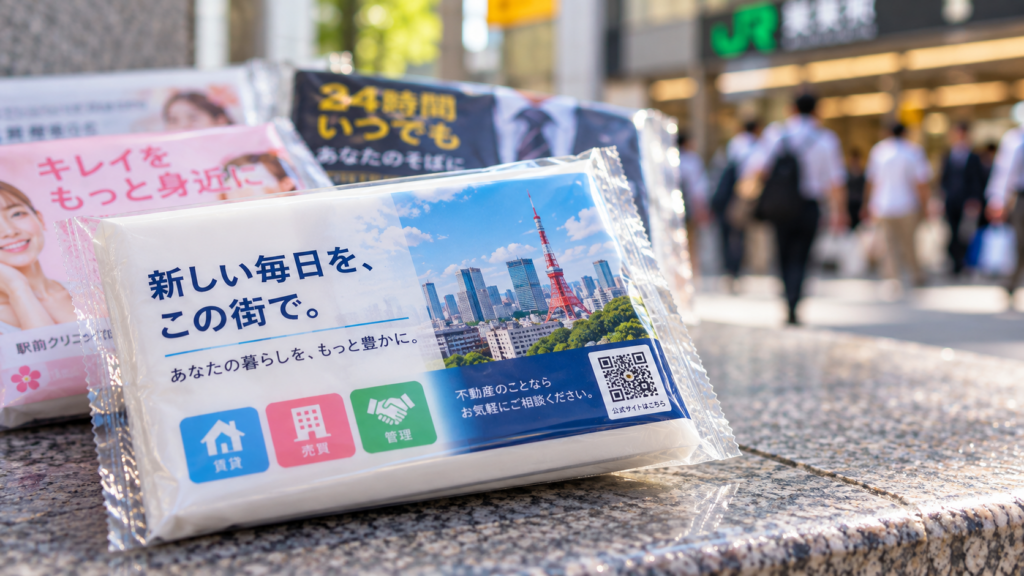
Free pocket tissues in Japan are a form of advertising. A company pays to have its message printed on or inserted into the wrapper, and the packets are distributed in places with plenty of foot traffic, especially around train stations and shopping districts.
The advertisement might promote a shop, service, campaign or discount. Today, it can also include a QR code leading to a website or digital coupon.
A 2024 survey by Japanese research company Navit asked 1,000 people in their 20s through 80s about promotional pocket tissues. Of those surveyed, 97.5% said they had received tissues handed out on the street at least once. That does not mean nearly everyone accepts them whenever they are offered, but it does show how familiar the practice is.
The same survey found that 49.9% of respondents always or sometimes checked the advertising on the packet.
My own habits probably help explain the appeal.
I usually walk past if someone is handing out nothing but a flyer. If they are handing out tissues, I am much more likely to take them. I have even, on occasion, walked a little closer to a distributor simply because I could use some tissues.
I was not interested in the advertisement. I wanted what came with it.
From Advertising Matches to Pocket Tissues
The idea has roots in an older Japanese promotional giveaway: matches.
Banks, shops and other businesses once handed out matches carrying their names and advertisements. They were practical objects that customers might keep rather than immediately throw away.
As disposable lighters became more common and demand for promotional matches declined, businesses needed other inexpensive items that could carry an advertisement.
Pocket-size tissues were already being sold in Japan by the mid-1960s. In the late 1960s, however, Japanese manufacturer Meisei Sansho developed pocket tissues specifically as a promotional medium. Records held by Japan’s National Museum of Nature and Science describe the company’s 1968 development as an alternative to advertising matches, with printed advertising material inserted into the package.
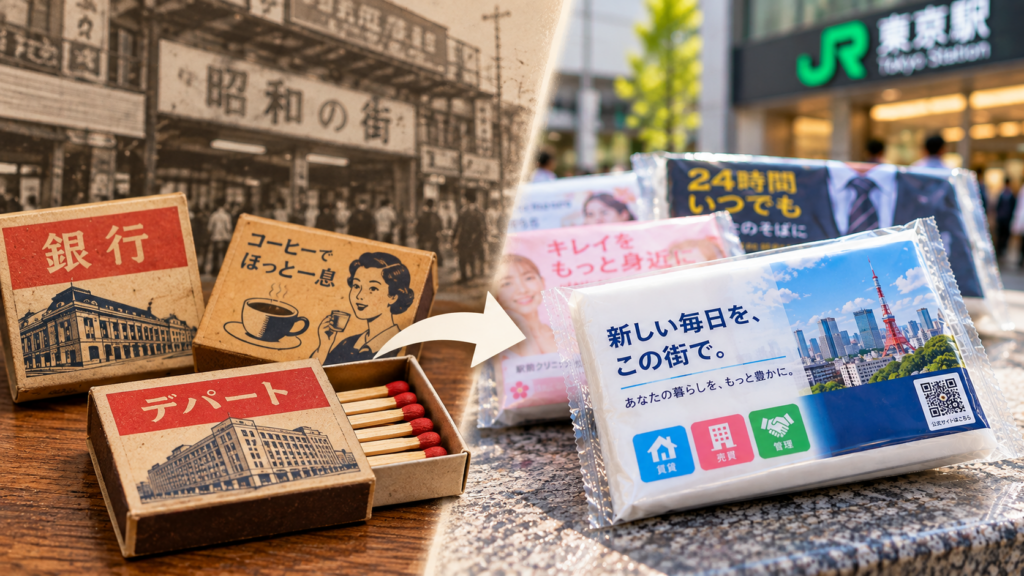
It proved to be a useful combination: an inexpensive advertisement attached to an everyday product.
The practice eventually grew to an enormous scale. In 2007, The Japan Times reported that roughly four billion free tissue packs were being distributed annually in Japan.
That is a historical figure, not an estimate of today’s market. But it gives some idea of how widespread tissue advertising became.
Why Tissues Can Work Better Than a Flyer
A flyer is useful mainly when the recipient wants the information printed on it. If I am not interested in the service being advertised, there is little reason for me to take one.
A packet of tissues is different. I do not need to care about the advertisement to find the packet useful.
After taking one, I usually put it in a bag or pocket and carry it around. Over the years, I have also ended up with plenty of free tissue packs at home.
I rarely stop and read the advertisement when someone first hands me the packet. I am more likely to notice it later, when I actually need a tissue.
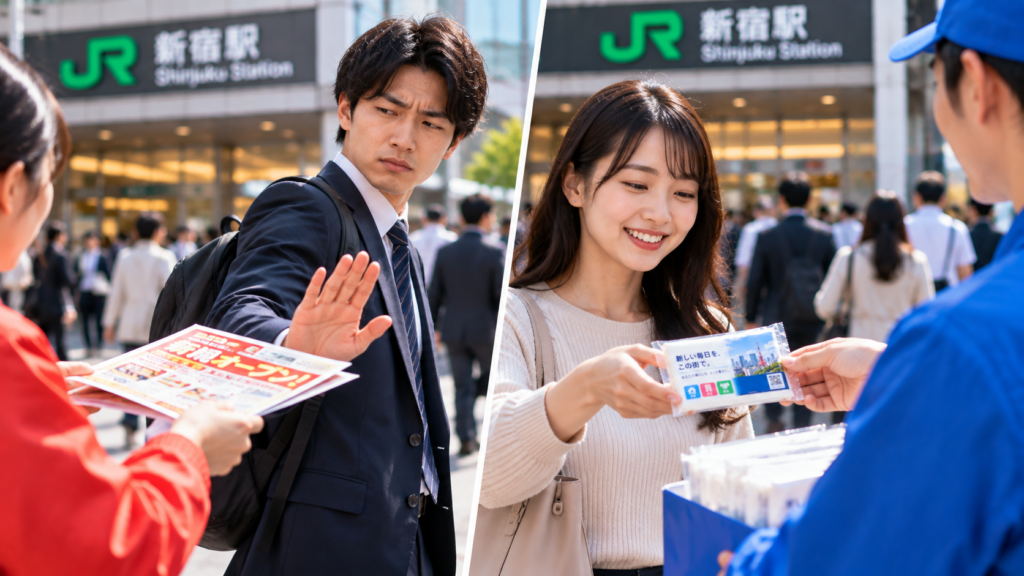
The 2024 Navit survey found a similar pattern. Almost half of respondents said they checked the advertising at least sometimes, while some of those who did not check it said they simply wanted the tissues.
That is what makes the format interesting. The recipient does not have to be interested in the advertisement when it is handed over. The useful item gives the advertisement a reason to stay around.
I have even used discount coupons included with promotional tissues.
That does not prove tissue advertising is more effective than online advertising, or that every campaign works well. Reliable conversion data are much harder to establish.
But the format solves one basic advertising problem: getting something carrying your message into someone’s hand.
Who Hands Them Out — and Who Gets One?
The advertisements I remember seeing have come from all kinds of businesses. Consumer finance companies, pachinko parlors, contact-lens shops and karaoke businesses are among those that stand out from my own experience.
The typical setting is familiar: a distributor stands near a station or another busy pedestrian area, holding packets and calling out as people pass.
Distribution does not have to be completely random. Street-sampling companies in Japan offer campaigns that can specify audiences by characteristics such as age and gender, as well as by location and time.
From my own experience, I sometimes get the impression that distributors are more likely to approach people who seem likely to accept what they are offering or fit the intended audience. That is only my observation, but targeted street distribution itself is part of the business.
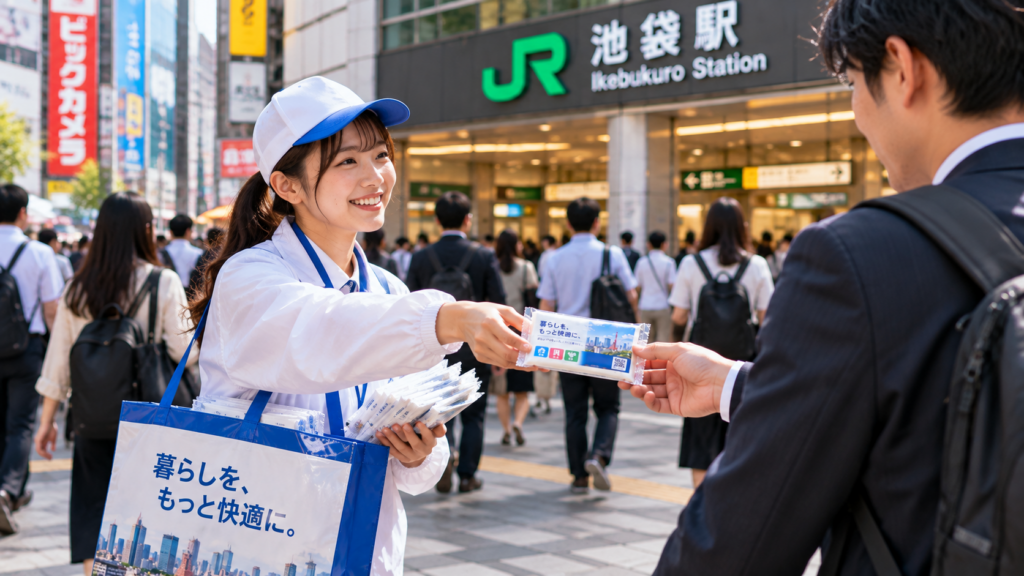
It makes an interesting contrast with online advertising. On a website or social platform, software decides whether you fit an advertiser’s target audience. Outside a station, that decision may be made by a person holding a box of tissues.
Do People Still Hand Out Free Tissues in Japan?
Yes, although I personally see them somewhat less often than I did 10 or 20 years ago.
Companies now have search advertising, social media, apps, digital coupons and many other ways to reach customers. Street distribution was also disrupted during the COVID-19 pandemic.
It would be too simple, however, to say that digital advertising killed the free tissue.
Companies still produce customized advertising tissues, and recent campaigns show that they are still being distributed.
In one campaign at Otsuka Station in Tokyo in 2025, 5,000 packets of pocket tissues were handed out over three days. The company that handled the campaign reported that the tissues were easier to distribute than standalone flyers or tickets in that particular case.
One campaign cannot tell us how tissue advertising performs everywhere, but it shows that companies still find reasons to use it.
I see the same thing at street level. I received a free packet outside a station in September 2026. For me, free tissues are not simply a memory of Japan in the 1980s or 1990s.
An Analog Ad with a QR Code
Pocket-tissue advertising has also changed with the technology around it.
Modern packets can carry QR codes that send people to campaign websites, online information or mobile coupons. A person can receive a physical giveaway outside a station and, seconds later, be looking at the advertiser’s website on a smartphone.
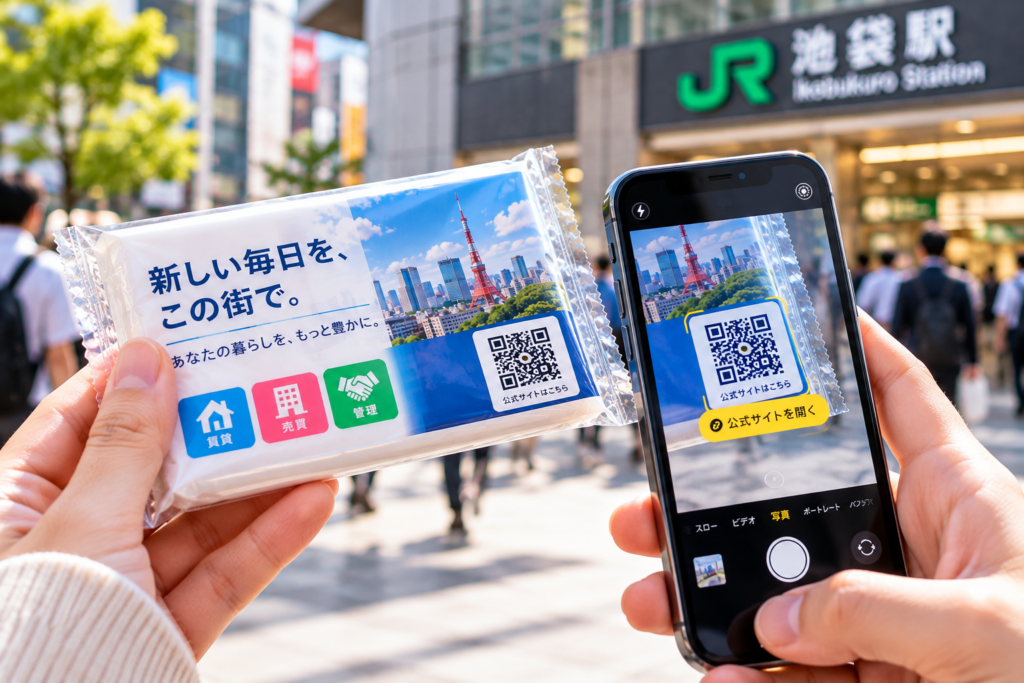
The customer journey can be surprisingly simple:
Station → tissue → QR code → smartphone
In that sense, tissue advertising does not have to compete with digital advertising. It can lead directly into it.
Promotional tissues grew partly because matches were becoming less useful as advertising giveaways. Decades later, instead of remaining separate from another major change in advertising, the printed packet can now serve as the first step in a digital campaign.
Japan has other examples of older systems continuing alongside newer technology. Fax machines are perhaps the most obvious one. Unlike fax, however, promotional tissues have found an easy way to connect the physical and digital worlds directly.
Older systems do not always survive because people refuse to change. Sometimes they adapt, and sometimes they continue because they still perform a useful function.
It Isn’t Just Tissues
Tissues are not the only useful items handed out for promotional purposes in Japan. Over the years, I have also received advertising fans, wet wipes, masks, pocket warmers and product samples.
Personally, I am particularly happy to receive samples. A flyer by itself is much easier to ignore.
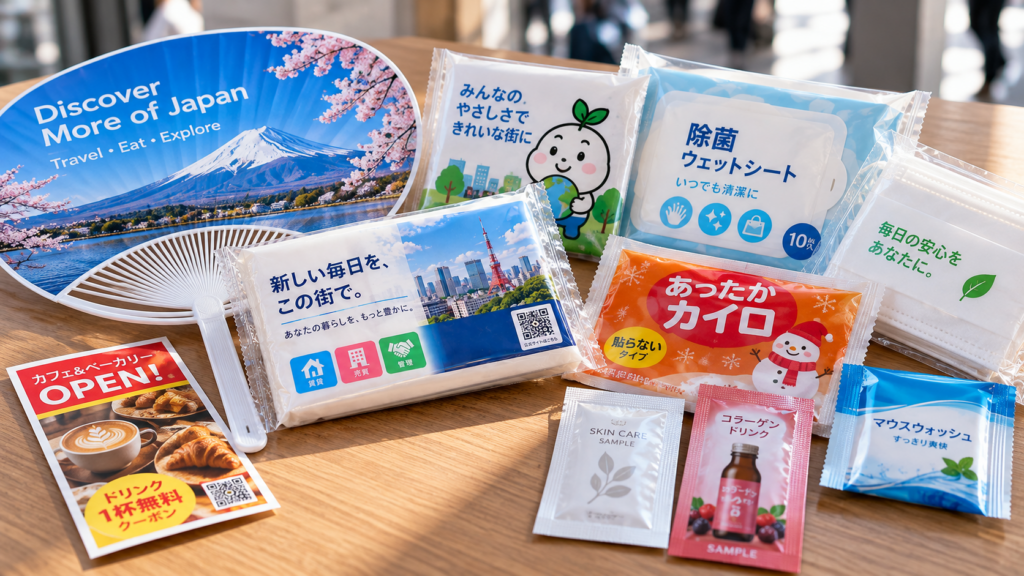
The underlying idea is much the same: people may be more willing to accept an advertisement when it comes with something they can use.
Pocket tissues just happen to be one of Japan’s best-known examples.
A Small Piece of Everyday Japan
I have never thought of free tissues as particularly strange. Seeing someone hand them out outside a station has been part of everyday life for as long as I can remember.
That is why hearing that foreign visitors sometimes find the practice surprising made me wonder about the opposite question: is handing out advertising on the street itself less common in other countries?
Either way, the history of Japan’s free pocket tissues explains why such a simple idea has lasted.
They are small, useful, easy to carry, and more appealing than a plain flyer to someone who has no interest in the advertisement. Once accepted, the packet may stay in a bag or pocket until the tissues are needed. Today, it can even carry a QR code leading straight back into the digital world.
Advertising has changed enormously since promotional pocket tissues appeared in Japan in the late 1960s.
The basic idea behind them has not.
People may not want your advertisement.
They might still want a tissue.