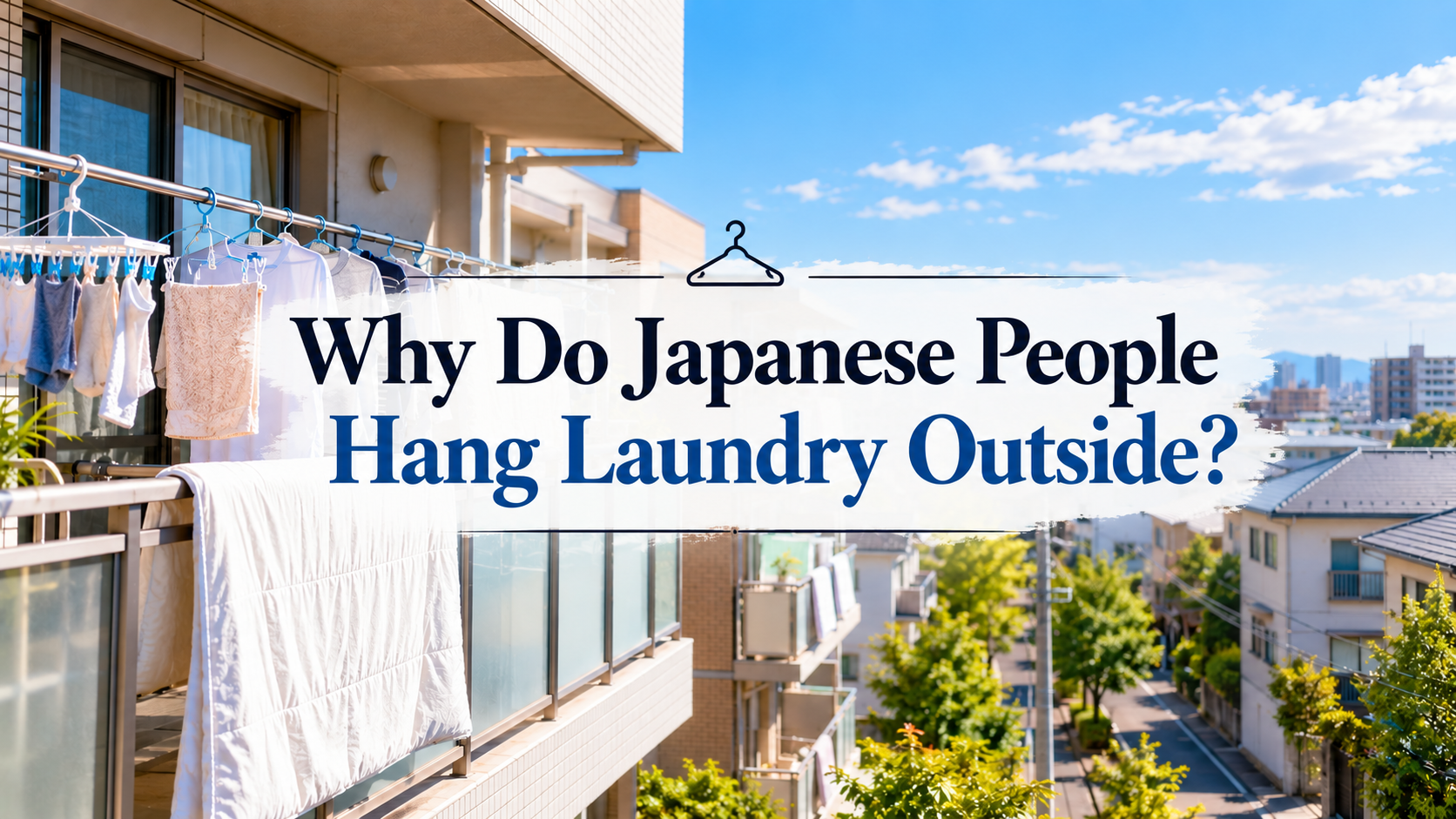
Walk through a Japanese residential neighborhood on a sunny morning and look up.
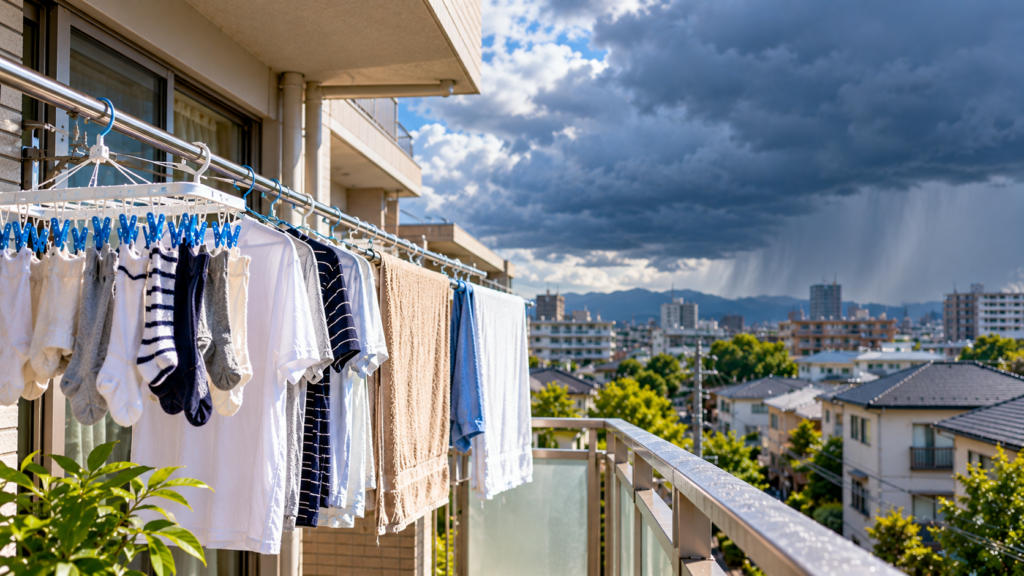
On apartment balconies and outside houses, you may see shirts, towels, bedsheets, and sometimes entire futons hanging in the sun. For visitors from countries where clothes dryers are the default, the scene can raise an obvious question: Why do so many people in Japan still hang their laundry outside?
For many Japanese people, it has never seemed unusual.
When I was growing up in an apartment in Japan, my family normally dried our laundry on the balcony. We didn’t have a clothes dryer, and I don’t remember thinking that we needed one. Hanging clothes outside was simply part of doing the laundry.
That habit is still alive. But in 2026, the reality is more complicated than rows of laundry-covered balconies suggest.
Hanging Laundry Is Still Common in Japan
Outdoor drying is not a disappearing custom.
In one 2026 survey of 1,000 people, 50.3% of respondents who regularly did laundry said outdoor hanging was their main drying method. Indoor hanging came second at 35.9%, while clothes dryers and bathroom drying systems were each the main method for only around 6%.
Another large 2026 survey produced a different picture: 57.6% mainly dried laundry indoors, compared with 40.9% who mainly dried it outside.
The surveys used different samples and questions, so the figures are not directly comparable. But together they show something important:
Outdoor drying remains very common in Japan, while indoor drying has also become a major part of everyday life.
That is quite different from saying Japanese people don’t use dryers. Japan has washer-dryers, bathroom drying systems, dehumidifiers, and coin laundries with large commercial dryers.
Yet hanging clothes — outside or indoors — remains remarkably persistent.
How Hanging Laundry Became Part of Everyday Japanese Life
For many Japanese households, the familiar laundry routine was simple:
wash → rinse → spin → hang
The washing machine handled the washing and removed much of the water. Drying remained a separate household task.
By the time washer-dryers became more capable and widely available, hanging laundry was already deeply embedded in everyday routines — and in Japanese housing itself.
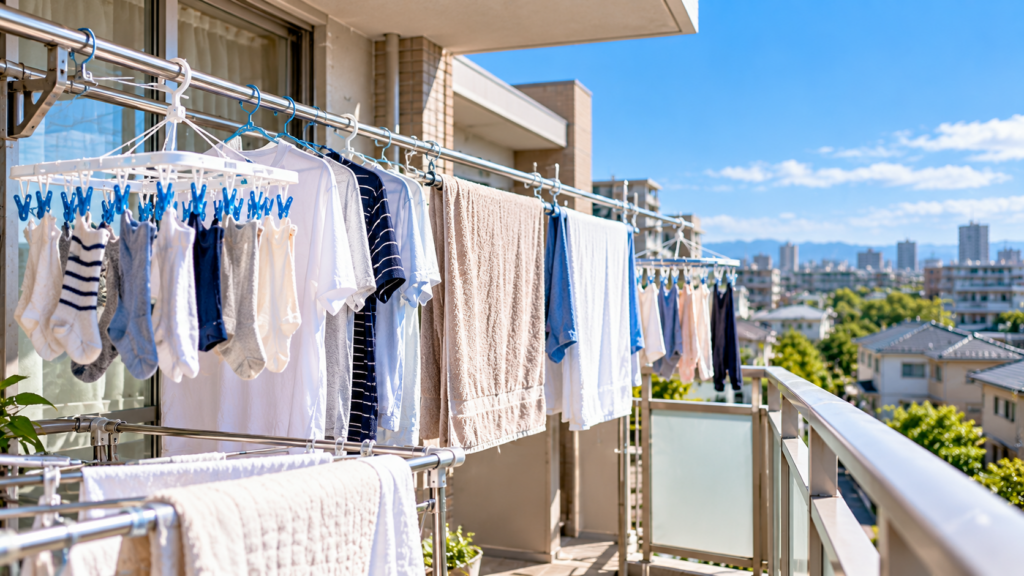
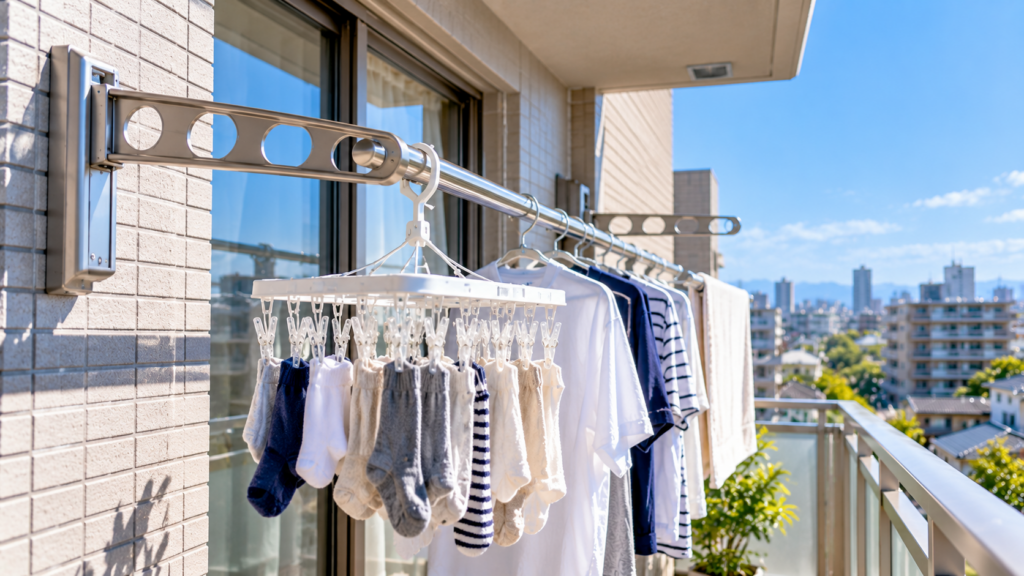
Apartment balconies commonly have fittings for laundry poles. Stores sell an enormous variety of poles, folding racks, clips, hangers, and multi-clip pinchi hangā for socks and smaller garments.
Growing up, our apartment balcony was simply where laundry went. On rainy days, if something needed to dry quickly, we sometimes hung it in the bathroom and ran the ventilation fan.
I didn’t see this as an inconvenient alternative to a dryer. It was just normal.
That may be the key point: hanging laundry isn’t merely a preference in Japan. It became part of the infrastructure of the home.
So Why Not Just Use a Dryer?
A common explanation is that Japanese homes are too small for dryers, or that Japanese people simply prefer natural drying. Neither tells the whole story.
Drying equipment is hardly rare in Japan. Government statistics show that more than half of two-or-more-person households have some form of clothes-drying equipment or function, including washer-dryers and bathroom drying systems. Modern drum-type washer-dryers are also a familiar option, and many owners regularly use their drying functions.
Still, owning drying equipment doesn’t mean using it for every load.
Consumer surveys have found reasons ranging from electricity costs to concerns about shrinking, wrinkles, or damage to certain clothes. Modern dryers have improved considerably, however, so these should not be treated as universal explanations.
In my own case, I have never felt a strong need to buy a dryer for ordinary laundry, partly because of the additional cost. Our current washing machine doesn’t have a drying function.
But I do use dryers when they make sense. For bulky items such as futons or carpets, I sometimes use the large machines at a coin laundry.
That illustrates an important point: Japanese households don’t necessarily choose one drying method and use it for everything.
Japan Even Has a Weather Forecast for Laundry
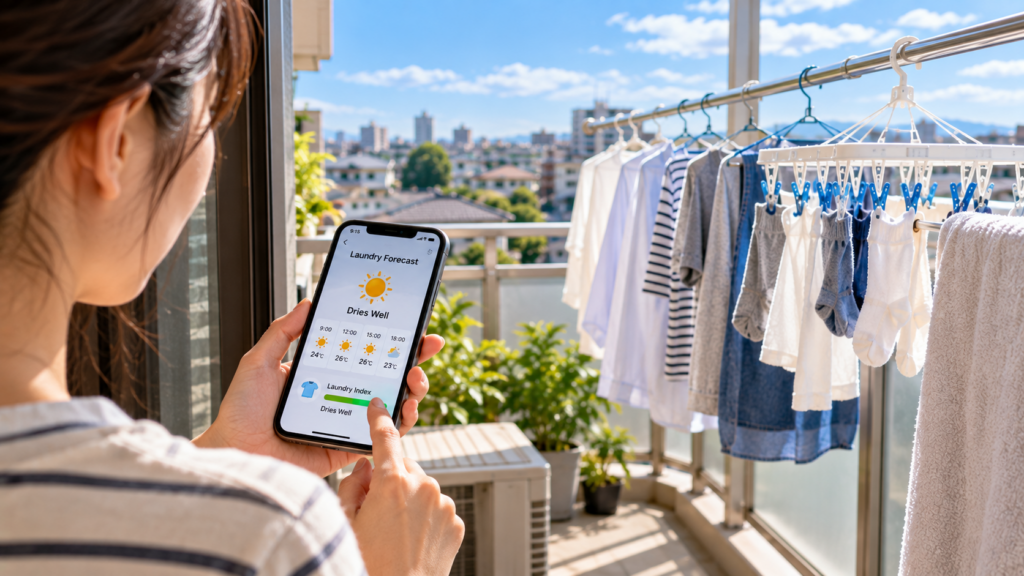
One clue to how deeply outdoor drying became embedded in Japanese life is the laundry index (sentaku shisū).
The Japan Weather Association’s tenki.jp service predicts how suitable the weather will be for drying laundry. Depending on the conditions, it can recommend indoor drying or rate conditions from “dries somewhat” to “dries extremely well.”
Japanese weather information doesn’t just tell you whether it will rain. It can tell you whether your laundry is likely to dry.
That makes sense when weather has traditionally influenced household planning. I remember thinking about the forecast when deciding when to wash clothes. A sunny day could also mean a good laundry day.
But depending on the weather creates an obvious problem: sometimes the weather changes after you leave home.
Why Outdoor Drying Is Becoming Harder
Japan’s rainy season, high humidity, sudden showers, typhoons, pollen, yellow dust, and regional winter conditions can all make outdoor drying inconvenient.
Modern lifestyles add another problem:
Nobody may be home when the weather changes.
This is the main reason my own household now dries almost everything indoors.
My wife and I both work. If we hang laundry outside in the morning and it suddenly starts raining in the afternoon, nobody is home to bring it inside. Pollen is another reason we prefer indoor drying.
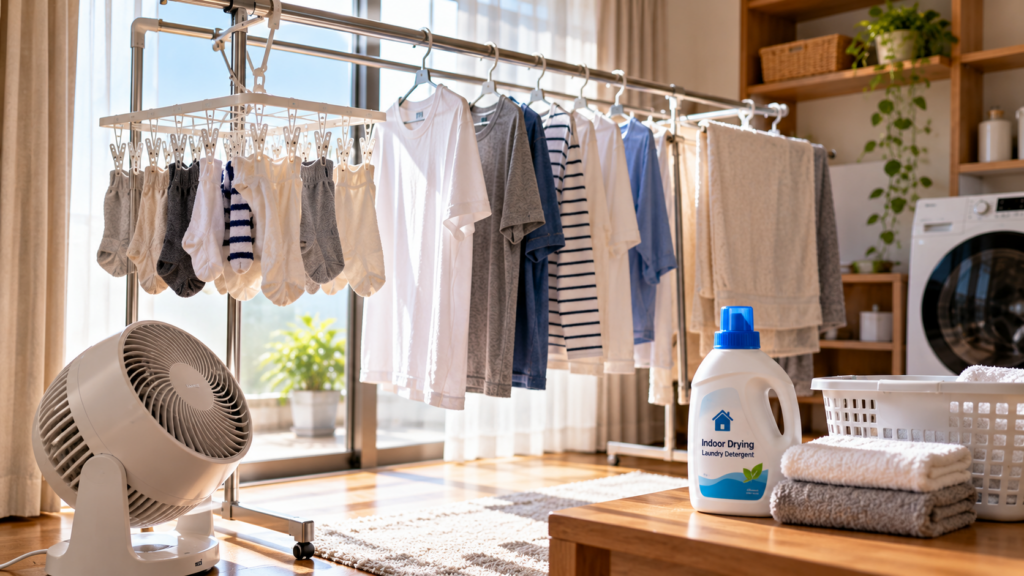
We changed to mainly indoor drying roughly ten years ago. Today, even though our home has a balcony and outdoor laundry fittings, we usually hang clothes inside. We use detergent designed for indoor drying and sometimes a circulator when clothes are taking too long to dry.
My experience is only one household, but it reflects a broader development visible in recent Japanese consumer and housing surveys.
For many households, indoor drying is no longer just the backup plan for a rainy day.
Japan’s Laundry Is Moving Indoors
One sign of this change can be found in an ordinary Japanese supermarket or drugstore: detergents specifically marketed for heya-boshi, or indoor drying.
Lion launched its “Heyaboshi Top” detergent in 2001, and indoor-drying detergents have since become a familiar product category. Kao has also developed versions of its Attack detergents aimed at problems such as odors associated with clothes drying slowly indoors.
A 2023 Kao survey found that roughly one in three respondents routinely dried laundry indoors.
And detergent is only part of the system.
Japanese households may use bathroom drying systems, dehumidifiers, circulators, retractable laundry poles, ceiling-mounted drying hardware, or washer-dryers.
From Balconies to Laundry Rooms
Newer homes are taking the idea further.
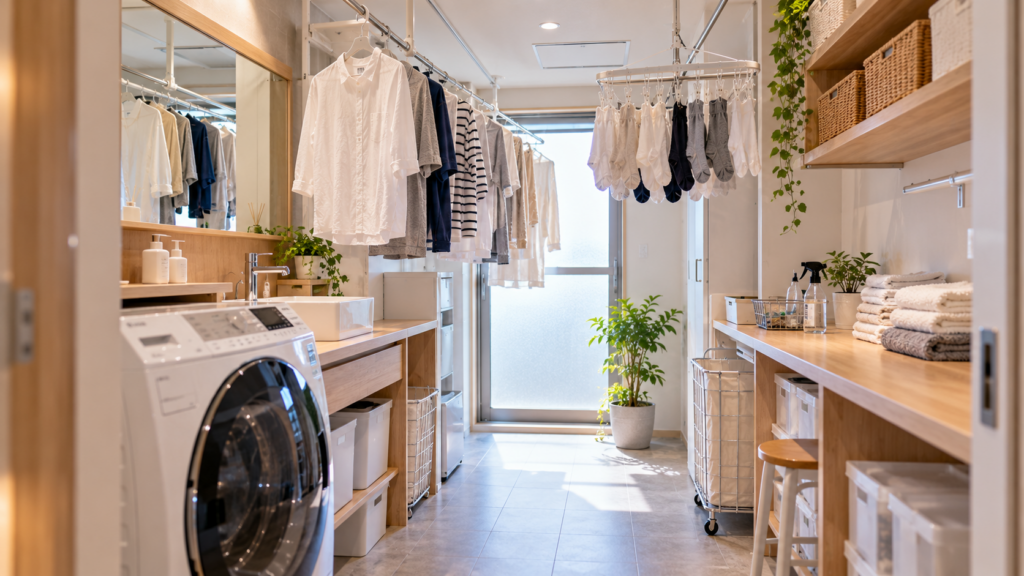
Dedicated laundry rooms — spaces designed for washing, hanging, folding, and sometimes storing clothes — have become increasingly visible in Japanese home design. Recent housing surveys show that newer homes are more likely to have dedicated laundry rooms or indoor drying spaces.
Some housing-industry data also show a growing share of new homes being built without balconies, particularly among younger buyers. In many of those homes, laundry has not disappeared — it has moved indoors.
For decades, the Japanese balcony provided a place to hang laundry outside. Now some homes are deliberately providing a room to hang it inside.
If I were choosing or building another home today, I would want a dedicated indoor laundry space myself. It would solve one of the main inconveniences of our current setup: finding available space around the house whenever laundry needs to be hung.
Japan may be moving away from the balcony without moving away from hanging laundry.
What’s changing isn’t necessarily whether clothes are hung. It’s where and how they are hung.
Is Hanging Laundry Really a Japanese Thing?
No.
This matters because framing the subject as “Japan versus the West” would be misleading.
In the United States, clothes dryers are dominant. Recent U.S. Energy Information Administration data indicate that roughly 84% of American households have one. For someone accustomed to moving clothes directly from washer to dryer, Japanese balconies full of laundry can look unusual.
Britain presents a different picture. Tumble dryers are common there too, but line drying and indoor drying are also familiar practices. Outdoor drying is normal in many other parts of the world as well.
So hanging laundry is not uniquely Japanese.
What is interesting about Japan is the system built around hanging it.
Homes have traditionally provided places and hardware for drying clothes. Weather services predict whether laundry will dry. Manufacturers sell detergents specifically for indoor hanging. Bathrooms can function as drying spaces. And newer homes increasingly incorporate dedicated indoor laundry areas.
Japanese laundry culture, then, is less about rejecting dryers than about the persistence of an established way of doing things.
So, Why Do Japanese People Hang Laundry Outside?
There is no single reason.
Japanese households became accustomed to washing clothes by machine and then hanging them to dry. Homes were designed around that routine, and outdoor drying became an ordinary part of domestic life.
That was certainly true for me as a child. Clothes came out of the washing machine and went onto the balcony. I didn’t wonder why we didn’t have a dryer. It was simply how laundry worked.
Today, the picture is changing.
Dryers and washer-dryers are familiar options. Work schedules can make outdoor drying inconvenient. Pollen, sudden rain, humidity, and other environmental concerns can push laundry indoors.
But the old habit hasn’t simply disappeared.
The balcony clothesline can become an indoor pole. A rainy-day solution can become the everyday routine. And a new home may replace the traditional laundry balcony with a dedicated laundry room.
The Japanese habit of hanging laundry isn’t disappearing. It’s adapting.