
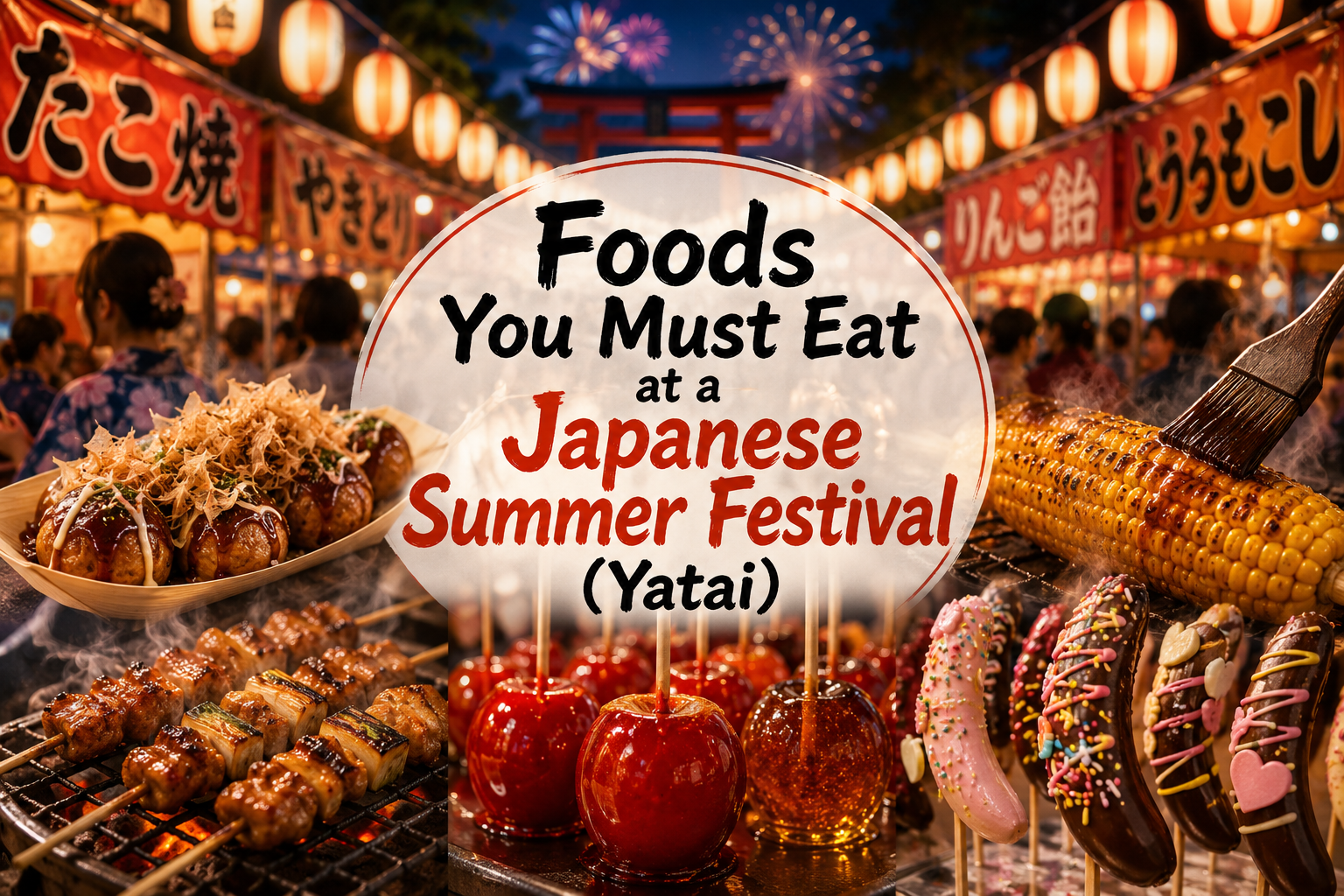
Every summer evening across Japan, the same transformation happens. A park, a riverbank, or a temple precinct that was empty in the afternoon fills with red paper lanterns, the smell of grilling food, and the sound of taiko drums. The yatai — Japan’s festival food stalls — are open.
A Japanese summer festival, or matsuri, is many things at once: a religious ceremony, a community gathering, a fireworks display, a chance to wear a yukata. But for a huge number of people who attend — locals and visitors alike — the central event is the food. The yatai stalls that line the approach to every major summer festival are not a sideshow. They are the show.
If you are visiting Japan between late June and mid-August and find yourself near a summer festival, here are the five things you should eat before you leave.
No. 01 — Takoyaki
Octopus balls — the ultimate festival food
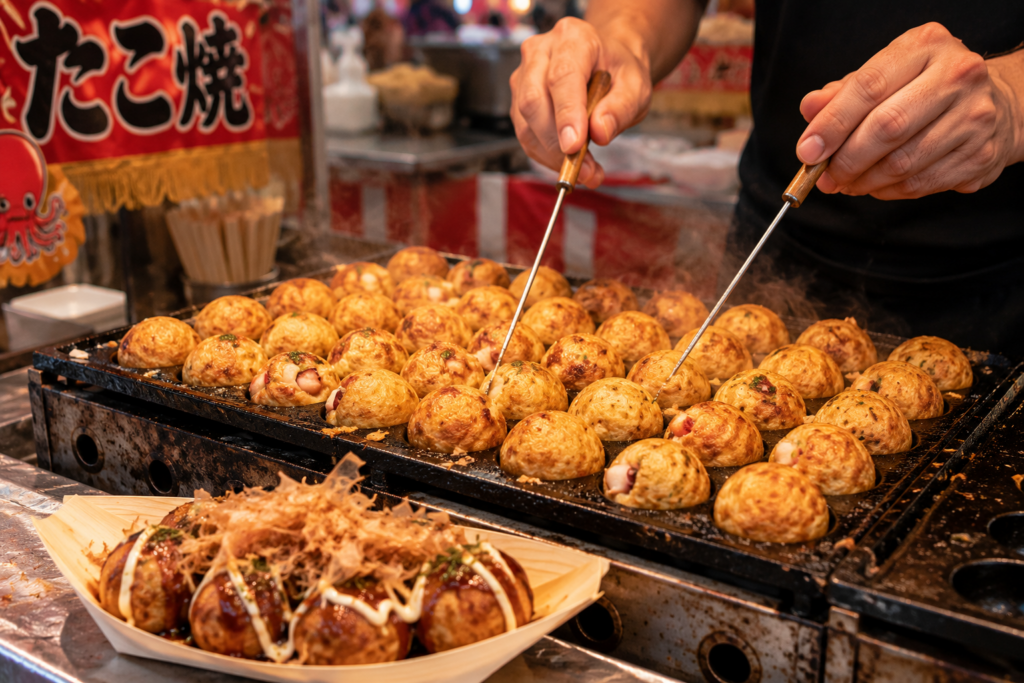
| Origin | Osaka | Price range | ¥400–700 / 6–8 pieces | Heat level | Very hot inside — wait 2 min |
If there is one dish that defines Japanese summer festival food, it is takoyaki. Round, golden spheres of batter cooked in a specialized cast-iron griddle, each one containing a piece of octopus at its center. They arrive in a paper boat, lacquered with sweet-savory sauce, drizzled with Japanese mayonnaise, and covered in dried bonito flakes that wave hypnotically in the rising heat.
The outside is crisp. The inside is molten and soft — almost liquid at the center when freshly made. This is intentional. The texture contrast between the outer shell and the molten interior is the point, and it is something that no Western food experience quite prepares you for.
One important warning: takoyaki retains heat with extraordinary efficiency. Biting into one immediately will burn the roof of your mouth badly. Watch what the locals do — they hold the piece for a moment, blow on it, and take a small first bite from the side before committing. This is not optional caution. It is a hard-learned survival skill.
Most takoyaki stalls offer a choice of toppings. The standard combination — sauce, mayo, and bonito — is the right starting point. Some stalls also offer a salt-and-ponzu version that is lighter and more delicate. If available, try one of each.
No. 02 — Jagabata
Butter potato — the humble dish that stops everyone in their tracks
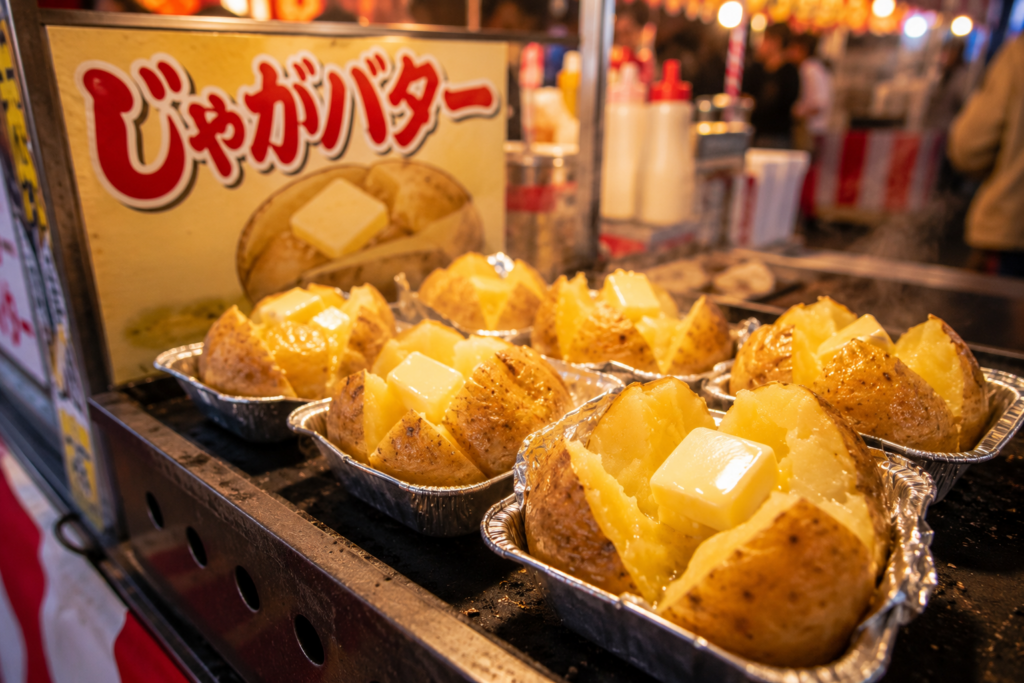
| Origin | Hokkaido | Price range | ¥300–600 | Key ingredient | Hokkaido potato + butter |
Jagabata — the name combines the Japanese word for potato with “butter” — is one of the most deceptively simple things you will find at a Japanese summer festival. A whole potato, steamed or boiled until soft all the way through, split open down the middle, and topped with a generous slab of butter that begins melting the moment it touches the hot flesh. Salt, sometimes soy sauce, and nothing else.
On paper, this should not be particularly remarkable. A potato with butter exists in every country on earth. But the jagabata at a summer festival stall operates at a different level, for one specific reason: the potato. Japan — and Hokkaido in particular — grows some of the best-tasting potatoes in the world. The most commonly used varieties for jagabata are dense, starchy, and naturally sweet in a way that most Western potatoes are not. They hold their shape when cooked, do not become watery, and have a depth of flavor that makes the butter feel less like an addition and more like a finishing touch.
There is also something about the format — the whole potato, the steam rising, the butter pooling in the split — that feels generous and unhurried in the middle of a loud, crowded festival. Most yatai food is small, quick, and eaten on the move. Jagabata slows you down. You need both hands. You need a moment. And after a humid summer evening of navigating crowds and eating things on sticks, that moment turns out to be exactly what you wanted.
Hokkaido, Japan’s northernmost main island, produces the majority of the country’s potato crop and is considered the spiritual home of jagabata culture. The dish became associated with summer festivals partly because Hokkaido potatoes reach peak quality in late summer — the same season as matsuri. At better festival stalls, the variety of potato used is sometimes listed on the sign.
No. 03 — Ringo Ame
Candied apple on a stick — Japan’s answer to the candy apple, and then some
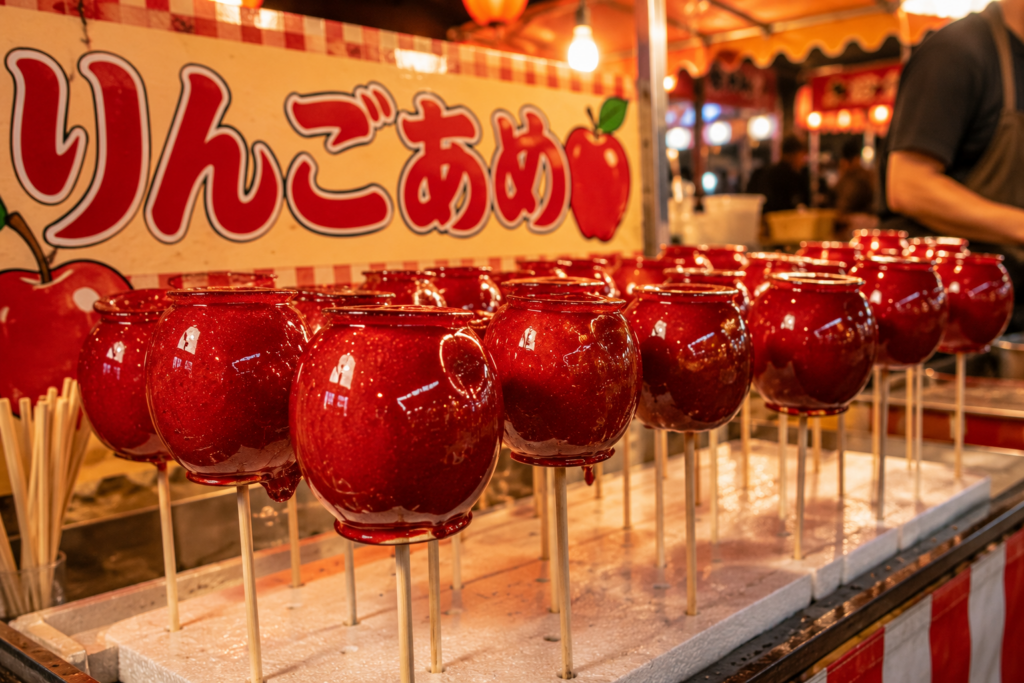
| Origin | Aomori Prefecture | Price range | ¥300–600 | Best moment | Mid-evening, after savory food |
At first glance, ringo ame looks like the candy apple you might find at a Western fairground — a whole apple, skewered on a stick, coated in a hard sugar shell. Visitors who grew up with the Western version might walk past it without much thought. That would be a mistake.
The Japanese candied apple is a different object. The sugar coating is thinner, clearer, and glassier than its Western counterpart — closer to a perfectly smooth lacquer than to the thick, opaque red candy shell you might remember. When the lantern light catches it at the right angle, a ringo ame gleams like something decorative. The apple inside is typically a small, intensely sweet Japanese variety, chosen specifically for its crunch and concentrated flavor rather than its size.
Biting through the sugar shell produces a sound — a clean, sharp crack — that is deeply satisfying in a way that is difficult to explain and impossible to anticipate. The shell shatters rather than crumbles. The cold, crisp apple underneath provides immediate contrast against the sweetness of the sugar. The combination is brief and perfect and gone before you want it to be.
What elevates ringo ame at a festival stall above being simply a sweet snack is its visual presence. A good ringo ame stall displays its apples hanging in rows, catching the light from paper lanterns, gleaming red and amber and gold. They are among the most photographed objects at any Japanese summer festival, and rightly so — they are genuinely beautiful objects that also happen to taste good. The aesthetic and the edible are, in this case, the same thing.
Aomori Prefecture — in the far north of Honshu — produces roughly half of all apples grown in Japan and is considered the heartland of ringo ame culture. The best festival stalls use small Aomori apples specifically, which are sweeter and more intensely flavored than larger varieties. If the stall displays the apple variety by name, that is a sign they care about what they are selling.
No. 04 — Yaki Tomorokoshi
Grilled corn — the one that surprises everyone
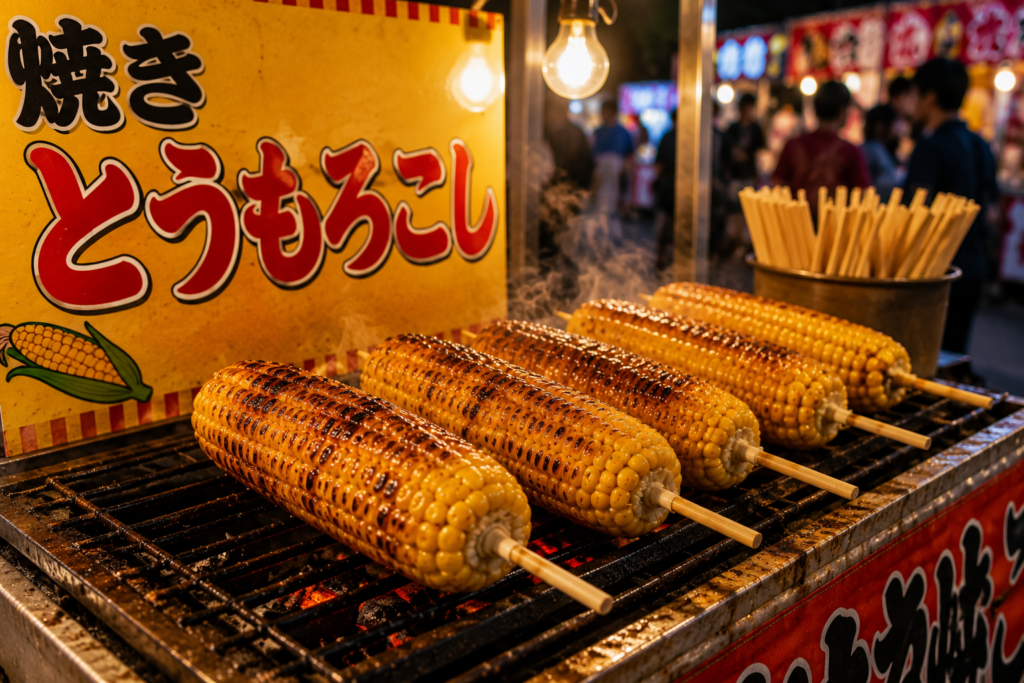
| Origin | Nationwide | Price range | ¥300–600 | Key ingredient | Soy sauce + butter glaze |
Grilled corn sounds like a side dish at a cookout. At a Japanese summer festival, it is something else entirely. The corn — typically a sweeter Japanese variety than most Western types — is grilled over an open flame until the kernels char slightly, then basted repeatedly with a glaze of soy sauce and butter while it continues to cook. The result is caramelized, smoky, and deeply savory, with the natural sweetness of the corn cutting through the richness of the glaze.
This is the yatai dish that tends to surprise Western visitors most. They approach it expecting something familiar and find instead a combination of flavors — sweet corn, soy sauce, butter, char — that is entirely new and immediately addictive. The soy sauce does not make the corn taste like anything else. It amplifies the corn flavor while adding a layer of umami that transforms the whole experience.
Eat it standing up, holding it by the stick, turning it as you go so each side stays warm. This is not a dish that benefits from sitting down and taking your time. It is festival food, meant to be eaten while walking and watching and taking everything in.
No. 05 — Chocobanana
Chocolate banana on a stick — strange, beloved, unmissable
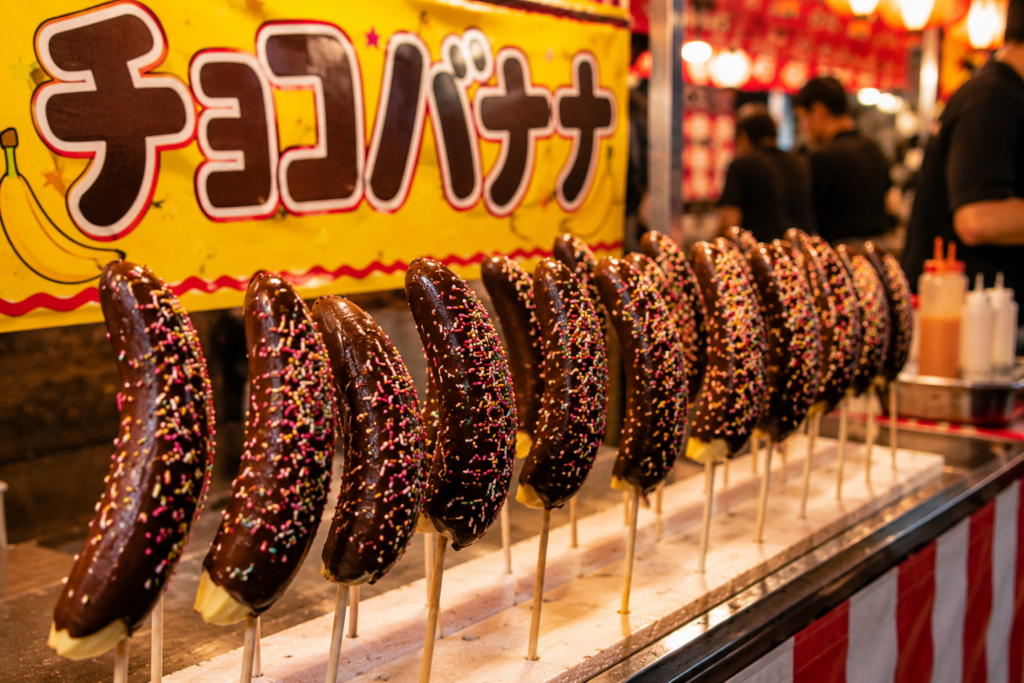
| Origin | Japan (1970s) | Price range | ¥200–400 | Best for | Children, and everyone else |
A whole banana on a stick, coated in hardened chocolate, decorated with sprinkles, sugar candy, or colored chocolate drizzle in patterns that range from simple stripes to elaborate character faces. The chocobanana is objectively a children’s festival treat. It is also eaten enthusiastically by adults who grew up with it and will not be talked out of it.
The chocobanana stall is one of the most visually distinctive stops at any Japanese summer festival. The finished bananas are displayed hanging from racks or standing upright in rows, their decorations catching the light from the paper lanterns. Some stalls have elevated this to an art form, with bananas decorated to look like cartoon characters, animals, or seasonal themes. The craftsmanship involved in a well-decorated chocobanana is genuine and not to be dismissed.
As a food experience, the chocobanana is straightforward: sweet chocolate, cold banana, sugar. Its value at a festival is not primarily culinary. It is cultural. Walking through a Japanese summer festival holding a chocobanana is a specific experience that connects you, however briefly, to the summers of every Japanese person who has ever attended one of these events. That connection is worth the ¥300.
“A festival without yatai is just a crowd. The food stalls are what make it a summer.”
How to Navigate a Festival Food Street
Summer festival food streets can be overwhelming the first time — dozens of stalls, unfamiliar smells, crowds moving in both directions, no obvious system. A few practical notes help enormously.
Cash is essential. Virtually all yatai stalls are cash-only. Bring more than you think you need — it is easy to spend ¥2,000–3,000 on food alone without realizing it, and the nearest ATM is usually a ten-minute walk away from the festival grounds.
The busiest stalls are almost always the best stalls. A queue in front of a yatai is a reliable quality signal, and at a major summer festival the wait is rarely longer than five minutes. The temptation to skip the queue and go to the empty stall next door is understandable but usually a mistake.
Practical tips for eating at a Japanese summer festival
- Carry cash. Yatai stalls are almost always cash-only. ¥3,000–5,000 is a reasonable budget for a full evening of eating and drinking.
- Arrive before dark. The best stalls sell out of certain items early. Arriving at 6–7 PM gives you access to everything while the atmosphere builds toward the evening peak.
- Follow the crowd. The stalls with the longest queues are almost always the best ones at that particular festival. Trust the crowd.
- Watch the takoyaki. Let it cool for at least two minutes before biting in. The inside stays dangerously hot long after the outside looks ready to eat.
- Eat while walking. Festival food is designed to be eaten on the move. Stopping to sit down is possible but rarely necessary — most stalls provide a napkin and expect you to keep moving.
- Check the festival schedule. Major fireworks displays happen at specific times, and the food stalls are at their most atmospheric in the thirty minutes leading up to them. Time your eating accordingly.
Beyond the Food
The best thing about eating at a Japanese summer festival is that the food is inseparable from everything else happening around it. The takoyaki tastes better because you are eating it while fireworks go off overhead. The jagabata is more satisfying because the steam rising from a split potato is exactly the right thing to hold on a humid August evening. The ringo ame gleams more brilliantly because paper lanterns are reflecting off the river. And the chocobanana is more charming because a child next to you is eating the same thing and looking at it with the same level of satisfaction.
Yatai food is not fine dining. It was never meant to be. It is food designed for a specific moment — a warm summer evening, a festival crowd, a brief window of the year when the streets transform into something that feels genuinely magical. Eat everything on this list, in that context, and you will understand why Japanese people look forward to summer festival season all year long.
Comments