
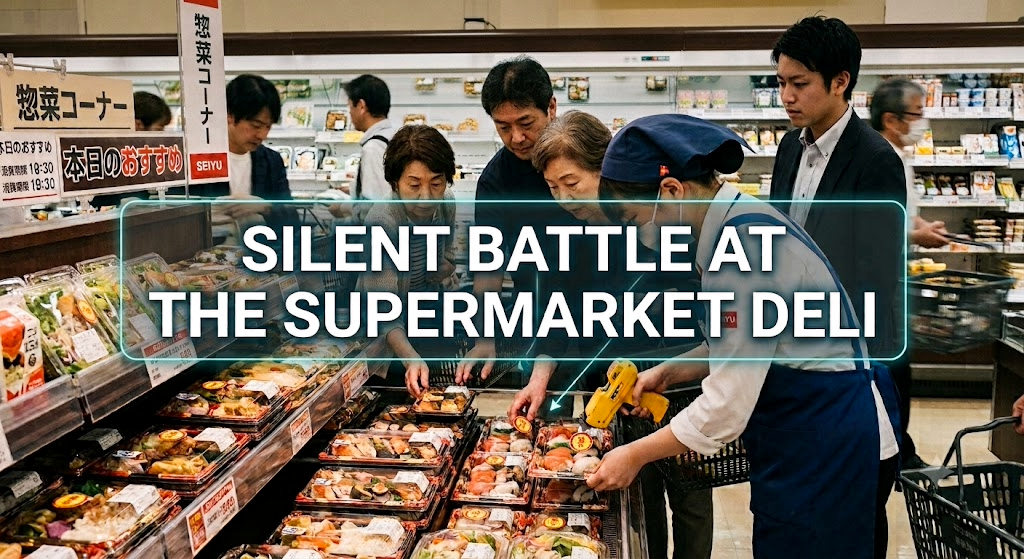
Every evening across Japan, a quiet, deeply competitive ritual unfolds in supermarket aisles — and it has nothing to do with coupons, apps, or loyalty cards. All you need is good timing, patience, and the ability to recognize a small sticker.
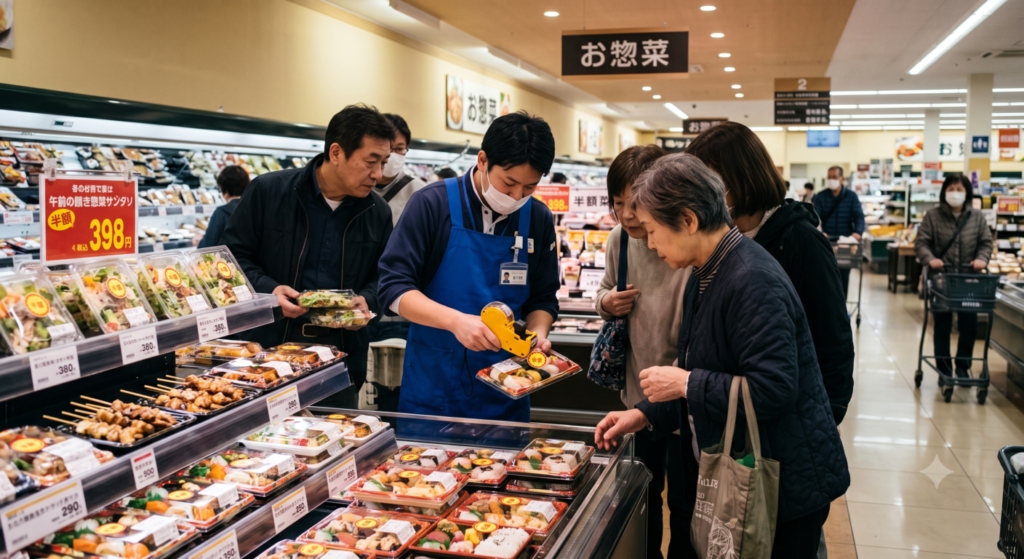
It usually starts with a cluster of people near the prepared food section — four or five shoppers pretending to study the labels on packaged salads they have no intention of buying. Nobody is talking. A store clerk approaches, holding what looks like a label gun. Without any announcement, they begin pressing it against bento boxes, sushi trays, and grilled chicken skewers. Within thirty seconds, the cluster dissolves into careful, deliberate hands reaching for discounted food.
This is ne-biki culture — Japan’s markdown system for food approaching its sell-by time. And once you know how it works, you will never shop at a Japanese supermarket the same way again.
Ne-biki = price reduction · Hangaku = half price · Waribiki = discount. When you spot any of these words on a sticker, that is your signal.
Why the Discounts Exist
Japanese supermarkets, department store food halls, and convenience stores share an uncompromising standard for food freshness. Prepared items — bento boxes, sushi, tempura, sandwiches, cakes — are made in-house throughout the day, and each carries a printed expiration time, sometimes just two or three hours after preparation.
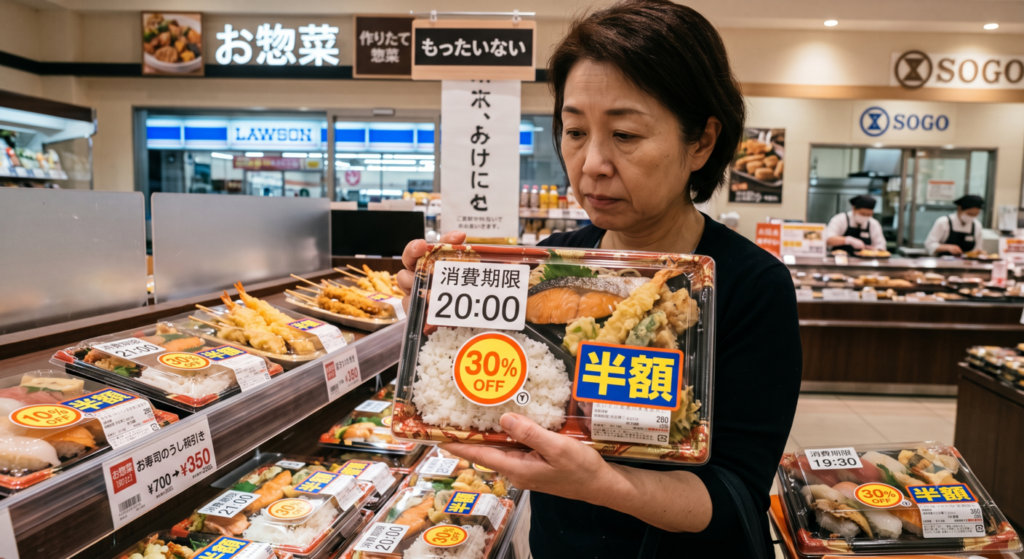
Rather than discard unsold food at closing time, stores systematically discount items as their sell-by time approaches. The discount deepens the closer to expiration the item gets. A ¥700 sushi platter at noon might be ¥560 at 5 PM, ¥490 at 7 PM, and ¥350 at 8:30 PM. The food has not changed. Only the clock has moved.
This system is rooted in a cultural concept many Japanese people hold intuitively: mottainai — the feeling of regret over waste. Throwing away perfectly edible food, even food technically past its best-before sticker, carries a kind of moral weight in Japan. The discount sticker is the supermarket’s way of honoring that value while still running a business.
What Do the Stickers Actually Look Like?
Here is something almost no English-language guide gets right: there is no universal sticker color system in Japan. Unlike, say, a traffic light, the colors and designs of discount stickers vary by supermarket chain, by region, and sometimes even by individual store. A red sticker at one chain means 50% off. At another chain, red might mean something different entirely, and the 50% sticker might be yellow.
What is consistent is the information on the sticker rather than its color: the discount percentage or the new price will always be printed clearly. Below is a rough guide to how some of Japan’s major chains tend to approach their sticker systems — but treat this as a starting point for observation, not a definitive rulebook.
| Chain | Sticker style (general) | Typical discount range | Notes |
| Ito-Yokado | Orange stickers common for prepared foods | 20% → 30% → 50% | Multiple rounds of stickering; timing depends on the section |
| Aeon | Red and orange stickers; varies by store | 20–50% | Large stores sometimes have dedicated markdown carts |
| Seiyu | Yellow-green stickers often used for first round; deeper discounts in different colors | 10% → 30% → 50% | Pricing is often printed numerically rather than by percentage |
| Maruetsu | Yellow for early markdowns; color escalates through the evening | 20–50% | Common in Tokyo metropolitan area |
| Local / regional stores | Entirely unpredictable — anything goes | 10–70% | Smaller independents sometimes go as deep as 70% to clear stock |
Important note:The table above reflects general tendencies observed by shoppers — it is not official policy from any chain, and individual stores vary widely. When you arrive at a new supermarket, spend five minutes watching what stickers are on already-discounted items to understand that store’s system before you start hunting.
When Do the Stickers Appear?
Timing varies by store format, day of the week, how busy the store has been, and sometimes the individual judgment of the clerk on duty. Rainy days, for instance, often mean slower foot traffic and earlier discounting. The night before a national holiday can see unusually deep cuts as stores try to clear perishable stock.
That said, a rough evening timeline holds across most urban supermarkets:
3:00–4:30 PM
Bakery and morning itemsBread, croissants, and sandwiches baked or made in the morning start getting their first markdowns — often 20–30%. Good moment for pastry hunters, but prepared meal options are slim.
5:00–6:30 PM
First wave of prepared foodsAfternoon-made bento boxes, sushi sets, and deli items begin receiving stickers. Discounts at this stage are typically 20–30%. Selection is excellent but prices are not at their lowest. This is when experienced shoppers arrive and start circling.
7:00–8:30 PM
The golden windowThis is when most stores apply their deepest markdowns — often 50%. The quiet competition around the prepared foods section peaks here. Move deliberately, stay polite, and do not reach for an item a clerk is still in the process of stickering.
8:30 PM – close
Final clearanceIn stores open until 10 PM or later, a final round of stickering can push discounts to 60–70%. Selection is thin by this point, but what remains is priced extraordinarily low. Some shoppers specifically target this window for ingredients they plan to freeze.
One important variable: stores in busy urban areas — near train stations, for instance — tend to discount later in the evening because foot traffic stays high. Stores in quieter residential neighborhoods may start earlier. If you are shopping in a rural town, the golden window might be 5–6 PM rather than 7–8 PM.
The Unwritten Rules of the Hunt
What makes this ritual fascinating to observe is not the discounts themselves — it is the social choreography surrounding them. There is no shoving. No arguments. No announcements over the intercom. And yet a clear set of unspoken rules governs everything.
The most experienced shoppers arrive before the clerk and position themselves nearby without hovering directly over the display case. They browse adjacent shelves — slowly, without urgency — and drift naturally into position when the clerk arrives with the sticker gun. Grabbing an item before the sticker has been applied is considered bad form. Reaching across another person to claim an item they have been clearly waiting for is worse.
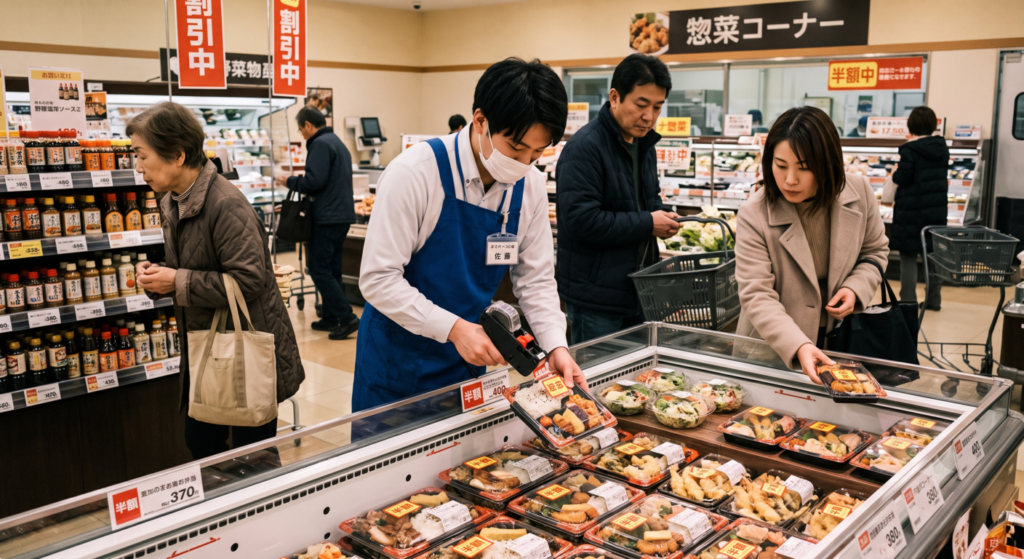
“The moment the clerk walks over with the sticker gun, everyone around me suddenly needs to look at something in that exact aisle.”
Because everyone maintains the polite fiction of not-quite-waiting, there is constant plausible deniability. Nobody will admit to lurking. Nobody has to. The result is a competition that feels almost collaborative — a shared game with no official rules, no referee, and no prizes except a very good dinner at a very fair price.
Convenience Stores: A Note
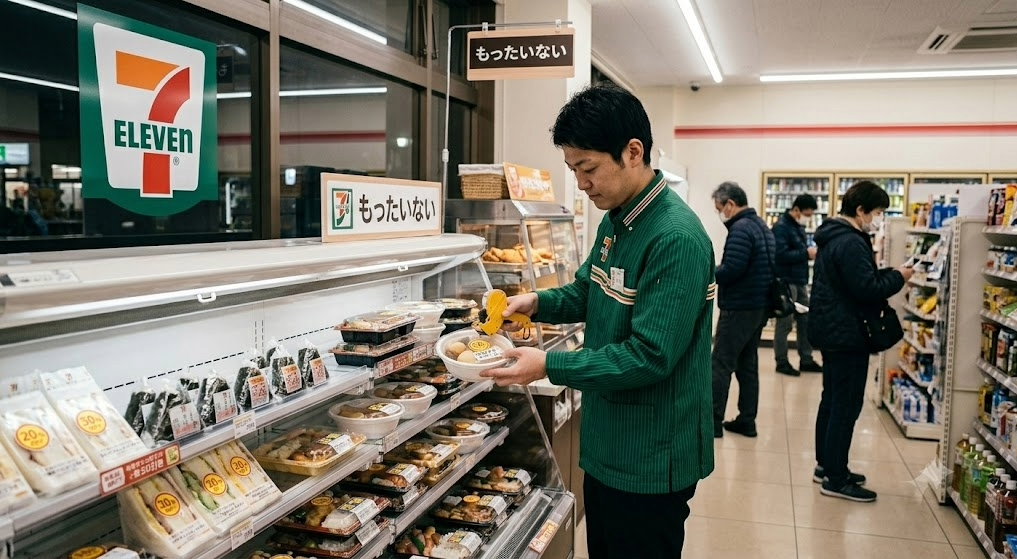
The discount sticker phenomenon is not limited to supermarkets. Convenience stores — 7-Eleven, FamilyMart, Lawson — also apply markdowns to food approaching expiration, though the system is slightly different. Rather than percentage stickers, convenience stores tend to apply a fixed-yen discount and often do so more quietly, without the gathering of waiting shoppers that supermarkets attract. A good rule of thumb: rice balls, sandwiches, and hot snacks are often discounted roughly one to two hours before the printed sell-by time. The sticker design varies by chain, but the price reduction will always be legible.
Practical Tips for Visitors
How to shop the discount sticker culture
- Arrive at 7 PM at most urban supermarkets to catch the deepest markdowns with decent selection still available.
- Observe first. Spend a few minutes identifying which sticker designs your specific store uses for discounts before you start shopping.
- Read the sticker, not the color. The discount percentage or new price is always printed clearly. That number is your guide, regardless of what color the sticker happens to be.
- Be patient and quiet. Hover near the prepared foods section without crowding the display. Let clerks finish applying stickers before you reach.
- Rainy evenings are your friend. Lower foot traffic often means earlier and deeper discounts.
- Check convenience stores too. 7-Eleven and FamilyMart both mark down unsold food — usually less fanfare, but the savings are real.
- Bring a compact bag. Discounted items often come in light packaging. A small reusable bag keeps things tidy.
A Budget Meal Worth Planning Around
Visitors to Japan often budget heavily for food — and rightfully so. The country has some of the world’s most extraordinary restaurants. But there is a particular satisfaction in walking into an ordinary neighborhood supermarket at 7:30 PM, reading the stickers correctly, and walking out with a beautifully arranged sushi platter, a warm side of grilled fish, and a slice of cheesecake for ¥800 total.
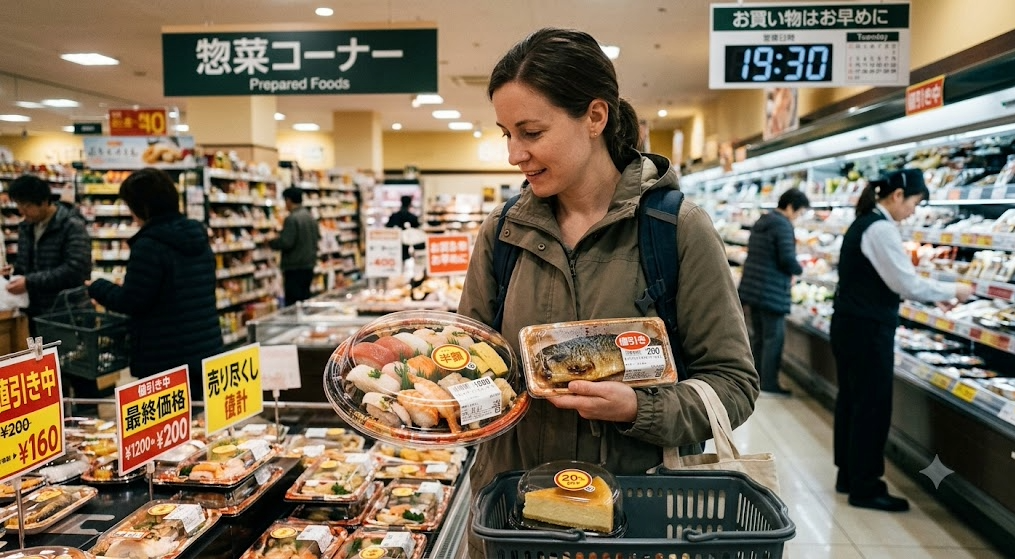
It is not a tourist attraction. It is not listed in any guidebook. It is just what a large portion of Japan does, quietly and practically, on any given Tuesday evening. And the moment you participate — staking out your position near the prepared foods aisle, watching the clerk make their rounds, selecting your dinner without fanfare — you are doing something more immersive than almost any packaged cultural experience the country offers.
Learn the rhythm. Read the sticker. Eat well.
Comments